Ahmedabad - 382430, Gujarat (India)

If you are a hardware engineer, an IoT startup founder, or an industrial procurement manager, you already know the headache I am about to describe.
You’ve spent weeks perfecting your board design. Now, you have to export your Gerbers, find a reliable bare-board fabricator, negotiate with three different component distributors to source your 150-line Bill of Materials (BOM), and then coordinate shipping all those loose parts to a separate assembly house. If even one critical IC is out of stock, or if the fabricator delays the bare boards, your entire production schedule collapses.
In my 20+ years of walking the factory floor here at Megabyte Circuit Systems, I’ve seen this fragmented process drain the life out of brilliant engineering teams. They spend 80% of their time chasing vendors and only 20% innovating.
This is exactly why turnkey PCB assembly services have become the gold standard for modern electronics manufacturing. Instead of juggling multiple suppliers, you hand over your design files and BOM to a single partner, and you receive fully populated, tested, and ready-to-use boards in return.
Let’s dive deep into what turnkey assembly actually entails, why it’s a game-changer for your bottom line, and how to optimize your designs to get the best results from a turnkey PCB manufacturer in India.
At its core, “turnkey” means a service that is ready to use the moment it is handed over to you—just turn the key. In the context of electronics, turnkey PCB assembly is a comprehensive, data-to-doorstep manufacturing solution where your manufacturing partner handles three critical phases:
Quick Technical Summary
Turnkey PCB assembly consolidates bare-board fabrication, component procurement, and SMT/THT soldering into a single vendor contract. This approach drastically minimizes supply chain bottlenecks, mitigates component attrition risks, and ensures end-to-end quality control under strict IPC standards. For a deeper dive into the exact machinery and processes used, check out our complete guide to the PCBA process.
There are generally two flavors of this service:
Why are top Indian OEMs and startups shifting away from the old consignment model? Here is what I always tell my clients when they sit across my desk looking for ways to scale:
When you use separate vendors, finger-pointing is inevitable. If a board fails testing, the assembler blames the bare-board fab, the fab blames the designer, and the component vendor says the parts were fine. With a turnkey partner, the buck stops with us. If there’s an issue, we fix it.
Time to market is everything. By eliminating the transit time between the bare-board factory, your office, and the assembly floor, you shave weeks off your production schedule. We often start component sourcing the exact same day your bare boards go into the pressing cycle.
You might think sourcing components yourself saves money, but the hidden costs add up. You pay multiple shipping fees, bear the cost of component overages (attrition), and waste expensive engineering hours on procurement. A dedicated turnkey PCB manufacturer in India buys components in massive volumes, passing those bulk-pricing discounts directly to you.
Right now, the global supply chain is volatile. We have dedicated procurement teams who know how to spot counterfeit chips, find cross-reference replacements for out-of-stock parts, and secure allocations that standard retail buyers simply cannot access.
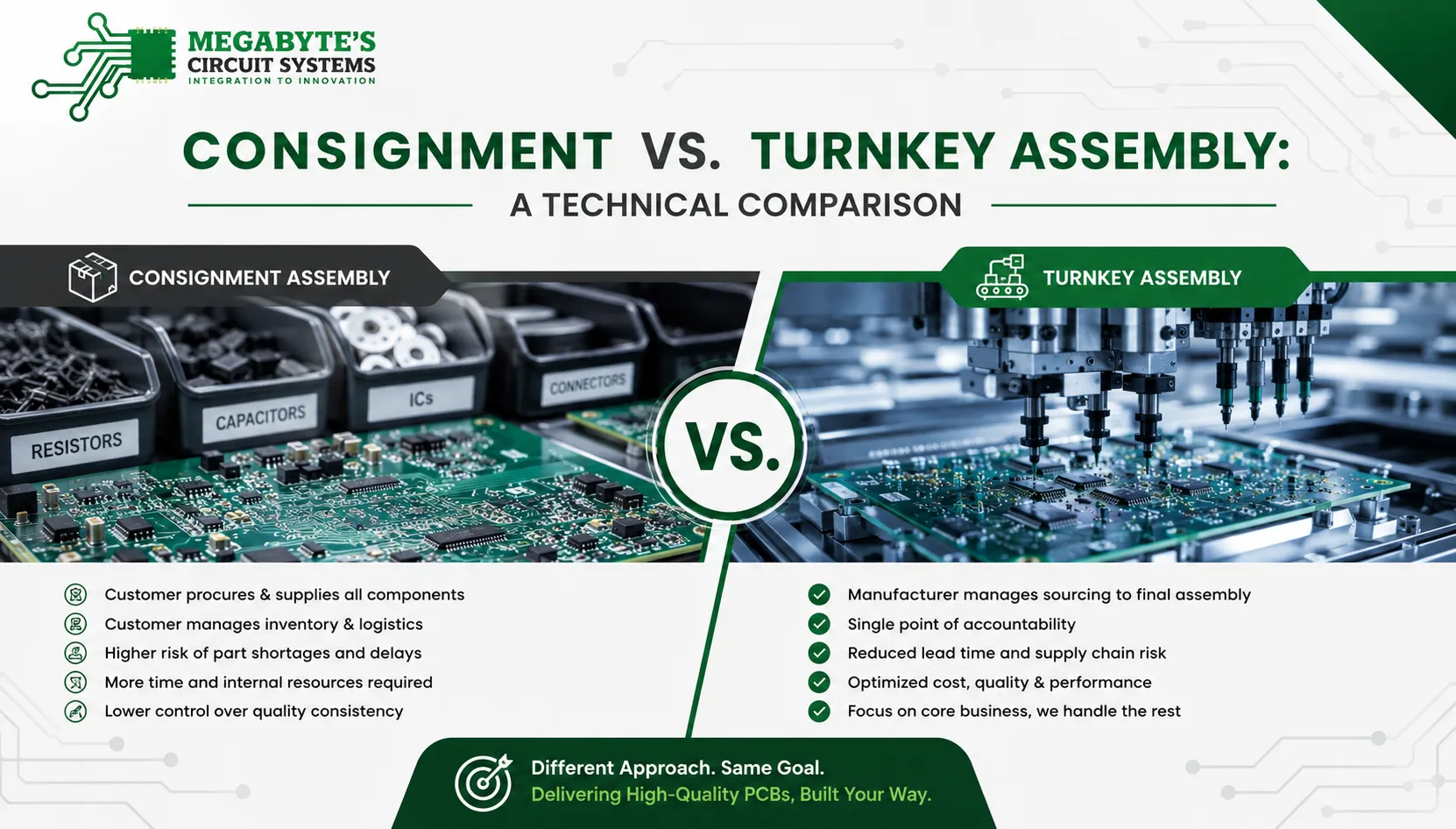
To make it perfectly clear, here is how the traditional “Consignment” (you supply everything) model stacks up against Full Turnkey.
Feature | Consignment Assembly | Full Turnkey Assembly |
Vendor Management | High (You manage Fab, Parts, Assembly) | Low (Single Point of Contact) |
Component Sourcing | Client’s responsibility | Manufacturer’s responsibility |
Shipping Costs | High (Multiple inbound freight charges) | Low (Only the final shipped product) |
Inventory Risk | Client holds excess stock & attrition | Manufacturer absorbs standard attrition |
Defect Resolution | Difficult (Cross-vendor blaming) | Easy (Internal root-cause analysis) |
Best For | Prototyping with proprietary/rare parts | Scaling, rapid production, and complex builds |
Consignment assembly forces the OEM to manage BOM logistics, component overages, and multi-vendor freight, increasing hidden costs. Turnkey assembly transfers supply chain risk, lifecycle management, and DFM validation to the manufacturer, streamlining the path from prototype to volume production.
As electronics shrink, the density of boards increases. If you are designing IoT wearables, advanced medical devices, or aerospace electronics, you aren’t just dealing with a basic Single Layer PCB. You are likely designing high-density interconnect (HDI) boards, blind/buried vias, and fine-pitch components.
This is where complex PCB assembly services truly shine.
When your design evolves from a standard Double Layer PCB into an intricate 8-layer or 12-layer Multilayer PCB, the assembly tolerances become microscopic.
Placing a 0201 package or a 0.4mm pitch Ball Grid Array (BGA) requires state-of-the-art Pick-and-Place machines and ultra-precise solder paste stenciling. Furthermore, high-speed signals require strict impedance control. If your trace width ($W$), trace thickness ($T$), and dielectric height ($H$) aren’t perfectly matched at the fab level, your assembled board will fail electrically.
For instance, microstrip impedance is governed by:
In a turnkey environment, our fabrication engineers and assembly technicians work in the same building. We verify that your controlled impedance requirements survive the high temperatures of the SMT reflow oven without delamination.
Even the best PCB Assembly service can only build what you design. Over the years, I’ve noticed that 90% of assembly delays are caused by poor file preparation.
Before you request a turnkey quote, run through this Design for Manufacturing (DFM) checklist:
Quick Technical Summary
Robust DFM requires a pristine BOM with exact MPNs, accurate Centroid (XY) data, and proper fiducial placement. Validating solder mask clearances and keeping silkscreen off component pads prevents tombstoning, solder bridging, and misalignments during the automated SMT reflow process.
Quality isn’t inspected into a product; it’s built into it. However, strict inspection verifies the build. As a premium manufacturer, we adhere to IPC-A-600 for bare boards and IPC-A-610 for electronic assemblies.
For turnkey projects, our QC pipeline includes:
You want top-tier quality, but you also need to protect your margins. Here are a few insider tips to optimize your turnkey costs:
You need to provide a complete set of Gerber files (RS-274X or X2 format), an NC Drill file, a highly detailed BOM in Excel format (with MPNs and reference designators), and a Centroid/Pick-and-Place file.
Yes. As an established turnkey PCB manufacturer in India, we have direct lines to global authorized distributors like Digi-Key, Mouser, and Arrow, as well as trusted secondary markets for obsolete or allocated parts.
Absolutely. If you have a proprietary IC or a pre-programmed microcontroller that you want to supply yourself, you can ship those specific parts to us (consignment), and we will source the rest of the standard components (turnkey).
Lead times depend entirely on component availability and board complexity. Standard turnkey prototypes can often be delivered in 10 to 15 working days, while high-volume production runs may take 3 to 5 weeks.
Reel-fed SMT machines naturally lose a few small passive components during setup. In a full turnkey contract, we calculate and purchase the necessary overages (usually 2-5% for passives) so you don’t have to worry about the math.
Transitioning to a turnkey assembly model is the single most effective way to scale your hardware business. It frees your engineers from supply chain purgatory, accelerates your time to market, and guarantees that your products meet industrial reliability standards.
At Megabyte Circuit Systems, situated right here in Ahmedabad, Gujarat, we take immense pride in being the silent manufacturing backbone for hundreds of Indian innovators. Whether you need a quick-turn prototype or are scaling up for a massive IoT deployment requiring complex PCB assembly services, our factory floor is ready for your Gerbers.
Stop chasing parts and start building great products. Upload your files today, or reach out to our engineering team to discuss your next big project. Let’s build something brilliant together.
C/10, Yogeshwar Estate, B/H Madhuram Estate, Nr. Vishala Estate, Sardar Patel Ring Rd, Odhav, Ahmedabad, Gujarat, Ahmedabad - 382430, Gujarat (India)
Copyright © 2025. Megabytes Circuit Systems All rights reserved.
Powered by FrogMEE Tech