Ahmedabad - 382430, Gujarat (India)

In my 20+ years on the factory floor here at Megabyte Circuit Systems, I’ve had the exact same conversation with hundreds of purchasing managers and hardware founders. You look at an overseas website, and the base price for prototyping your boards seems incredibly cheap. Two dollars for five boards? It feels like a no-brainer.
But then the shipment arrives. Your logistics partner slaps you with a massive bill for “Customs Duty & Disbursement Fees.” A project that was supposed to take seven days is now stuck at the customs port for two weeks, completely derailing your production timeline.
One thing I always tell my clients is that a PCB isn’t cheap if it holds up a million-rupee product launch. Evaluating your sourcing strategy strictly by the “Add to Cart” price is a rookie mistake. Today, the Indian manufacturing ecosystem has matured immensely. Whether you are building a simple home automation switch or a complex IoT gateway, local fabrication is frequently beating imports on overall value.
As a senior consultant, I am going to walk you through the actual math. We will break down the true landed costs, explain how Indian customs calculates duty on bare PCBs, and show you exactly why shifting your procurement back home makes perfect business sense.
The supplier’s base price (FOB) only represents a fraction of your final expense. Landed cost encompasses the base price plus international freight, cargo insurance, Basic Customs Duty (BCD), Social Welfare Surcharge (SWS), IGST, and courier brokerage fees, which often double the initial invoice value.
When you place an order with a Chinese fabricator, you are looking at the EXW (Ex Works) or FOB (Free on Board) price. However, as an electronics procurement manager, the only number that should matter to you is the Landed Cost—the total amount you pay to get those boards physically sitting on your assembly line.
When importing bare PCBs into India, the government assesses taxes based on the CIF value, not just the cost of the boards. The calculation follows this structure:
Because high-speed international freight for a heavy stack of Multilayer PCBs is incredibly expensive, your CIF value skyrockets. Customs then applies their percentages on top of that inflated number, turning a “cheap” order into an expensive headache.
Bare PCBs are imported into India under HS Code 8534. They attract a Basic Customs Duty (BCD) of around 10%, a 10% Social Welfare Surcharge on the BCD, and 18% IGST. Furthermore, courier companies charge hefty advanced clearance and brokerage fees just to process the paperwork.
We see this issue very often with startups ordering their first batch of Double Layer PCBs from overseas. They assume the shipping fee they paid at checkout covers delivery. It does not cover customs clearance.
When your package hits the Indian border, it falls under HS Code 85340000 (Printed circuits). Even if your order is relatively small, couriers like DHL or FedEx have to file a Bill of Entry (BOE). To clear the shipment quickly, the courier pays the customs duty on your behalf. But they don’t do this for free. They will charge you an “Advancement Fee” or “Brokerage Fee,” which can easily range from ₹1,000 to ₹3,000, regardless of whether your PCB order was only worth ₹1,500.
By utilizing a domestic PCB Manufacturing service, you bypass the customs department entirely. There are no HS code classifications to fight over, no KYC documents to upload repeatedly, and zero unexpected courier surcharges.
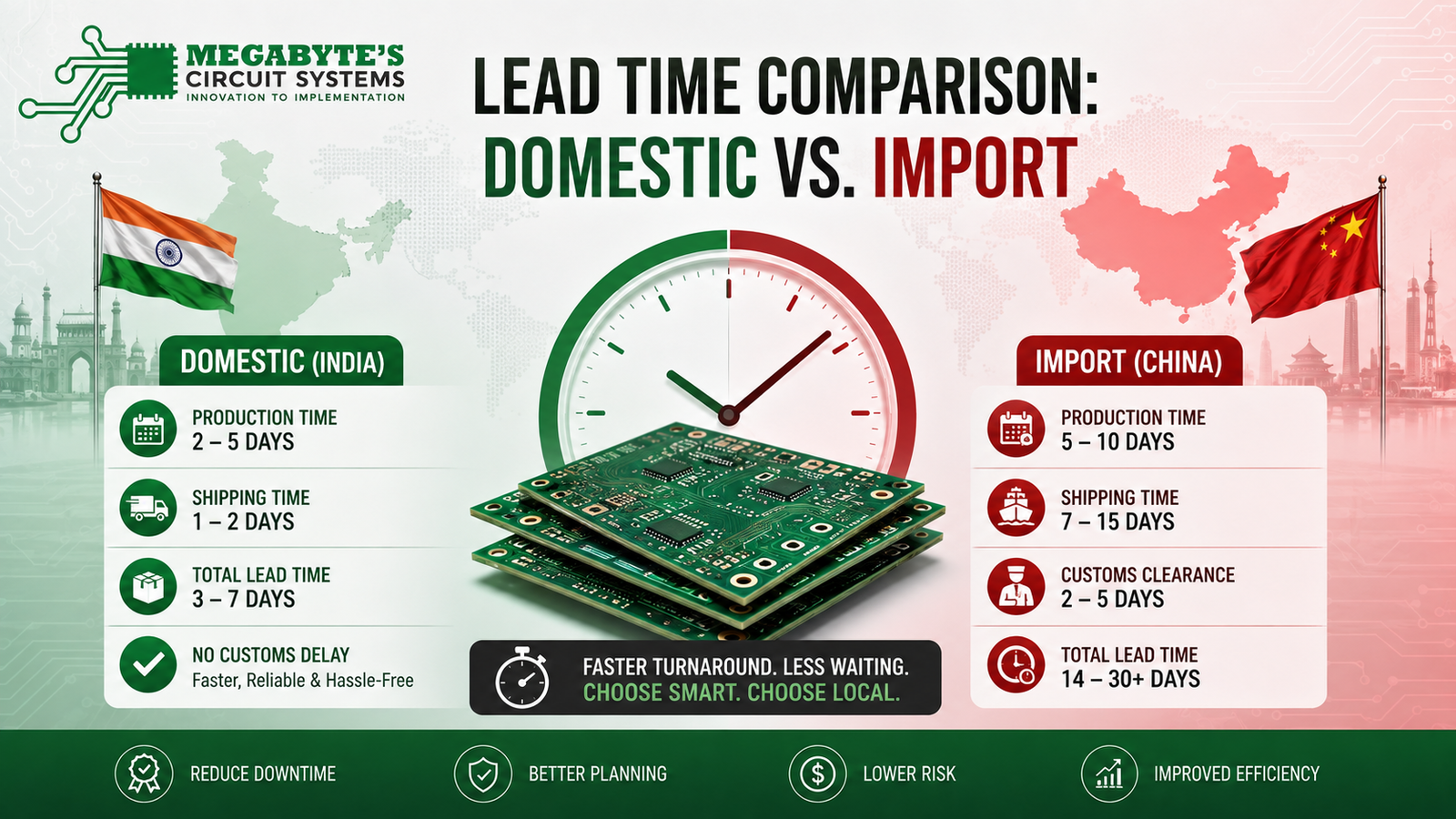
While overseas fabricators boast quick manufacturing times, international shipping and customs processing typically extend the actual delivery lead time to 12-18 days. Domestic Indian manufacturing offers true 3-5 day turnarounds from CAD export to physical delivery.
In hardware development, time is your most expensive commodity. A Chinese manufacturer might turn your board around in 24 hours, but that is just factory time.
Once it leaves their floor, it goes to a sorting hub, waits for an international flight, lands in India, enters the customs queue, undergoes inspection, and finally gets handed over to local dispatch. If the customs officer decides the declared value of your board seems suspiciously low—a common occurrence—they will hold the shipment and demand bank transaction proofs. A best-case scenario is 10 days; a worst-case scenario is three weeks.
Conversely, when you manufacture with us in Ahmedabad, our machines start cutting your FR4 the moment your Gerber files pass our DFM check. A standard Single Layer PCB batch can be manufactured, quality-tested, packed, and delivered to your office via standard overnight courier within 3 to 5 days.
When comparing a mid-sized prototyping run, the heavy international freight costs, combined with import duties and courier handling fees, often make importing from China more expensive or equal to premium domestic manufacturing, completely negating the overseas price advantage.
Let’s look at a highly realistic comparison for an R&D team ordering 100 pieces of a standard 100mm x 100mm double-sided board.
Cost Component | Importing from China | Manufacturing in India (Megabyte) |
Bare Board Base Price | ₹3,000 | ₹7,500 |
Shipping / Freight | ₹3,000 (DHL/FedEx) | ₹500 (Local Courier) |
CIF Value (Assessable) | ₹6,000 | N/A |
Customs Duty (BCD + SWS) | ~₹660 (11% of CIF) | ₹0 (No Import) |
IGST / Local GST (18%) | ~₹1,198 | ₹1,440 |
Customs Brokerage Fee | ₹1,500 (Courier Handling) | ₹0 |
Total Landed Cost | ~₹9,358 | ₹9,440 |
Actual Lead Time | 12 – 18 Days | 3 – 5 Days |
Note: Imported orders frequently face fluctuating exchange rates that alter final billing.
When you do the exact math, the prices are nearly identical. But with local manufacturing, you cut your waiting time by more than half, and you have direct access to our engineers if there is a design flaw.
Another major hurdle procurement teams face when importing is claiming the 18% IGST back as an Input Tax Credit (ITC). When a courier clears a consolidated shipment, getting the Bill of Entry (BOE) correctly linked to your company’s GST portal can be an administrative nightmare.
When you buy locally, it is a standard B2B transaction. We generate an E-invoice, it reflects immediately in your GSTR-2B, and your finance team claims the ₹1,440 credit without making a single phone call. This effectively brings your true local cost down significantly, making Indian manufacturing the smarter financial choice.
You get what you pay for. Offshore manufacturers pushing ultra-cheap boards often skip electrical testing (E-test) on standard runs, or they use lower-grade FR4 material to offset their costs.
At Megabyte Circuit Systems, we adhere strictly to IPC-A-600 standards. Every board undergoes rigorous Automated Optical Inspection (AOI) and flying probe continuity testing. More importantly, if there is ever an issue with a batch, you don’t have to deal with a language barrier, time zone differences, or the impossible task of shipping defective boards back to China for a refund. You pick up the phone, speak directly with our senior engineers, and we resolve it immediately.
Attempting to evade customs by under-declaring goods is illegal and highly risky. Indian customs officers are fully aware of this tactic. If caught, your shipment will be seized, and you will be forced to pay heavy penalties, demurrage charges, and face severe project delays.
The courier will contact you via email requesting a KYC update, purchase order, and bank transaction proof. Until you provide satisfactory documentation that matches the declared value, your boards will sit in a warehouse, occasionally racking up daily storage fees.
No, you do not need to list the bare printed circuit board as a line item in your assembly BOM. The bare board specs are derived entirely from your Gerber files and fabrication notes. The BOM is exclusively for the components that will be soldered onto the board.
PCBs are dense and surprisingly heavy. A stack of 100 standard boards weighs several kilograms. International air freight charges are calculated volumetrically or by dead weight (whichever is higher), which severely punishes heavy electronics.
Absolutely. The machinery used in top-tier Indian factories—from CNC drills to photoplotters is the exact same industrial-grade equipment used globally. At Megabyte, our raw materials and chemical processes adhere to the highest international IPC standards.
You don’t need to wait for a manual quote. Simply export your manufacturing files and use our automated tool to get accurate pricing right away.
The era of defaulting to overseas suppliers for bare PCBs is over. When you account for the hidden customs fees, unpredictable lead times, and the administrative burden of international logistics, domestic manufacturing is the clear winner for Indian engineering teams.
At Megabyte Circuit Systems, we are proud to offer a fast, reliable, and entirely transparent alternative right here in Ahmedabad, Gujarat.
Stop gambling with your project deadlines. Head over to our PCB Calculator, upload your Gerber files, and see exactly how competitive local manufacturing can be. Let’s get your boards built locally, perfectly, and on time.
C/10, Yogeshwar Estate, B/H Madhuram Estate, Nr. Vishala Estate, Sardar Patel Ring Rd, Odhav, Ahmedabad, Gujarat, Ahmedabad - 382430, Gujarat (India)
Copyright © 2025. Megabytes Circuit Systems All rights reserved.
Powered by FrogMEE Tech