Ahmedabad - 382430, Gujarat (India)

If you’re searching for the best PCB manufacturer in India, you’re probably facing a very real challenge.
You have a design ready. Maybe your Gerber files are finalized. Maybe you’re still iterating. But one question is always there:
“Can I trust this manufacturer with my product?”
In my 20+ years of working with hardware engineers, startups, and procurement teams across India, I’ve seen this decision make or break entire projects. A PCB is not just a component it’s the foundation of your product’s reliability. If something goes wrong at this stage, the cost doesn’t stay limited to the board. It affects testing, assembly, performance, and sometimes even your brand reputation.
This guide is not just theory. I’ll walk you through how experienced engineers actually evaluate PCB manufacturers in India what matters, what doesn’t, and how to avoid expensive mistakes.
When people say “best PCB manufacturer,” they often think in terms of price or speed. But in reality, the definition is much deeper.
A good PCB manufacturer ensures your board works.
A great PCB manufacturer ensures your product succeeds.
There’s a difference.
For example, I’ve seen cases where a low-cost manufacturer delivered boards on time, but the impedance was off by just enough to cause signal integrity issues. The product worked in lab testing but failed in real-world conditions. The redesign cost was far higher than what was saved initially.
That’s why the right partner is someone who understands not just fabrication, but also application-level requirements whether it’s IoT, automotive, RF, or industrial electronics.
Quick Technical Summary
The best PCB manufacturer is not the cheapest it’s the one who ensures performance, reliability, and scalability from prototype to production.
One of the first things I always evaluate is whether the manufacturer can handle both current requirements and future complexity.
A simple prototype might work on a 2-layer board today, but what happens when your design evolves into a multilayer PCB with controlled impedance?
This is where many partnerships fail. Engineers choose a vendor based on current needs, only to realize later that the same vendor cannot support advanced designs.
For example, basic boards like
Single Layer PCB are relatively straightforward. But once you move into Double Layer PCB and especially Multilayer PCB you start dealing with stack-ups, signal integrity, EMI control, and thermal considerations.
A capable manufacturer should be able to guide you through these transitions not just accept your files and fabricate blindly.
Choose a manufacturer that supports multilayer PCBs, tight tolerances, and advanced materials to future-proof your product.
Let me be very direct here.
Most PCB issues don’t happen in manufacturing they start in design.
And if your manufacturer is not reviewing your design, you’re taking a big risk.
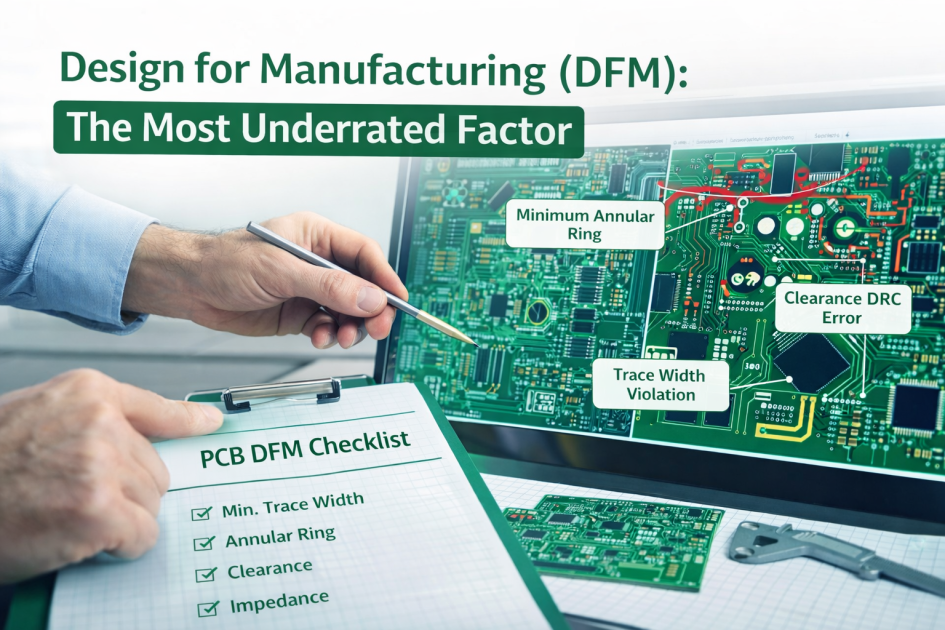
DFM (Design for Manufacturing) is where an experienced partner adds real value. Instead of simply fabricating what you send, they check whether your design is actually manufacturable and reliable.
In real projects, we often see problems like trace widths being too narrow for the required current, insufficient annular ring sizes, or poor solder mask clearance. These are not design “mistakes” in the traditional sense they are optimization issues that only show up when design meets manufacturing reality.
For example, current handling in a PCB trace is not arbitrary. It depends on copper thickness, width, and temperature rise:
𝐼=𝑘⋅(Δ𝑇)0.44⋅(𝐴)0.725I=k⋅(ΔT)0.44⋅(A)0.725
Without proper calculation or validation, overheating becomes a real issue.
And if your design is still evolving, working with experts through PCB Design Service can significantly reduce iterations and time-to-market.
DFM ensures your PCB design is manufacturable, reliable, and cost-efficient before production even begins.
This is where the gap between average and top-tier PCB manufacturers becomes very clear.
A serious manufacturer doesn’t rely on visual inspection alone. They follow structured, globally accepted standards like IPC-A-600 and IPC-6012, which define how a PCB should be built and inspected.
Testing is not optional it’s essential.
For prototypes, flying probe testing is often used because it doesn’t require fixtures. For production, E-test (electrical testing) ensures every connection is verified. Automated Optical Inspection (AOI) helps detect defects that are invisible to the naked eye.
In my experience, skipping or compromising on testing is one of the fastest ways to create field failures. And those failures don’t just cost money they damage trust.
High-quality PCB manufacturers follow IPC standards and perform thorough testing like AOI and E-test to ensure zero-defect delivery.
Let’s talk honestly about cost.
India is known for cost-effective PCB manufacturing, and that’s absolutely true. But there’s a difference between low cost and optimized cost.
A cheaper PCB might use lower-grade material, inconsistent copper thickness, or poor plating quality. These differences are not always visible immediately, but they affect long-term performance.
On the other hand, an optimized PCB balances cost with performance.
For example, choosing between single, double, and multilayer boards is not just about price it’s about functionality.
PCB Type | Typical Use Case | Cost Impact | Complexity |
Single Layer | Basic circuits, power supply | Low | Simple |
Double Layer | Embedded systems, IoT | Medium | Moderate |
Multilayer | High-speed, industrial | High | Complex |
In many cases, I’ve advised clients to slightly increase their initial PCB cost to avoid much larger costs in redesign, testing delays, or product failures.
Focus on value, not just price. A slightly higher upfront cost often saves significant long-term expenses.
Speed matters but consistency matters more.
A good PCB manufacturer should be able to deliver quick prototypes, but also maintain the same quality when you scale to production volumes.
This transition phase is where many vendors struggle.
You might receive excellent prototype boards, but when you move to bulk production, variations start appearing different solder mask quality, inconsistent drilling, or even dimensional inaccuracies.
A reliable partner ensures process consistency, not just fast delivery.
Choose a manufacturer who can maintain consistent quality from prototype to mass production.
This might sound simple, but it’s one of the most important factors.
A good manufacturer communicates clearly. A great one communicates proactively.
If you send Gerber files and receive no feedback, that’s not efficiency that’s a warning sign. A serious partner will review your design, ask questions, and suggest improvements.
In real-world projects, this communication often prevents major issues before they happen.
Strong communication ensures fewer errors, faster decisions, and smoother project execution.
India has rapidly become a strong hub for PCB manufacturing, thanks to its combination of technical expertise, competitive pricing, and growing electronics ecosystem.
Cities like Ahmedabad, Gujarat are especially well-positioned because of strong industrial infrastructure and access to skilled engineers.
Companies like Megabyte Circuit Systems have built their reputation by combining local manufacturing strength with global quality standards.
The best manufacturer is one who combines technical expertise, quality standards, and reliable communication, not just low pricing.
Look for experience, DFM support, testing capabilities, and scalability. Always evaluate beyond cost.
DFM ensures your design is optimized for production, reducing errors and improving reliability.
Prototypes can be ready in 2–3 days, while production depends on complexity and quantity.
Layer count, material, board size, and quantity are the biggest cost drivers.
If you’ve read this far, you already understand something important:
Choosing the right PCB manufacturer is not a purchasing decision it’s an engineering decision.
At Megabyte Circuit Systems, based in Ahmedabad, Gujarat, we work closely with engineers, startups, and industries to ensure their designs are not just manufactured but optimized, tested, and ready for real-world performance.
If you already have your Gerber files ready, you can:
And if you’re still in the design phase, our team can guide you through every step just like a true technical partner.
C/10, Yogeshwar Estate, B/H Madhuram Estate, Nr. Vishala Estate, Sardar Patel Ring Rd, Odhav, Ahmedabad, Gujarat, Ahmedabad - 382430, Gujarat (India)
Copyright © 2025. Megabytes Circuit Systems All rights reserved.
Powered by FrogMEE Tech