Ahmedabad - 382430, Gujarat (India)

In the world of medical electronics, “reliability” isn’t just a marketing buzzword—it is a life-saving requirement. Whether it is a portable ventilator, an implantable pacemaker, or a high-end MRI machine, the internal circuitry must function without fail for years, if not decades. For hardware engineers and procurement managers in India, understanding the nuances of medical pcb manufacturing is the first step toward building a successful, compliant product.
At Megabyte Circuit Systems, we have seen firsthand how the shift from industrial-grade (Class 2) to medical-grade (IPC Class 3 pcb) standards can drastically reduce field failures. When a device is mission-critical, the margin for error in the fabrication process is zero. This guide explores the technical demands, design rules, and manufacturing standards required to achieve medical-grade excellence.
Quick Technical Summary: IPC Class 3 represents the pinnacle of high-reliability manufacturing, where equipment downtime is unacceptable. For medical devices, this standard mandates strict tolerances for annular rings, plating thickness, and solder joints to ensure continuous operation in life-critical environments.
The IPC (Association Connecting Electronics Industries) classifies PCBs into three categories. While Class 2 is standard for most consumer and industrial electronics, medical devices—especially those categorized as life-support systems—must adhere to Class 3.
The core of Megabyte Circuit Systems quality lies in our ability to meet these heightened tolerances. In a Class 3 board, the requirements for Plated Through Holes (PTH) and annular rings are significantly more stringent. For instance, in Class 2, a 90-degree breakout of the pad from the hole is often permissible. In Class 3, there is a “zero breakout” policy. This ensures that the mechanical and electrical connection remains robust even under thermal expansion or mechanical stress.
When you engage our PCB Manufacturing service for medical projects, we prioritize the integrity of the conductive path. This often involves specialized drilling processes and enhanced desmear cycles to ensure the copper plating bonds perfectly to the inner layers of a Multilayer PCB.
Quick Technical Summary: Medical devices operate in electrically noisy environments, requiring precise impedance control and advanced EMI shielding. Utilizing a high-reliability manufacturer ensures that signal-to-noise ratios are optimized for diagnostic accuracy in equipment like EEG and ECG monitors.
In medical diagnostics, signal integrity is paramount. A stray millivolt of noise can lead to a misdiagnosis. This is why medical pcb manufacturing often requires controlled impedance. Designers must calculate the Trace Width and spacing based on the dielectric constant (ϵr) of the substrate.
The formula for the characteristic impedance (Z0) of a microstrip line is often approximated as:
Z0=ϵr+1.4187ln(0.8w+t5.98h)
Where:
Ensuring these variables remain constant across a large production run requires a reliable pcb manufacturer with precision etching capabilities. Any deviation in the etching process that narrows the trace width will increase the impedance, potentially causing signal reflections that compromise the device’s accuracy. Furthermore, in our PCB Assembly service, we ensure that shielding cans and ground planes are perfectly integrated to block electromagnetic interference (EMI).
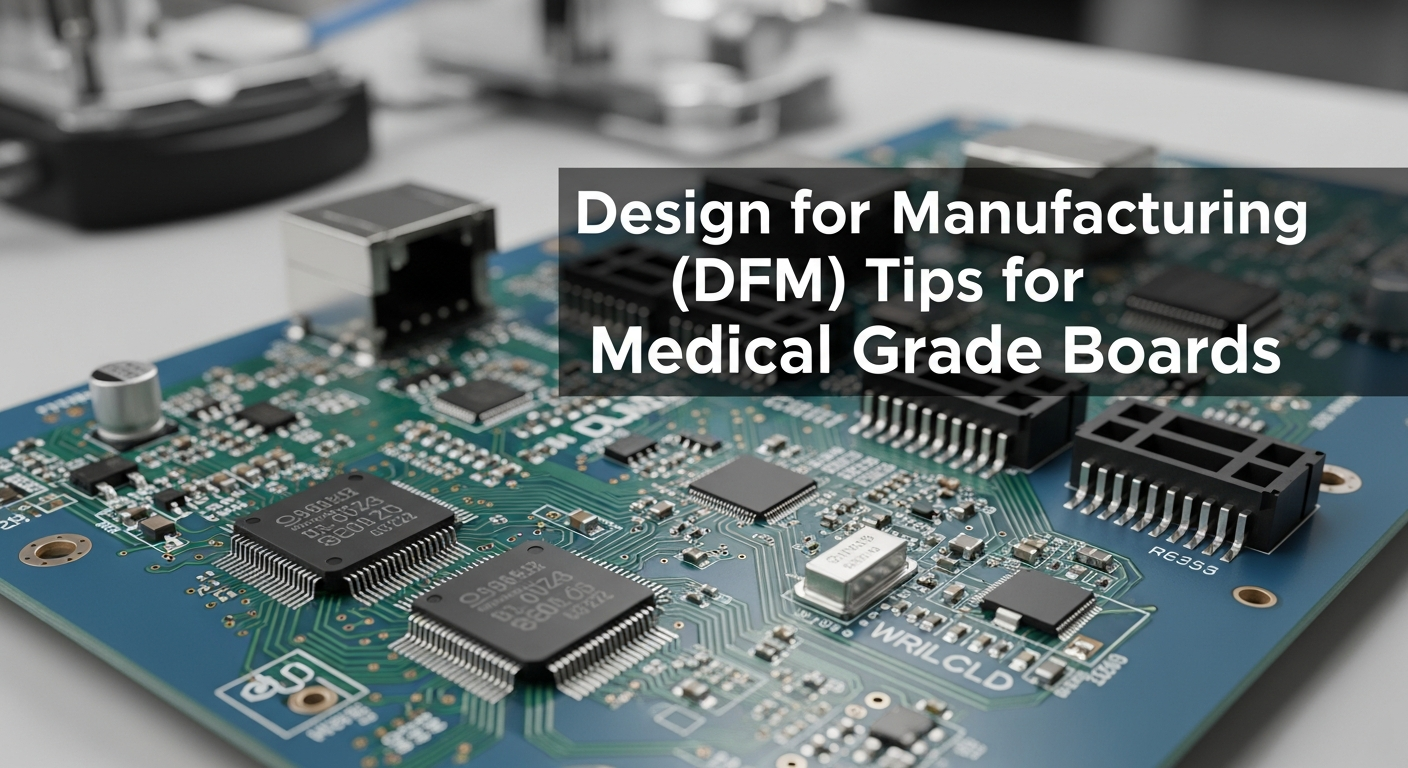
Quick Technical Summary: Medical DFM focuses on maximizing board longevity through generous copper clearances and robust via designs. Engineers should prioritize thermal management and specify “Teardrops” on all pads to mitigate the risk of stress-induced fractures in the circuit path.
Transitioning a design from a prototype to a medical-grade production run requires a specialized DFM approach. Here are actionable tips to optimize your Gerber files for Megabyte’s high-precision factory:
By following these rules, you enable Megabyte to deliver a board that isn’t just functional, but “medical-ready.”
Choosing the wrong class can result in catastrophic field failures. The following table highlights why Class 3 is the only choice for a reliable pcb manufacturer working in the healthcare sector.
Feature | IPC Class 2 (Standard) | IPC Class 3 (High Reliability) | Medical Impact |
Annular Ring (External) | 90° breakout allowed | 0° breakout (Min 0.05mm ring) | Prevents connection failure. |
PTH Copper Plating | Average 20µm (0.8 mil) | Average 25µm (1.0 mil) | Better thermal/mechanical load. |
Visual Defects | Minor imperfections allowed | Zero tolerance for major defects | Ensures long-term substrate health. |
Solder Joint Quality | 180° wetting allowed | 270° wetting required | Superior vibration resistance. |
Dielectric Spacing | Minimum 0.1mm | Minimum 0.1mm (Strictly enforced) | Prevents high-voltage arcing. |
While a Single Layer PCB might suffice for basic medical disposables, complex diagnostic tools almost always require Class 3 multilayer structures to maintain the tight tolerances listed above.
Quick Technical Summary: Medical-grade quality control involves a multi-stage verification process including AOI, X-ray inspection, and Flying Probe E-Testing. Megabyte Circuit Systems employs these technologies to validate IPC-A-600 compliance, ensuring every internal layer meets the high-reliability mandate.
The “Megabyte Quality” promise is backed by rigorous testing protocols. For medical pcb manufacturing, we do not rely on visual inspection alone.
X-Ray Inspection: For boards involving BGA (Ball Grid Array) components, X-ray inspection is mandatory to verify that solder joints beneath the chip are void-free and perfectly aligned.
Quick Technical Summary: To balance cost and quality, engineers should standardize their stack-ups and utilize Megabyte’s online tools for real-time pricing. Local manufacturing in India eliminates high shipping costs and customs delays associated with importing medical components.
High-reliability doesn’t always have to mean high-cost. At Megabyte, we help Indian startups stay competitive through:
Early-Stage Quote Analysis: Use our PCB Calculator to experiment with different layer counts and surface finishes (like ENIG vs. ENEPIG) to find the most cost-effective solution for your medical certification needs.
While the device OEM must be ISO 13485 certified, the reliable pcb manufacturer should have a robust quality management system (like ISO 9001) and demonstrate the ability to manufacture to IPC Class 3 standards, which align with medical regulatory requirements.
Electroless Nickel Immersion Gold (ENIG) provides a flat surface for fine-pitch components and offers excellent oxidation resistance, ensuring a long shelf life for medical devices that might sit in storage.
Yes. Any board—be it a Single Layer PCB or a 20-layer stack-up—can be manufactured to Class 3 standards if the design rules for spacing, plating, and annular rings are followed.
IPC-6012 is the performance specification (the “what”), while IPC-A-600 is the visual acceptability criteria (the “how it should look”). A medical grade board must satisfy both.
We offer dedicated prototype lines that follow the same Class 3 processes as our production runs, ensuring that your clinical trial units are identical to your final production units.
The path to medical device certification is long and complex. Don’t let your PCB be the weak link that causes a regulatory delay or a field recall. By adhering to IPC Class 3 standards and partnering with an expert like Megabyte Circuit Systems, you ensure that your hardware is as robust as the medical professionals who use it.
Ready to start your next medical-grade project?
Megabyte Circuit Systems: Where Precision Meets Life-Saving Reliability.
C/10, Yogeshwar Estate, B/H Madhuram Estate, Nr. Vishala Estate, Sardar Patel Ring Rd, Odhav, Ahmedabad, Gujarat, Ahmedabad - 382430, Gujarat (India)
Copyright © 2025. Megabytes Circuit Systems All rights reserved.
Powered by FrogMEE Tech