Ahmedabad - 382430, Gujarat (India)

Multilayer PCB design in India is increasingly essential for developing compact, high-performance electronic devices. Unlike simpler board types such as a Single Layer PCB or even a Double Layer PCB, multilayer PCBs integrate multiple layers of conductive traces separated by insulating material, allowing for greater circuit density and improved signal integrity. This complexity, while offering significant benefits, also introduces unique challenges in design, manufacturing, and cost management. Understanding these aspects is crucial for engineers and businesses looking to leverage the advanced capabilities of Multilayer PCB technology for their projects within the Indian market.
The rapid advancement in electronics, characterized by ever-shrinking device footprints and increasing functionality, has made multilayer PCB design a cornerstone of modern product development. As electronic components become smaller and more powerful, the need for more complex interconnections and efficient signal routing grows. Multilayer PCBs provide the necessary real estate to accommodate intricate circuits, high pin-count components, and dedicated power/ground planes, which are vital for maintaining signal integrity and reducing electromagnetic interference (EMI).
In India, the burgeoning electronics manufacturing sector and the demand for innovative consumer electronics, medical devices, and industrial automation solutions further underscore the importance of robust multilayer PCB capabilities. These advanced boards enable the creation of highly integrated systems, fostering miniaturization and enhancing overall device performance. Designers can route signals more effectively, control impedance precisely, and manage thermal dissipation better, leading to more reliable and efficient electronic products. The transition from simpler board types to multilayer designs is not merely a choice but often a necessity driven by technological demands.
Designing multilayer PCBs presents a unique set of challenges that require specialized knowledge and advanced tools. In India, these challenges are often compounded by specific market dynamics, access to specialized materials, and manufacturing capabilities.
One of the most significant hurdles in multilayer PCB design is ensuring signal integrity, especially for high-speed digital and RF circuits. With multiple layers, longer traces, and increased density, issues like crosstalk, reflections, and electromagnetic interference (EMI) become more pronounced. Proper impedance control, achieved through careful trace geometry, dielectric constant, and stack-up, is paramount. Additionally, designing an efficient power delivery network (PDN) across multiple layers to provide stable power to sensitive components while minimizing noise and voltage drops is a complex task. Designers must meticulously plan ground and power planes to isolate signals and reduce noise coupling.
As devices become more compact and powerful, thermal management in multilayer PCB design becomes increasingly critical. Heat generated by densely packed components must be efficiently dissipated to prevent performance degradation and extend component lifespan. Multilayer boards, with their multiple insulating layers, can sometimes trap heat. Designers must employ strategies such as thermal vias, larger copper pours, and strategic component placement to guide heat away from sensitive areas. This challenge is particularly relevant in India’s diverse climatic conditions, where products might operate in high ambient temperatures.
The stack-up configuration, which defines the order and type of dielectric and copper layers, is fundamental to multilayer PCB design. An optimized stack-up can significantly improve signal integrity, reduce EMI, and facilitate efficient routing. Choosing the right dielectric materials, considering their dielectric constant, loss tangent, and thermal properties, is crucial for high-frequency applications. The availability and cost of specialized materials in the Indian market can sometimes influence design decisions, requiring designers to balance performance requirements with practical supply chain considerations.
Integrating Design for Manufacturability (DFM) principles early in the multilayer PCB design process is vital. This involves designing boards that are not only functional but also manufacturable efficiently and cost-effectively. Factors such as minimum trace width, spacing, via sizes, and panelization must adhere to the capabilities of the chosen PCB manufacturing service. Failing to consider DFM can lead to increased manufacturing costs, higher defect rates, and delayed production schedules. In the Indian context, where cost-efficiency is often a key driver, optimizing the design for manufacturing plays a crucial role in project success.
The cost associated with multilayer PCB design and subsequent manufacturing in India is influenced by several critical factors. Understanding these elements helps in budget planning and making informed decisions.
The most direct cost driver for a Multilayer PCB is the number of layers. Each additional layer increases the manufacturing steps, material usage, and process complexity, leading to higher costs. Boards with more intricate routing, finer traces, smaller vias, and tighter tolerances also contribute to increased design and manufacturing expenses. For example, an 8-layer board will inherently cost more than a 4-layer one due to the added materials and processing.
The choice of substrate material (e.g., standard FR-4 vs. high-Tg FR-4, or specialized low-loss laminates for RF applications) significantly impacts the cost. High-performance materials offer better electrical properties and thermal stability but come at a higher price point. Similarly, the copper thickness, surface finish (e.g., ENIG, OSP), and overall board thickness also affect material costs. Utilizing specialized materials often requires a more advanced PCB manufacturing service with specific capabilities, which can also influence pricing.
The complexity of multilayer PCB design often necessitates experienced engineers and sophisticated Electronic Design Automation (EDA) tools. The cost of a professional PCB design service will reflect the designer’s expertise, the complexity of the project, and the time required to meet strict performance criteria, including signal integrity and power integrity analysis. Engaging skilled designers can prevent costly errors down the line, but it is an upfront investment. Many services also offer PCB developing services which encompass more than just layout, adding to the overall cost but ensuring a robust final product.
As with most manufacturing processes, the quantity of PCBs ordered plays a significant role in per-unit cost. Larger production runs typically benefit from economies of scale, leading to lower per-board prices. Conversely, small-batch orders or prototypes will have a higher per-unit cost. Furthermore, urgent or “expedited” lead times for manufacturing and delivery can substantially increase costs due to the need for faster processing and potentially overtime labor. Utilizing a PCB Calculator can help estimate costs based on these factors.
Beyond the bare board, if the project requires full PCBA (Printed Circuit Board Assembly), the costs associated with component procurement, assembly services, and testing must be factored in. Component costs can fluctuate, and assembly complexity (e.g., fine-pitch components, BGA packages) directly influences the labor and equipment required for a quality PCB Assembly service. Testing, including functional testing and in-circuit testing, also adds to the overall project cost but is crucial for ensuring product reliability.
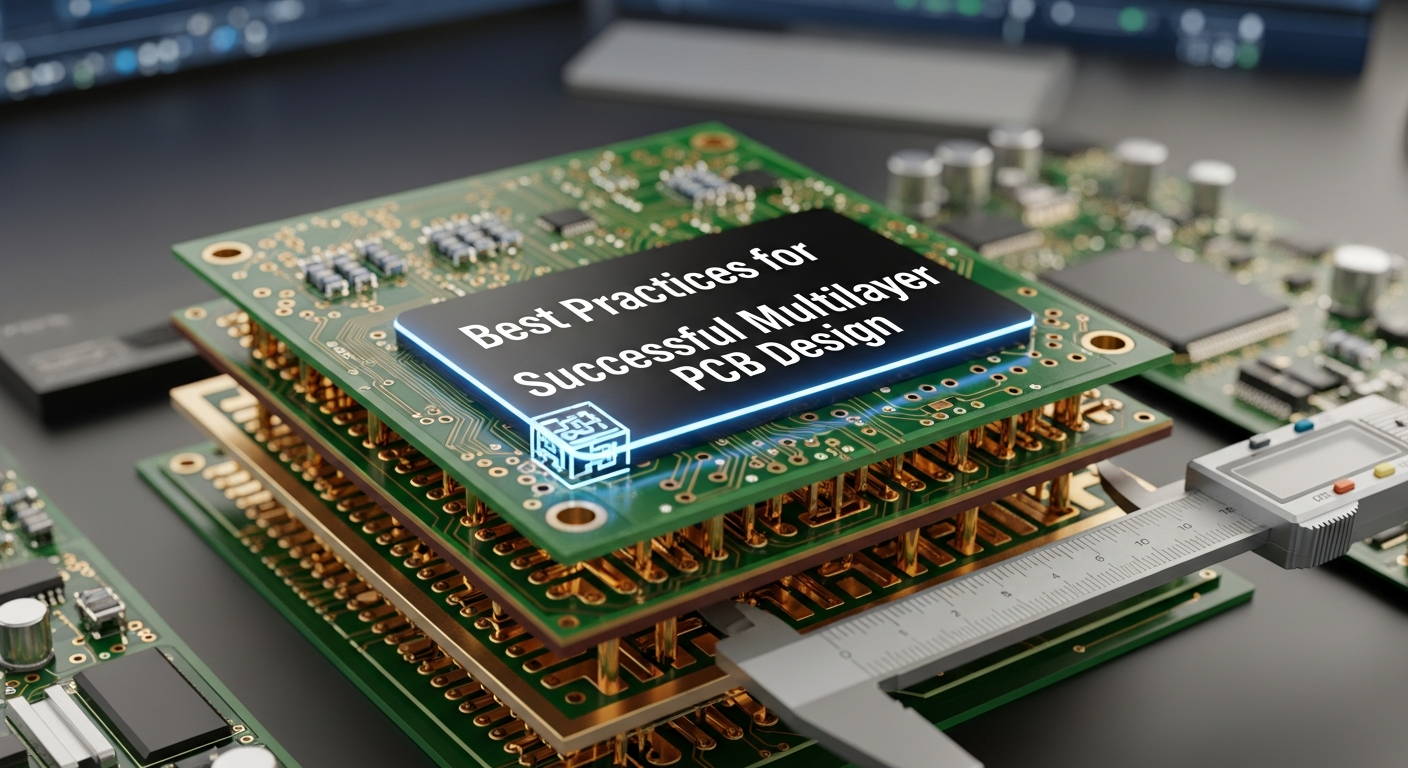
Adhering to best practices is paramount for navigating the complexities of multilayer PCB design and achieving optimal results. These practices encompass various stages, from initial conceptualization to final manufacturing.
The stack-up is the foundation of any multilayer design. Start by defining an optimized layer stack-up that provides dedicated ground and power planes, ensuring good signal return paths and minimizing noise. Prioritize placing high-speed signals adjacent to ground planes. A well-planned stack-up also helps with impedance control, which is vital for high-frequency performance. Consult with your chosen PCB manufacturing service early to understand their standard stack-up options and material properties.
For high-speed designs, signal integrity (SI) and power integrity (PI) analysis are non-negotiable. Minimize trace lengths, avoid sharp bends, and maintain consistent impedance. Utilize differential pairs for high-speed signals to mitigate common-mode noise. For power delivery, employ wide traces and ample decoupling capacitors, placed as close as possible to the IC pins, to ensure a stable power supply and reduce ripple. Proper plane segmentation for different voltage rails can further isolate noise.
Integrate thermal management into the multilayer PCB design from the outset. Identify hot spots and use techniques such as thermal vias to conduct heat away from components to cooler layers or heat sinks. Large copper pours on outer layers can also act as heat spreaders. Consider the power dissipation of individual components and design accordingly to prevent localized temperature increases that can impact reliability.
A solid ground plane is critical for multilayer PCB design to provide a low-impedance return path for all signals and reduce EMI. Ensure that ground planes are continuous and unbroken beneath critical signals. Implement shielding strategies where necessary, such as using guard traces around sensitive signals or placing components in areas less susceptible to external interference. Following EMI/EMC guidelines helps ensure your product passes compliance testing.
Always design with manufacturing and testing in mind. Adhere to your manufacturer’s design rules for trace width, spacing, annular rings, and drill sizes to ensure successful fabrication. For testing, incorporate test points for critical signals and power rails (Design for Testability – DFT) to facilitate easier debugging and quality control. Early DFM checks, possibly through a PCB design service provider, can identify and resolve potential manufacturing issues before production, saving significant time and cost.
Successfully navigating the complexities of multilayer PCB design in India often requires collaboration with experienced partners. Choosing a capable design and manufacturing firm can make a significant difference in the quality, cost, and time-to-market of your electronic products.
Megabytes Circuit Systems is your trusted partner for advanced multilayer PCB design and manufacturing solutions in India. We combine deep technical expertise with state-of-the-art facilities to deliver high-quality, reliable, and cost-effective PCBs tailored to your specific requirements. Our comprehensive offerings include expert PCB design service, meticulous PCB developing services, and advanced PCB manufacturing service for complex multilayer boards.
We understand the challenges inherent in designing and producing modern electronics, from intricate signal integrity issues to precise thermal management. Our team employs best practices in stack-up optimization, impedance control, and DFM to ensure your designs are not only functional but also efficiently manufacturable. Beyond bare boards, our integrated PCB Assembly service means we can provide a complete PCBA solution, from component procurement to final testing. With tools like our PCB Calculator, we empower you with transparency and control over your project. Partner with Megabytes Circuit Systems to bring your innovative multilayer PCB designs to life with confidence and precision.
C/10, Yogeshwar Estate, B/H Madhuram Estate, Nr. Vishala Estate, Sardar Patel Ring Rd, Odhav, Ahmedabad, Gujarat, Ahmedabad - 382430, Gujarat (India)
Copyright © 2025. Megabytes Circuit Systems All rights reserved.
Powered by FrogMEE Tech