Ahmedabad - 382430, Gujarat (India)

If you’re an automotive hardware engineer or procurement manager in India, you already know the pain: one failed PCB in an ECU, BMS or ADAS module can stop an entire production line. With EVs, connected cars and stricter safety norms exploding across India, your PCB supplier must deliver boards that survive 150 °C, constant vibration, thermal shock and 15-year lifespans all while keeping costs competitive and lead times under control.
In this guide I share exactly what I’ve learned in 20+ years guiding Tier-1 and Tier-2 automotive clients at Megabyte Circuit Systems in Ahmedabad. You’ll walk away with clear technical requirements, DFM mistakes that cost Indian OEMs lakhs every month, material choices that actually work, and practical steps to get production-ready automotive PCBs faster and cheaper right here in India.
Standard consumer PCBs simply don’t survive under the bonnet. Automotive boards face extreme temperature cycling (−40 °C to +150 °C), continuous vibration (up to 10 g), humidity, salt spray and functional-safety requirements under ISO 26262. A single short or open can trigger ASIL-D failure.
That’s why automotive PCB manufacturing demands IPC Class 3 acceptance criteria (instead of Class 2), tighter impedance control (±10 % instead of ±15 %), and full traceability from laminate to final board.
Quick Technical Summary
Automotive PCBs must meet AEC-Q100/200 component-level qualification plus IPC Class 3 workmanship. They require high-Tg materials, controlled impedance and 100 % electrical testing with flying probe or fixture. In India, only a handful of manufacturers consistently deliver this combination without 8–12 week China lead times.
We see many startups from Pune, Bengaluru and Chennai initially design with standard FR-4 only to fail qualification. One thing I always tell my clients is: choose material and stack-up during schematic stage, not after Gerber release.
For most engine-control and body-control units we recommend high-Tg FR-4 (Tg ≥ 170 °C) or FR-4 with high Td (≥ 340 °C). For radar, 77 GHz ADAS or 5G-V2X modules we move to Rogers RO4000 or Rogers 4350B with hybrid stack-ups.
Here’s a quick comparison I share with every new automotive client:
Parameter | Standard FR-4 | High-Tg FR-4 (170 °C+) | Rogers RO4350B (Hybrid) | Metal-Core (Aluminium) |
Tg | 130–140 °C | 170–180 °C | 280 °C+ | N/A |
CTE (Z-axis) | 50–60 ppm/°C | 30–40 ppm/°C | 30 ppm/°C | Very low |
Thermal Conductivity | 0.3 W/m·K | 0.5–0.7 W/m·K | 0.69 W/m·K | 1.0–2.0 W/m·K |
Best For | Non-critical | Most ECUs & BMS | Radar & RF | LED headlights & power |
Cost in India (2026) | Lowest | +15–20 % | +80–120 % | +40–60 % |
Multilayer PCBs with 4–8 layers using high-Tg material are now the sweet spot for most Indian EV and two-wheeler OEMs.
I’ve reviewed thousands of automotive Gerber files. The top three reasons for rejection or costly re-spins are:
Practical Automotive DFM Checklist (copy-paste into your next design review):
Upload your files to our PCB Calculator it instantly flags DFM issues specific to automotive standards.
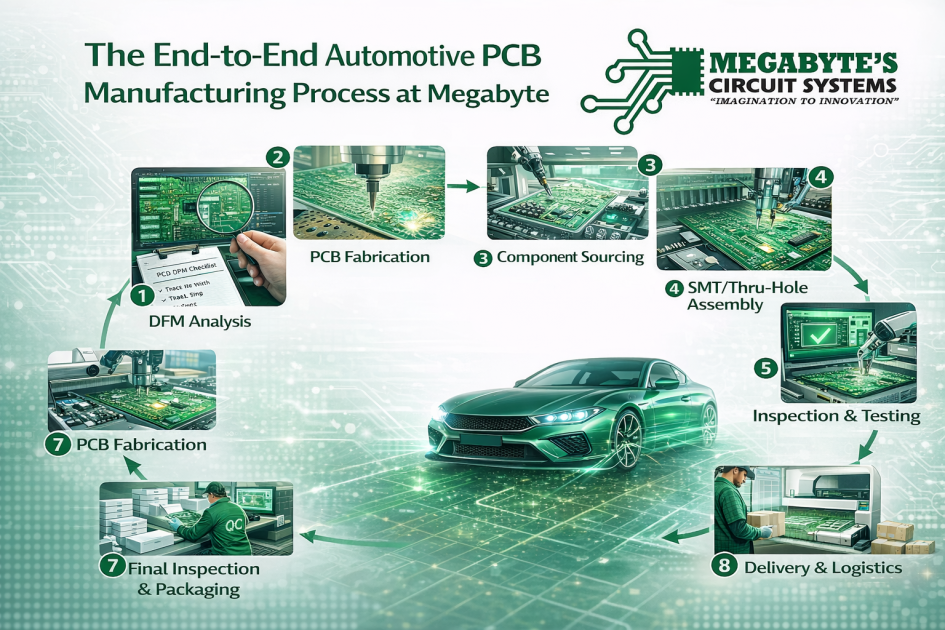
From Gerber review to final shipment, every step is IATF 16949 controlled:
For urgent EV prototypes we offer quick-turn automotive PCBs in 5–7 working days using our dedicated automotive line.
Every board leaving our Ahmedabad facility carries:
We also provide PPAP documentation (Production Part Approval Process) when your customer demands it, something very few PCB manufacturers in India are equipped to deliver.
Indian automotive buyers can achieve 18–28 % lower landed cost compared to China when volume crosses 500 pcs/lot. Here’s how:
For Single Layer PCB dashboard indicators or Double Layer PCB body-control modules, we regularly beat imported pricing while delivering in 8–10 days.
For prototypes we start at 5–10 pcs. Production typically begins at 100–500 pcs/lot depending on board complexity.
Yes. Every automotive project includes full PPAP Level 3 documentation as standard.
ENIG (Electroless Nickel Immersion Gold) is the industry choice because of excellent solderability after multiple reflows and long shelf life.
Absolutely. We regularly manufacture 3 oz and 4 oz outer layers with 2 oz inner layers for 48 V and 800 V battery-management systems.
Every panel carries a unique job number laser-marked. We maintain digital records of laminate batch, drill program, and test results for 15 years.
5–7 days for prototypes, 12–15 days for production lots of 500+ pcs.
At Megabyte Circuit Systems in Ahmedabad, Gujarat, we’ve built our entire process around the exact needs of Indian automotive and EV companies. Whether you need 10 prototype boards for an ADAS module or 10,000 multilayer ECUs every month, you’ll get consistent Class 3 quality, full documentation, and pricing that makes “Make in India” actually profitable.
Upload your Gerber files right now on our PCB Calculator or drop me a message for a same-day technical review and quote.
Your next automotive board is only one click away from being manufactured by a partner who truly understands what’s under the hood.
Harshil Patel, Senior Consultant & Head of Automotive PCB Projects
Megabyte Circuit Systems, Ahmedabad
C/10, Yogeshwar Estate, B/H Madhuram Estate, Nr. Vishala Estate, Sardar Patel Ring Rd, Odhav, Ahmedabad, Gujarat, Ahmedabad - 382430, Gujarat (India)
Copyright © 2025. Megabytes Circuit Systems All rights reserved.
Powered by FrogMEE Tech