Categories
PCB Guide

PCB Prototype India: Mastering Quick-Turn 24-48 Hour Fabrication

PCB Prototype India: Mastering Quick-Turn 24-48 Hour Fabrication

In the high-stakes world of electronic product development, the bridge between a schematic and a functional hardware product is the prototype. For Indian hardware engineers and IoT startups, time-to-market is the ultimate KPI. A delay in receiving a pcb prototype India can mean missing a venture capital milestone or a critical product launch window.

At Megabyte Circuit Systems, we recognize that “fast” isn’t just about shipping speed; it’s about the technical precision of the quick-turn prototyping process. Whether you are developing a Single Layer PCB for a power supply or a complex Multilayer PCB for an AI-on-the-edge device, your prototype serves as the definitive proof of concept. This guide explores the technical parameters, manufacturing standards, and speed-optimized workflows that define the fastest PCB prototype India services in 2026.

The Anatomy of a Quick-Turn PCB Prototyping Process

Quick Technical Summary: The quick-turn PCB prototyping process compresses traditional 14-day manufacturing cycles into 24–48 hours by utilizing high-speed digital imaging (LDI) and automated CAM validation. This workflow eliminates physical tooling delays, allowing for immediate transition from Gerber files to the etching stage.

When an engineer searches for a pcb prototype India, they are typically looking for an agile response to design iterations. The process at Megabyte begins with an automated CAM (Computer-Aided Manufacturing) review. As soon as you upload your Gerber files (RS-274X or ODB++ formats), our engineers perform a netlist comparison to ensure the physical board will match your electrical intent.

The manufacturing stages for an urgent prototype include:

  1. LDI (Laser Direct Imaging): Instead of creating film phototools, we use lasers to scan the circuit pattern directly onto the photoresist-coated copper. This is essential for maintaining a tight trace width and spacing (down to 4/4 mil).
  2. PTH (Plated Through Hole) Processing: For a Double Layer PCB, we utilize high-speed electrolysis to deposit copper in the drilled holes, ensuring electrical continuity between layers.
  3. Automated Solder Mask Application: Using liquid photoimageable (LPI) solder mask, we protect the copper traces while leaving the pads exposed for soldering.
  4. Final Finish: Depending on the application, we apply HASL, ENIG (Electroless Nickel Immersion Gold), or OSP to ensure the pads remain solderable.

Design for Manufacturing (DFM): The Key to 48-Hour Success

Quick Technical Summary: DFM optimization for prototypes focuses on eliminating “technical holds” caused by clearance violations or missing drill data. Adhering to standard aspect ratios and providing a complete ODB++ or Gerber X2 package ensures the board moves directly to production without manual intervention.

To guarantee a 24-48 hour turnaround, the design must be “clean.” Our PCB Manufacturing service often encounters delays not due to production capacity, but due to file errors.

Critical DFM Checklist for Prototypes:

  • Annular Ring Integrity: Ensure the pad size is at least 10–12 mils larger than the drill diameter to prevent breakout.
  • Clearance Rules: Maintain a minimum of 6 mils between copper traces and 8 mils between copper and the board edge to avoid short circuits.
  • Drill File Accuracy: Always include a separate Excellon drill file with the correct scale (2:4 or 2:3 decimal format).
  • Silkscreen Legibility: Avoid placing silkscreen over solder pads, as this will lead to solderability issues during the PCB Assembly service.

Technical Calculation: Trace Resistance and Heat

When prototyping for high-power IoT devices, calculating the resistance of your traces is vital to avoid overheating. The resistance (R) of a PCB trace is calculated as:

R=w⋅t⋅[1+α(T−Tamb​)]ρ⋅L​

Where:

  • ρ is the resistivity of copper (1.724×10⁻⁸Ω⋅m).
  • L is the trace length.
  • w is the trace width.
  • t is the copper thickness (e.g., 35μm for 1oz copper).
  • α is the temperature coefficient of copper (0.00393/∘C).

By optimizing these variables during the design phase, you ensure that your pcb prototype India performs reliably under real-world thermal loads.

Technical Comparison: Prototype vs. Production Standards

Understanding the differences in manufacturing tolerances helps procurement managers set realistic expectations for their initial builds.

Specification

Standard Prototyping

High-Density Production

Impact on Development

Turnaround Time

24 – 48 Hours

10 – 15 Days

Critical for rapid R&D iterations.

Min. Trace/Space

5 mil / 5 mil

3 mil / 3 mil

Standard prototypes fit most IoT designs.

Material Base

Standard FR4 (Tg 130-140)

High-Tg FR4, Rogers, Polyimide

Prototypes use versatile, cost-effective FR4.

Layer Alignment

± 2 mils

± 1 mil

Sufficient for standard SMT components.

Surface Finish

HASL / Lead-Free HASL

ENIG / Hard Gold / ENEPIG

HASL is faster; ENIG is better for BGA.

If your design requires advanced materials for high-frequency signals, you can check specific material availability using our PCB Calculator.

Quality Control & Standards: Why IPC-A-600 Matters
Quality Control & Standards: Why IPC-A-600 Matters

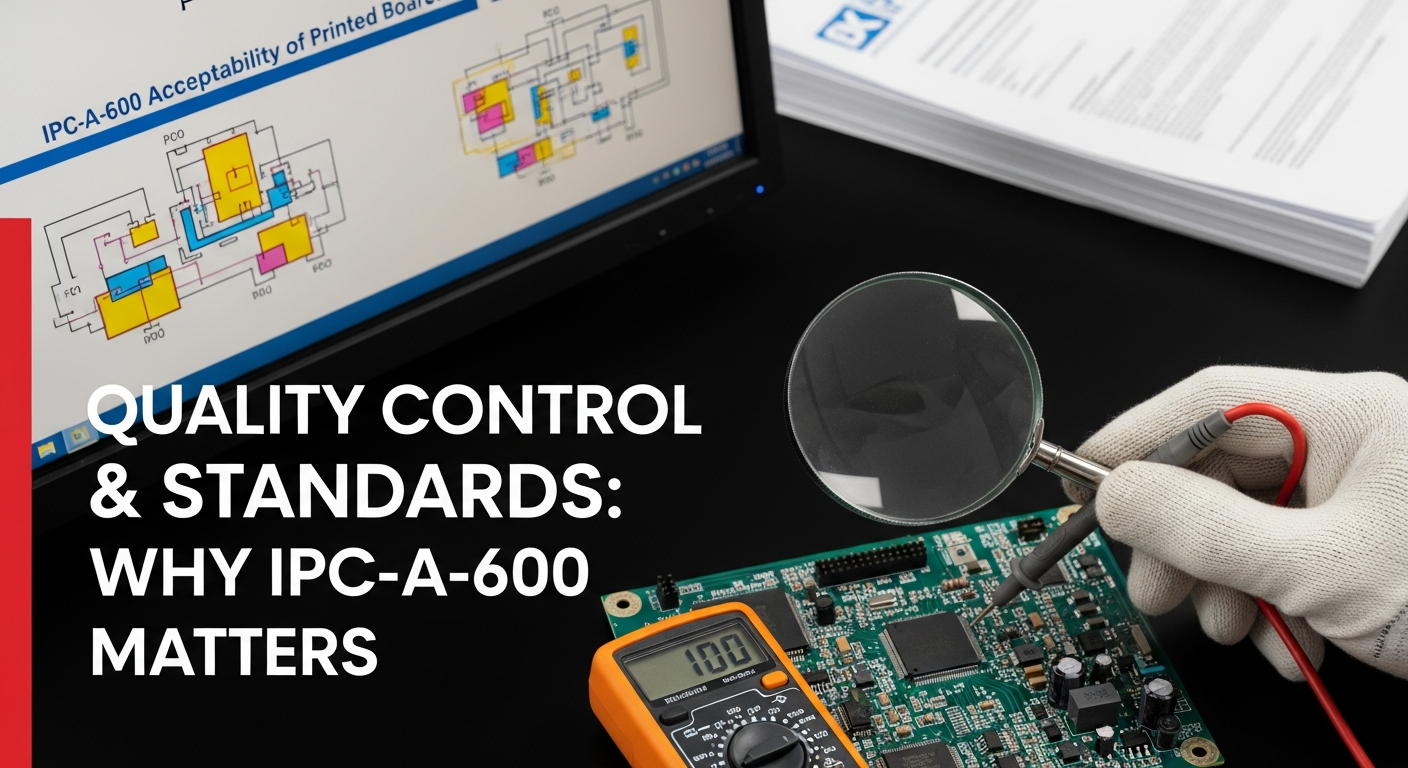
Quick Technical Summary: Quality control for prototypes is governed by the IPC-A-600 standard, which defines the acceptability of printed boards. Megabyte utilizes Flying Probe E-Testing to verify 100% of the netlist, ensuring that even “urgent” boards meet industrial reliability benchmarks.

A fastest PCB prototype India service is useless if the board arrives with “opens” or “shorts.” At Megabyte, we don’t skip quality steps for speed.

  1. Flying Probe Testing: Unlike traditional fixture-based testing, a flying probe uses high-speed robotic arms to test every single net on the board. This is the gold standard for pcb prototype India verification because it requires no custom “bed of nails” tooling.
  2. Micro-sectioning Analysis: We periodically perform cross-sectional analysis on our PTH samples to ensure copper plating thickness meets the IPC Class 2 requirement of 20μm (0.79 mils) in the hole walls.
  3. Visual Inspection: Every board undergoes high-magnification visual inspection to check for solder mask registration and silkscreen clarity.

By adhering to these rigorous standards, we ensure that your prototype is not just a “dummy board” but a high-fidelity representation of your final product.

Factors Influencing PCB Prototype Cost in India

Quick Technical Summary: Prototype pricing is primarily driven by the “setup cost” and “turnaround premium” rather than material volume. Optimizing the layer count and utilizing standard FR4 thicknesses are the most effective ways to manage the budget for an RFQ.

While we provide tailored quotes for every project, several technical factors influence the final cost of a pcb prototype India:

  • Layer Count: Moving from a Double Layer PCB to a Multilayer PCB typically increases the price due to the additional lamination and registration steps involved.
  • Copper Weight: Standard 1oz (35μm) copper is the most economical. Heavy copper (2oz or 3oz) for power electronics requires longer etching times and specialized chemistry.
  • Hole Density: A high number of holes per square inch or extremely small via sizes (under 0.2mm) can impact the mechanical drilling time.
  • Surface Finish: Lead-Free HASL is the fastest and most cost-effective. ENIG, while superior for fine-pitch components, involves a more complex chemical process that can add a small premium.

To get a precise estimate based on your specific design requirements, please Contact Megabyte Circuit Systems or use our automated tool to input your board dimensions.

FAQ: Frequently Asked Questions on PCB Prototyping

1. Can Megabyte handle 4-layer prototypes in 48 hours?

Yes. Our facility is optimized for quick-turn multilayer fabrication. As long as the Gerber files pass our initial DFM check, we can manufacture 4-layer and 6-layer boards within a 48-72 hour window.

2. What file formats do you accept for a pcb prototype India?

We prefer RS-274X (Gerber), ODB++, or Gerber X2. Please ensure you include the aperture list and Excellon drill data.

3. Do you offer assembly services for prototypes?

Absolutely. Our PCB Assembly service can handle everything from hand-soldered prototypes to fully automated SMT runs for small batches.

4. What is the minimum trace width Megabyte can support?

For our standard quick-turn service, we support a minimum trace width and spacing of 4 mils (0.1mm).

5. Is there a minimum order quantity (MOQ) for prototypes?

No. We understand that R&D requires flexibility. You can order as few as 1 to 5 pieces for your initial testing phase.

Conclusion: Accelerate Your Innovation with Megabyte

In the competitive landscape of Indian electronics, your choice of a fabrication partner determines your speed of innovation. A pcb prototype India should be a seamless experience where speed meets technical excellence. By integrating advanced DFM checks, IPC-compliant manufacturing, and a dedicated 24-48 hour quick-turn line, Megabyte Circuit Systems empowers engineers to fail fast, iterate faster, and succeed sooner.

Take the next step in your design cycle:

Categories
PCB Guide

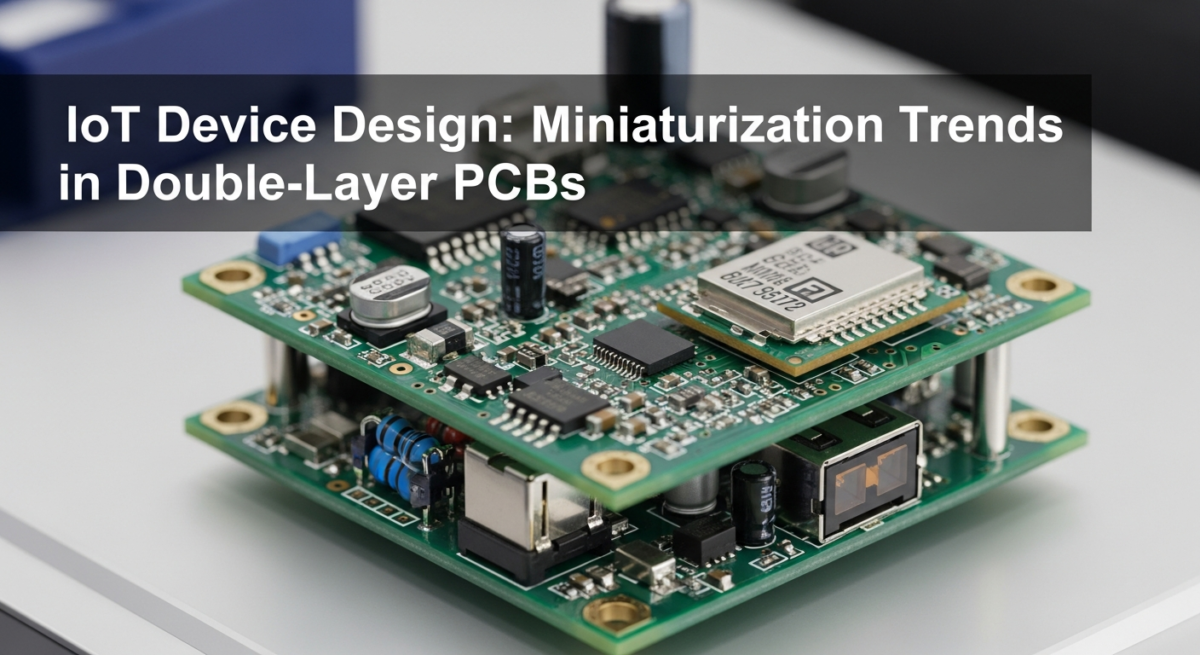
IoT Device Design: Miniaturization Trends in Double-Layer PCBs

IoT Device Design: Miniaturization Trends in Double-Layer PCBs

The relentless push toward “smart everything” has forced hardware engineers to rethink the traditional boundaries of circuit design. In the IoT (Internet of Things) era, the primary challenge is no longer just connectivity it is space. Fitting a micro-controller, multiple sensors, a power management IC, and an RF antenna into a wearable or a compact industrial sensor requires a masterclass in small form factor pcb engineering.

For many Indian startups and developers, the jump to complex HDI (High-Density Interconnect) or high-layer count boards can be cost-prohibitive. This is where the optimization of double layer pcb india standards becomes critical. At Megabyte Circuit Systems, we specialize in helping engineers push the limits of two-layer designs to achieve miniaturization goals without the expense of multilayer fabrication.

The Technical Shift: Why Double-Layer PCBs Still Dominate IoT

Quick Technical Summary: Double-layer PCBs remain the preferred choice for IoT due to their cost-to-performance ratio and faster prototyping cycles. Miniaturization is achieved through high-density SMD placement and optimized routing techniques that maintain signal integrity on a two-layer FR4 substrate.

While a Multilayer PCB offers dedicated ground and power planes, the double layer pcb india market continues to grow because it offers a significant cost advantage for high-volume IoT nodes. The challenge, however, is dealing with EMI (Electromagnetic Interference) and thermal dissipation in a confined space without those dedicated planes.

To achieve a small form factor pcb, engineers are moving away from through-hole components and toward ultra-fine pitch SMD (Surface Mount Device) packages like WLCSP (Wafer Level Chip Scale Packaging) and QFN (Quad Flat No-leads). This shift requires a reliable pcb manufacturer capable of handling tighter trace width and clearance tolerances. At Megabyte, our PCB Manufacturing service is tuned to handle 4-mil traces, allowing for the dense routing required by modern ESP32, Nordic, or STM32-based IoT designs.

Design for Manufacturing (DFM) for High-Density IoT Boards

Quick Technical Summary: IoT DFM focuses on reducing via sizes and optimizing the solder mask to prevent defects in fine-pitch components. Implementing “Via-in-Pad” (where permissible) and minimizing annular rings are essential strategies for reclaiming valuable board real estate.

When designing a pcb prototype for iot, the DFM (Design for Manufacturing) rules you follow will determine the yield and reliability of your product. For miniaturized designs, we recommend several specific adjustments to your Gerber files:

  1. Trace and Space Optimization: While 6/6 mil (trace/space) is standard, pushing to 4/4 mil can increase routing density by nearly 40%. However, this requires a controlled etching process to prevent over-etching.
  2. Solder Mask Dams: In high-density designs, the distance between pads is minimal. We ensure a minimum solder mask bridge of 0.1mm to prevent solder bridging during our PCB Assembly service.
  3. Copper Pour and Ground Planes: In a double-layer setup, use copper pours on both the top and bottom layers to create a “pseudo-ground plane.” This helps in reducing loop inductance and improving the performance of onboard chip antennas.
  4. Hole-to-Copper Clearance: To prevent shorts during the PTH (Plated Through Hole) process, maintain at least 8-10 mils of clearance between the hole wall and the nearest copper trace.

If your internal team is struggling with these constraints, utilizing a professional PCB Design Service can help bridge the gap between a conceptual schematic and a manufacturable layout.

Technical Comparison: Double-Layer vs. Multilayer for IoT

Understanding the trade-offs between layer counts is vital for procurement managers balancing performance and budget.

Feature

Double-Layer PCB

Multilayer PCB (4+ Layers)

Impact on IoT Design

Cost

Lower (Best for BOM optimization)

Higher (Significant price jump)

Crucial for 10–\20 IoT nodes.

Signal Integrity

Moderate (Requires careful routing)

Excellent (Dedicated GND planes)

Vital for high-speed WiFi/BLE.

Size Constraints

Moderate

Excellent (Vertical density)

Multilayer allows for smaller X-Y dimensions.

Manufacturing Time

24-48 Hours (Quick-turn)

4-7 Days

Critical for rapid PCB Developing Services.

Thermal Mgmt

Limited (Requires thermal vias)

High (Internal planes act as sinks)

Important for cellular (LTE/5G) IoT.

While a Single Layer PCB might work for a simple LED driver, the complexity of IoT pcb design almost always starts at the double-layer level to accommodate the necessary return paths for RF signals.

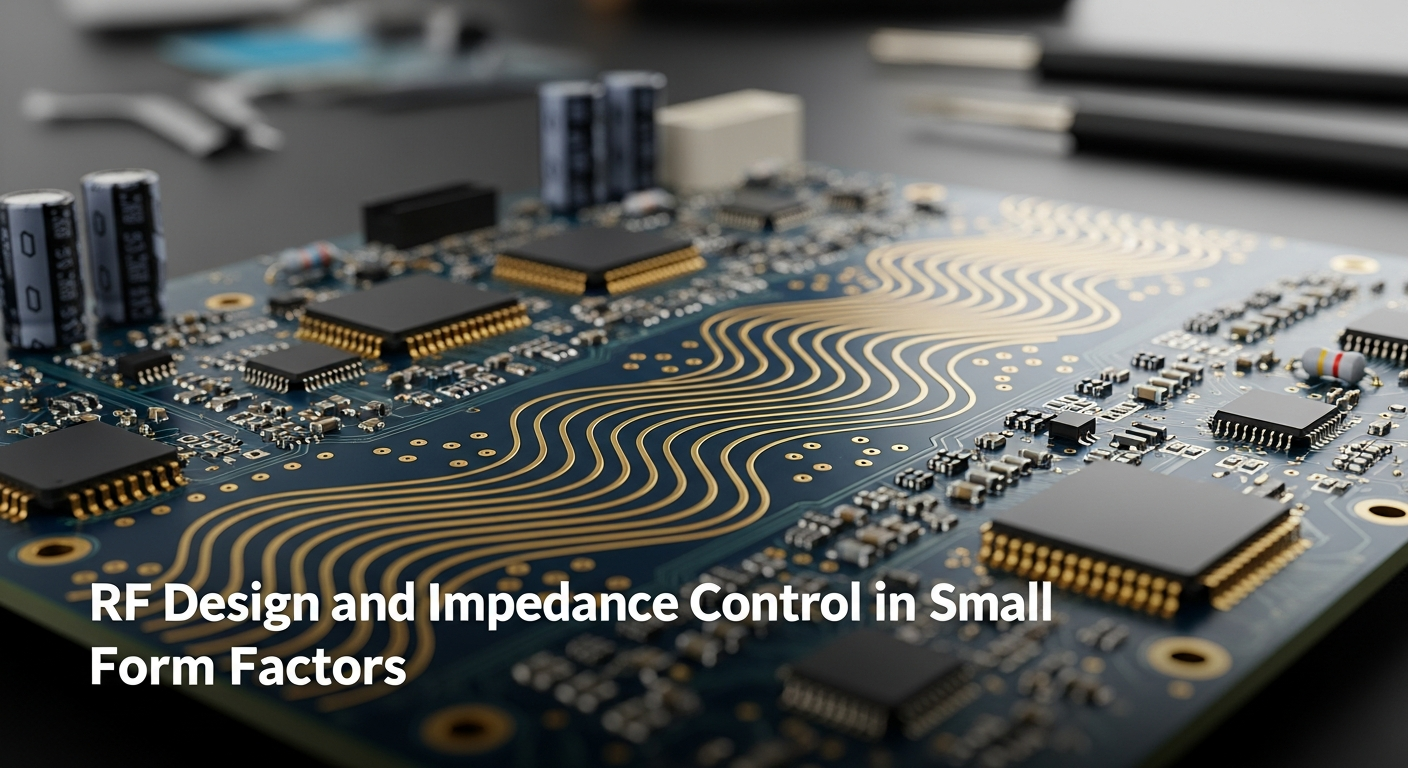
RF Design and Impedance Control in Small Form Factors

RF Design and Impedance Control in Small Form Factors

Quick Technical Summary: Managing RF impedance on a double-layer board requires precise substrate thickness selection and trace geometry calculations. Since there is no internal ground plane, the bottom layer must act as a reference to maintain the standard 50-ohm impedance required for IoT antennas.

In miniaturized IoT devices, the antenna is often the most sensitive component. Whether you are using a PCB trace antenna (like an Inverted-F) or a ceramic chip antenna, the feedline must be impedance-matched. On a double layer pcb india standard FR4 substrate, the trace width (w) for a 50Ω microstrip is determined by the height (h) of the dielectric.

The formula for characteristic impedance (Z0​) is:

Z0​=ϵr​+1.41​87​ln(0.8w+t5.98h​)

Where:

  • ϵr​ is the dielectric constant of FR4 (typically 4.2 to 4.6).
  • h is the thickness of the core material.
  • t is the copper thickness (usually 35μm for 1oz copper).

At Megabyte, we provide precise dielectric stack-ups so your calculations match the physical reality of the board. This precision is why we are considered a reliable pcb manufacturer for RF-intensive applications like LoRaWAN, Zigbee, and NB-IoT.

Quality Control: Validating Miniaturized IoT Boards

Quick Technical Summary: Quality control for small form factor PCBs involves high-resolution AOI and E-Testing to identify microscopic defects in fine-pitch traces. Megabyte utilizes Flying Probe testing to ensure 100% netlist integrity without the need for expensive test fixtures.

Miniaturization increases the risk of manufacturing defects. A 4-mil trace is more susceptible to “opens” caused by dust during the imaging process. To mitigate this, we employ:

  • Automated Optical Inspection (AOI): Our systems scan the Double Layer PCB after etching to ensure the trace geometry matches the design files perfectly.
  • Flying Probe E-Test: For a pcb prototype for iot, we use flying probes that touch every pad on the board to verify electrical continuity, ensuring your prototype works the moment it hits your desk.
  • IPC-A-600 Compliance: We adhere to Class 2 and Class 3 standards to ensure that even the smallest vias have sufficient copper plating to withstand thermal expansion.

Cost Optimization for IoT Startups in India

Quick Technical Summary: To minimize costs, engineers should avoid “over-specifying” tolerances and use standard panel sizes provided by the fabricator. Leveraging an online calculator helps in visualizing the price impact of different surface finishes like HASL versus ENIG.

For many startups, the goal is to reach a “Price-to-Density” sweet spot. Here is how to optimize your costs at Megabyte:

  1. Choose the Right Surface Finish: For low-cost IoT, Lead-Free HASL is often sufficient. However, if you are using fine-pitch BGA or QFN components, ENIG (Electroless Nickel Immersion Gold) is required for pad flatness.
  2. Standardize Board Thickness: A 1.6mm thickness is the industry standard. Dropping to 0.8mm or 1.0mm for a small form factor pcb is possible but can sometimes increase cost due to material handling.
  3. Use the Online Tools: Before finalizing your design, use our PCB Calculator to see how changing your board dimensions by even a few millimeters can fit more units on a production panel.
  4. Consolidate Orders: Combining your pcb prototype for iot with a small-batch production run can significantly reduce the “per-piece” cost.

FAQ: Common Questions on IoT PCB Miniaturization

1. Can I use a double-layer PCB for a high-speed IoT device?

Yes, but it requires extreme care. You must ensure a solid ground return path directly under high-speed signal traces. If your design exceeds 100MHz or has fast rise times, a 4-layer board is generally safer.

2. What is the smallest via size Megabyte can manufacture for a double-layer board?

We typically support a minimum drill size of 0.2mm (8 mil) with a 0.4mm (16 mil) annular ring for standard production. For specialized IoT needs, contact us for tighter tolerances.

3. Why is my RF range poor on my 2-layer IoT board?

This is often due to poor ground plane continuity or interference from nearby switching power supplies. Ensure your antenna has a clear “keep-out” zone where no copper or components are present on any layer.

4. Is ENIG necessary for IoT PCBs?

If you are using 0402 components or fine-pitch ICs, ENIG is highly recommended. It provides a flat surface for the PCB Assembly service, reducing the risk of tombstoning or cold solder joints.

5. How do I get a quote for a custom IoT PCB?

Simply upload your Gerber files to our PCB Calculator. We offer instant pricing for most standard double-layer configurations.

Conclusion: Partnering for IoT Success

Miniaturization is the engine of the IoT revolution, but it requires a fabrication partner that understands the technical nuances of high-density design. Whether you are at the PCB Design Service stage or ready for a full-scale production run, Megabyte Circuit Systems provides the engineering support and manufacturing precision to bring your vision to life.

Don’t let space constraints hold back your innovation. Leverage our expertise in double layer pcb india manufacturing to build smaller, smarter, and more cost-effective IoT solutions.

Ready to start?

  • Calculate your project cost: PCB Calculator
  • Submit your files for review: Contact our technical team for a DFM check today.


Categories
PCB Guide

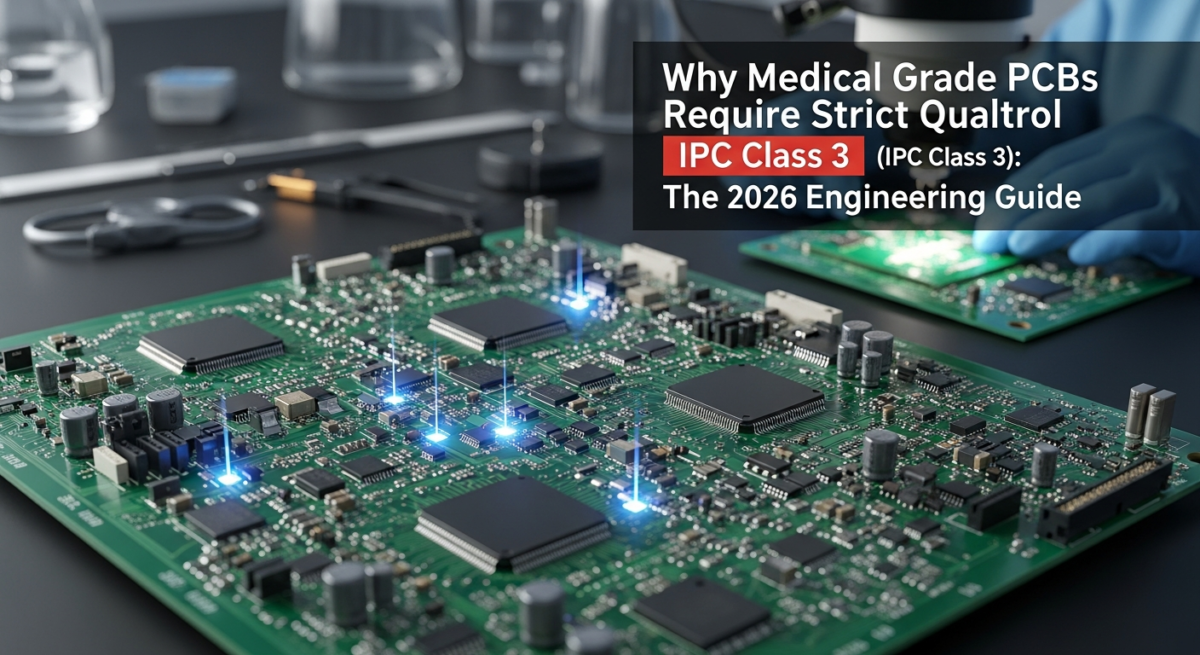
Why Medical Grade PCBs Require Strict Quality Control (IPC Class 3): The 2026 Engineering Guide

Why Medical Grade PCBs Require Strict Quality Control (IPC Class 3): The 2026 Engineering Guide

In the world of medical electronics, “reliability” isn’t just a marketing buzzword—it is a life-saving requirement. Whether it is a portable ventilator, an implantable pacemaker, or a high-end MRI machine, the internal circuitry must function without fail for years, if not decades. For hardware engineers and procurement managers in India, understanding the nuances of medical pcb manufacturing is the first step toward building a successful, compliant product.

At Megabyte Circuit Systems, we have seen firsthand how the shift from industrial-grade (Class 2) to medical-grade (IPC Class 3 pcb) standards can drastically reduce field failures. When a device is mission-critical, the margin for error in the fabrication process is zero. This guide explores the technical demands, design rules, and manufacturing standards required to achieve medical-grade excellence.

The Anatomy of IPC Class 3 in Medical PCB Manufacturing

Quick Technical Summary: IPC Class 3 represents the pinnacle of high-reliability manufacturing, where equipment downtime is unacceptable. For medical devices, this standard mandates strict tolerances for annular rings, plating thickness, and solder joints to ensure continuous operation in life-critical environments.

The IPC (Association Connecting Electronics Industries) classifies PCBs into three categories. While Class 2 is standard for most consumer and industrial electronics, medical devices—especially those categorized as life-support systems—must adhere to Class 3.

The core of Megabyte Circuit Systems quality lies in our ability to meet these heightened tolerances. In a Class 3 board, the requirements for Plated Through Holes (PTH) and annular rings are significantly more stringent. For instance, in Class 2, a 90-degree breakout of the pad from the hole is often permissible. In Class 3, there is a “zero breakout” policy. This ensures that the mechanical and electrical connection remains robust even under thermal expansion or mechanical stress.

When you engage our PCB Manufacturing service for medical projects, we prioritize the integrity of the conductive path. This often involves specialized drilling processes and enhanced desmear cycles to ensure the copper plating bonds perfectly to the inner layers of a Multilayer PCB.

Why Medical PCBs Demand Superior Signal Integrity and EMI Shielding

Quick Technical Summary: Medical devices operate in electrically noisy environments, requiring precise impedance control and advanced EMI shielding. Utilizing a high-reliability manufacturer ensures that signal-to-noise ratios are optimized for diagnostic accuracy in equipment like EEG and ECG monitors.

In medical diagnostics, signal integrity is paramount. A stray millivolt of noise can lead to a misdiagnosis. This is why medical pcb manufacturing often requires controlled impedance. Designers must calculate the Trace Width and spacing based on the dielectric constant (ϵr​) of the substrate.

The formula for the characteristic impedance (Z0​) of a microstrip line is often approximated as:

Z0​=ϵr​+1.41​87​ln(0.8w+t5.98h​)

Where:

  • h is the dielectric thickness.
  • w is the trace width.
  • t is the trace thickness.
  • ϵr​ is the dielectric constant of the FR4 or specialized material.

Ensuring these variables remain constant across a large production run requires a reliable pcb manufacturer with precision etching capabilities. Any deviation in the etching process that narrows the trace width will increase the impedance, potentially causing signal reflections that compromise the device’s accuracy. Furthermore, in our PCB Assembly service, we ensure that shielding cans and ground planes are perfectly integrated to block electromagnetic interference (EMI).

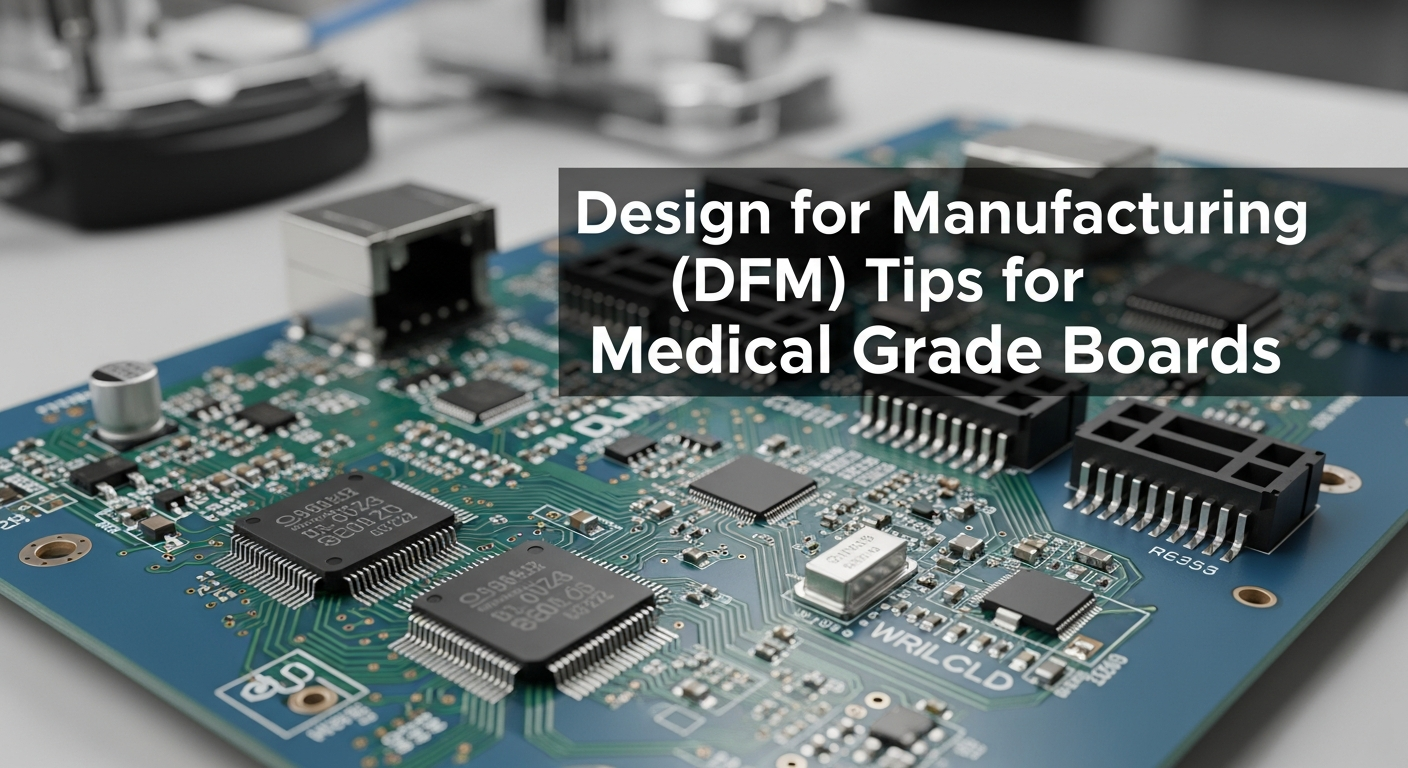
Design for Manufacturing (DFM) Tips for Medical Grade Boards

Design for Manufacturing (DFM) Tips for Medical Grade Boards

Quick Technical Summary: Medical DFM focuses on maximizing board longevity through generous copper clearances and robust via designs. Engineers should prioritize thermal management and specify “Teardrops” on all pads to mitigate the risk of stress-induced fractures in the circuit path.

Transitioning a design from a prototype to a medical-grade production run requires a specialized DFM approach. Here are actionable tips to optimize your Gerber files for Megabyte’s high-precision factory:

  1. Enlarge Annular Rings: To meet IPC Class 3 “zero breakout” rules, increase your pad sizes relative to the drill size. This provides a safety margin for slight drill registration shifts.
  2. Specify High-Tg Materials: Medical devices often undergo sterilization or operate in high-temperature environments. Using High-Tg (Glass Transition Temperature) FR4 ensures the board doesn’t delaminate during thermal cycling.
  3. Optimize Solder Mask: Specify a high-quality, LPI (Liquid Photoimageable) solder mask to prevent bridge formation between fine-pitch components, which is critical for the high-density interconnects (HDI) found in modern medical IoT.
  4. Via Filling: For Double Layer PCB or multilayer designs, consider conductive or non-conductive via plugging (Via-in-Pad) to save space and improve thermal dissipation.

By following these rules, you enable Megabyte to deliver a board that isn’t just functional, but “medical-ready.”

Class 2 vs. Class 3: Technical Comparison for Medical Applications

Choosing the wrong class can result in catastrophic field failures. The following table highlights why Class 3 is the only choice for a reliable pcb manufacturer working in the healthcare sector.

Feature

IPC Class 2 (Standard)

IPC Class 3 (High Reliability)

Medical Impact

Annular Ring (External)

90° breakout allowed

0° breakout (Min 0.05mm ring)

Prevents connection failure.

PTH Copper Plating

Average 20µm (0.8 mil)

Average 25µm (1.0 mil)

Better thermal/mechanical load.

Visual Defects

Minor imperfections allowed

Zero tolerance for major defects

Ensures long-term substrate health.

Solder Joint Quality

180° wetting allowed

270° wetting required

Superior vibration resistance.

Dielectric Spacing

Minimum 0.1mm

Minimum 0.1mm (Strictly enforced)

Prevents high-voltage arcing.

While a Single Layer PCB might suffice for basic medical disposables, complex diagnostic tools almost always require Class 3 multilayer structures to maintain the tight tolerances listed above.

Quality Control & Standards: How Megabyte Ensures Compliance

Quick Technical Summary: Medical-grade quality control involves a multi-stage verification process including AOI, X-ray inspection, and Flying Probe E-Testing. Megabyte Circuit Systems employs these technologies to validate IPC-A-600 compliance, ensuring every internal layer meets the high-reliability mandate.

The “Megabyte Quality” promise is backed by rigorous testing protocols. For medical pcb manufacturing, we do not rely on visual inspection alone.

  • Automated Optical Inspection (AOI): Our AOI systems compare the fabricated board against your original Gerber files to detect missing traces, shorts, or “mouse bites” that could lead to latent failures.
  • Flying Probe E-Test: This ensures 100% electrical continuity. For medical boards, we test every net to ensure there are no microscopic opens that could be triggered by the vibration of a portable medical device.
  • Micro-sectioning: We take sample cross-sections of the production lot to verify the copper plating thickness inside the holes, ensuring it meets the 25µm Class 3 requirement.

X-Ray Inspection: For boards involving BGA (Ball Grid Array) components, X-ray inspection is mandatory to verify that solder joints beneath the chip are void-free and perfectly aligned.

Cost Optimization for High-Reliability PCBs in India

Quick Technical Summary: To balance cost and quality, engineers should standardize their stack-ups and utilize Megabyte’s online tools for real-time pricing. Local manufacturing in India eliminates high shipping costs and customs delays associated with importing medical components.

High-reliability doesn’t always have to mean high-cost. At Megabyte, we help Indian startups stay competitive through:

  • Material Standardization: Using widely available High-Tg FR4 rather than exotic, hard-to-source laminates unless absolutely necessary for RF performance.
  • Panelization Efficiency: Our engineering team assists in optimizing your board array to get the maximum number of boards per production panel, reducing material waste.

Early-Stage Quote Analysis: Use our PCB Calculator to experiment with different layer counts and surface finishes (like ENIG vs. ENEPIG) to find the most cost-effective solution for your medical certification needs.

FAQ: People Also Ask About Medical PCBs

1. Is ISO 13485 required for PCB manufacturers?

While the device OEM must be ISO 13485 certified, the reliable pcb manufacturer should have a robust quality management system (like ISO 9001) and demonstrate the ability to manufacture to IPC Class 3 standards, which align with medical regulatory requirements.

2. Why is ENIG the preferred surface finish for medical PCBs?

Electroless Nickel Immersion Gold (ENIG) provides a flat surface for fine-pitch components and offers excellent oxidation resistance, ensuring a long shelf life for medical devices that might sit in storage.

3. Can a Single Layer PCB be Class 3?

Yes. Any board—be it a Single Layer PCB or a 20-layer stack-up—can be manufactured to Class 3 standards if the design rules for spacing, plating, and annular rings are followed.

4. What is the difference between IPC-A-600 and IPC-6012?

IPC-6012 is the performance specification (the “what”), while IPC-A-600 is the visual acceptability criteria (the “how it should look”). A medical grade board must satisfy both.

5. How does Megabyte Circuit Systems handle quick-turn medical prototypes?

We offer dedicated prototype lines that follow the same Class 3 processes as our production runs, ensuring that your clinical trial units are identical to your final production units.

Conclusion: Build Your Medical Innovation on a Solid Foundation

The path to medical device certification is long and complex. Don’t let your PCB be the weak link that causes a regulatory delay or a field recall. By adhering to IPC Class 3 standards and partnering with an expert like Megabyte Circuit Systems, you ensure that your hardware is as robust as the medical professionals who use it.

Ready to start your next medical-grade project?

  • Get Instant Pricing: Check our PCB Calculator for your specific requirements.
  • Expert Review: Send your Gerber files to our team for a free DFM and Class 3 compliance check.

Megabyte Circuit Systems: Where Precision Meets Life-Saving Reliability.

Categories
PCB Guide

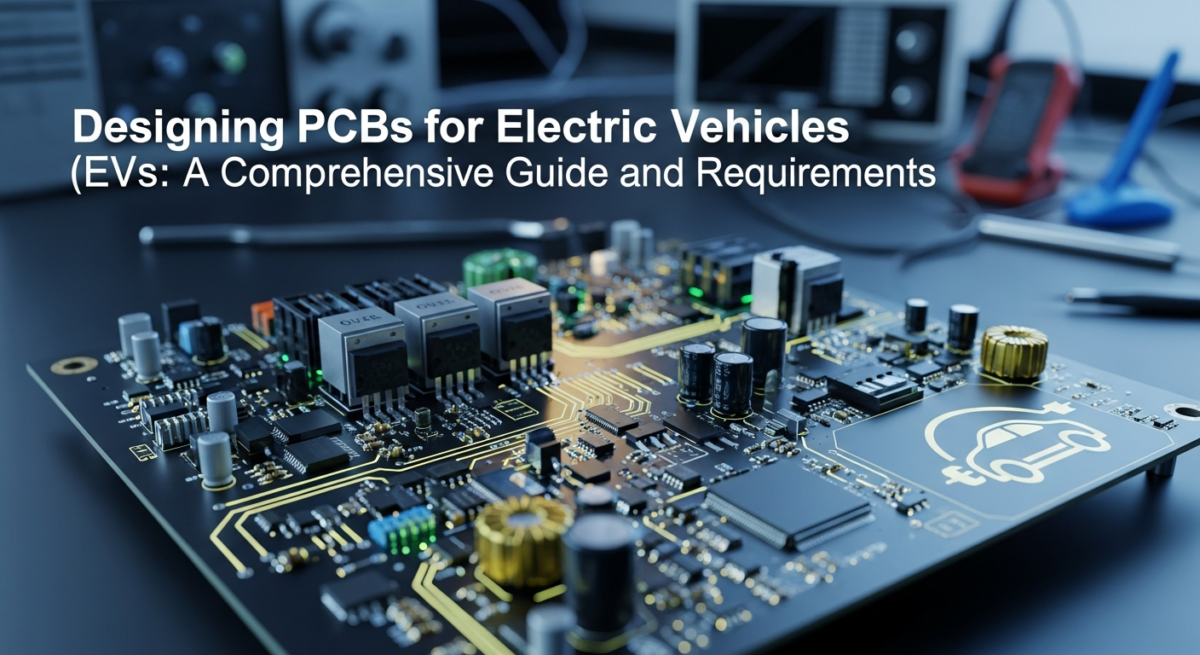
Designing PCBs for Electric Vehicles (EVs): A Comprehensive Guide to Standards and Requirements

Designing PCBs for Electric Vehicles (EVs): A Comprehensive Guide to Standards and Requirements

The Indian automotive landscape is undergoing a radical shift toward electrification. For hardware engineers and IoT developers, this transition brings a unique set of challenges. Unlike consumer electronics, automotive pcb fabrication for Electric Vehicles (EVs) must handle extreme thermal cycles, high-voltage environments, and constant mechanical vibration. At Megabyte Circuit Systems, we understand that a failure in a Battery Management System (BMS) or a Traction Inverter isn’t just a technical glitch—it’s a safety critical event.

Designing for EVs requires a departure from standard FR4 thinking. You are no longer just routing signals; you are managing power density and ensuring long-term reliability in harsh environments.

Why EV PCB Design Requires a High-Voltage Paradigm Shift

Quick Technical Summary: High-voltage PCB design for EVs focuses on maintaining electrical isolation and thermal stability under loads often exceeding 400V–800V. Engineers must prioritize creepage and clearance distances while utilizing heavy copper traces to manage high current densities without catastrophic heat rise.

In a typical Electric Vehicle, the PCB acts as the nervous system and the muscle. From the BMS to the DC-DC converters, these boards must withstand “High-Voltage (HV)” and “Low-Voltage (LV)” signals residing on the same substrate. This necessitates a deep understanding of high voltage pcb design rules.

When you partner with a specialized PCB Manufacturing service, the primary focus is on dielectric breakdown strength. In EV environments, the risk of “tracking” or “arcing” across the board surface is high. Designers must calculate the minimum spacing based on the Comparative Tracking Index (CTI) of the base material. For most EV applications, utilizing a material with a CTI of 600V+ is mandatory to ensure the longevity of the Power Distribution Unit (PDU).

Heavy Copper PCB: The Backbone of EV Power Electronics

Quick Technical Summary: Heavy copper PCBs (utilizing 3oz to 10oz of copper) are essential for EV inverters and charging systems to conduct high currents and dissipate heat. These boards replace traditional busbars, reducing the weight and complexity of the vehicle’s electrical architecture.

For a leading EV pcb manufacturer india, the demand for heavy copper pcb has skyrocketed. Standard PCBs typically use 1oz (35µm) copper. However, EV power stages often require 3oz, 4oz, or even up to 10oz copper to handle the massive current surges during acceleration and fast charging.

The formula for calculating the required cross-sectional area A of a trace for a given current I and temperature rise ΔT is derived from IPC-2221:

I=k⋅ΔT0.44⋅A0.725

Where:

  • I is the current in Amperes.
  • k is a constant (0.048 for outer layers).
  • ΔT is the temperature rise above ambient.
  • A is the cross-sectional area in square mils.

By using thick copper layers, we reduce the DC resistance of the traces, which directly minimizes I2R losses and heat generation.

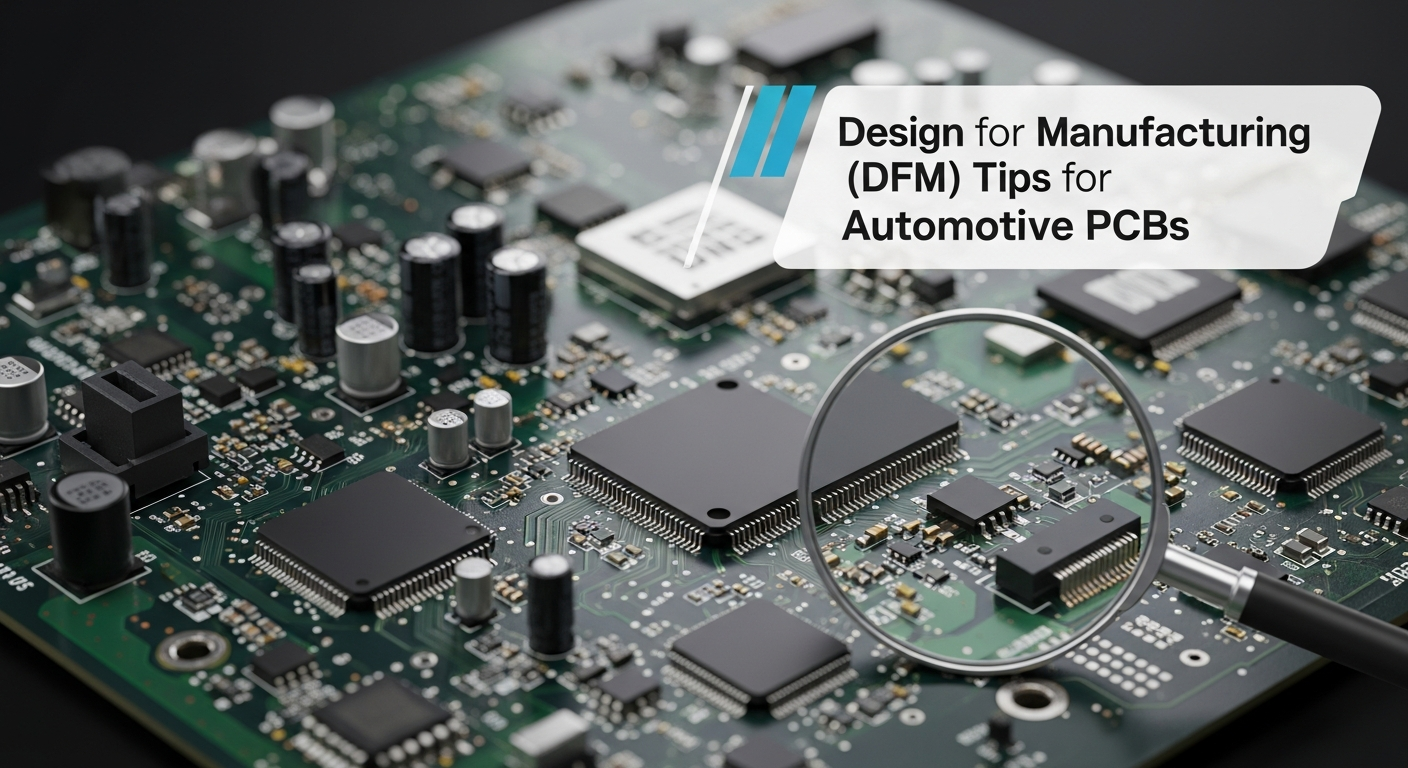
Design for Manufacturing (DFM) Tips for Automotive PCBs

Design for Manufacturing (DFM) Tips for Automotive PCBs

Quick Technical Summary: Automotive DFM focuses on structural integrity, such as teardrop padding to prevent stress fractures and advanced solder mask application to ensure insulation. Engineers should work closely with their fabricator to optimize via-in-pad designs and thermal relief patterns.

When preparing your automotive pcb fabrication files for Megabyte Circuit Systems, consider the following expert DFM tips:

  1. Teardrops are Mandatory: In high-vibration EV environments, the junction between a trace and a pad is a failure point. Adding teardrops significantly increases the mechanical strength of the PCB Assembly service connections.
  2. Solder Mask Thickness: For high-voltage boards, the solder mask is more than just a coating; it’s an insulator. Specify a minimum thickness of 0.5 mils over the traces to prevent environmental oxidation and provide an extra layer of dielectric protection.
  3. Vias and Current: Do not rely on a single via for high-current paths. Use “Via Arrays” to distribute the current load and reduce the parasitic inductance of the connection.
  4. Thermal Management: Incorporate thermal vias to move heat from high-power components to an internal heat-sink layer or a bottom-side aluminum plate.

Topic Specific Comparison: Material Selection for EV PCBs

Choosing the right substrate is the difference between a board that lasts 10 years and one that fails in six months.

Feature

Standard FR4

High-Tg FR4 (IT-180A)

Ceramic Substrate (AlN)

Metal Core PCB (MCPCB)

Thermal Conductivity

~0.25 W/mK

~0.40 W/mK

150-180 W/mK

1.0 – 5.0 W/mK

Glass Transition (Tg)

130°C – 140°C

170°C – 180°C

N/A

Variable

Dielectric Strength

Good

Excellent

Superior

Moderate

Typical EV Use Case

Infotainment

BMS / ECUs

High-Power Inverters

LED Headlights

Cost Profile

Low

Medium

High

Medium-High

For most Multilayer PCB projects in the EV sector, we recommend High-Tg FR4 as the baseline to ensure the board remains dimensionally stable during the high-heat cycles of automotive operation.

Quality Control & Standards: IPC-6012DA and Beyond

Quick Technical Summary: Automotive PCBs must meet IPC-6012DA (Automotive Addendum), which mandates stricter criteria for copper plating thickness and hole wall integrity. Megabyte Circuit Systems employs 100% E-Testing and Flying Probe tests to ensure zero-defect shipments for EV clients.

Reliability is non-negotiable in the automotive world. While consumer electronics often follow IPC Class 2 standards, automotive pcb fabrication usually demands IPC Class 3 or the specific IPC-6012DA automotive addendum. These standards dictate:

  • Higher copper plating thickness in the barrels of Double Layer PCB and multilayer designs.
  • Zero tolerance for “wiking” or internal shorts.
  • Stringent cleanliness requirements to prevent electrochemical migration.

At Megabyte, we utilize Flying Probe Testing for prototypes and high-speed Automatic Optical Inspection (AOI) for production runs. This ensures that every Single Layer PCB or complex multilayer stack-up we deliver is ready for the rigors of the road.

Cost Optimization for EV PCBs in India

Quick Technical Summary: To optimize costs without sacrificing quality, engineers should standardize panel utilization and avoid exotic materials unless thermally necessary. Utilizing a local partner like Megabyte Circuit Systems reduces logistics costs and import duties associated with foreign sourcing.

Managing the “BOM cost” is critical for Indian EV startups. Here is how you can save:

  • Copper Weight Balance: Only use heavy copper on the layers that actually need it. Mixing 4oz and 1oz copper on the same board is possible but requires a careful stack-up.
  • Panelization: Design your board dimensions to fit standard production panels (e.g., 18″x24″) to minimize waste.

Tooling: For initial prototypes, use our PCB Calculator to compare the cost of different surface finishes (HASL vs. ENIG). While ENIG is better for fine-pitch components, HASL is often more cost-effective for power-heavy boards.

FAQ: Frequently Asked Questions about EV PCBs

1. What is the biggest challenge in high voltage PCB design?

The biggest challenge is managing “Creepage” (distance over the surface) and “Clearance” (distance through the air). For 800V EV systems, these distances must be strictly maintained to prevent catastrophic electrical arcing.

2. Why is heavy copper used in EV PCBs?

EVs deal with high currents (often 200A or more). Heavy copper allows the PCB to carry this current without overheating, effectively acting as a compact, integrated busbar.

3. Is FR4 suitable for all EV applications?

Standard FR4 is fine for low-power control logic. However, for traction inverters and fast-charging modules, High-Tg FR4 or Ceramic substrates are preferred due to their superior thermal performance.

4. What standards should an EV pcb manufacturer in India follow?

Look for manufacturers who are familiar with IATF 16949 quality management systems and IPC-6012DA automotive standards.

5. How does vibration affect PCB design for vehicles?

Vibration can cause solder joint fatigue. Designers mitigate this by using smaller components, adding mechanical support, and utilizing “Teardrops” on all pad-to-trace junctions.

Conclusion: Partner with India’s EV PCB Experts

The transition to Electric Vehicles is a high-stakes engineering challenge. Success depends on the reliability of your printed circuit boards. Whether you are developing a next-gen two-wheeler BMS or a heavy-duty commercial vehicle inverter, Megabyte Circuit Systems has the technical expertise and manufacturing capability to bring your design to life.

Ready to take your EV project to the next level?

  • Calculate your project costs: Use our PCB Calculator for instant pricing.
  • Get a Custom RFQ: Upload your Gerber files today for a comprehensive DFM review by our senior engineering team.

Megabyte Circuit Systems: Powering the Future of Indian Mobility.

Categories
PCB Guide

Custom PCB Manufacturing in India: From Prototype to Production

Custom PCB Manufacturing in India: From Prototype to Production

Custom PCB manufacturing in India has emerged as a critical capability for innovators and businesses seeking tailored electronic solutions. Moving a product from an initial concept to a market-ready device requires a seamless journey from prototyping to full-scale production. This involves not only precision PCB fabrication in India but also a deep understanding of design, material selection, and assembly processes. 

Whether you’re looking to develop a single board for testing or require thousands for commercial release, understanding the robust ecosystem for custom PCB India offers is essential. Megabytes Circuit Systems provides comprehensive services to navigate this entire process efficiently, ensuring your designs transform into reliable physical products.

The Evolution of Custom PCB Manufacturing in India

The landscape of electronics manufacturing in India has undergone a significant transformation, with custom PCB manufacturing capabilities expanding rapidly. Historically, many companies relied on international suppliers for specialized PCB needs. However, advancements in technology, skilled labor availability, and supportive government policies have fostered a robust domestic industry. Today, India boasts numerous facilities capable of producing high-quality, complex custom PCBs, catering to diverse sectors such as automotive, medical devices, telecommunications, and consumer electronics.

This growth signifies a maturity in PCB manufacturing in India, enabling local businesses and international clients to leverage efficient production cycles, competitive pricing, and reduced lead times. The ability to source custom PCB India locally simplifies logistics, reduces supply chain risks, and facilitates quicker iteration cycles for product development. This localized expertise covers a broad spectrum of board types, from simple Single Layer PCB designs to intricate Multilayer PCB constructions, ensuring that complex project requirements can be met domestically.

From Concept to Prototype: The Initial Steps in Custom PCB Manufacturing

The journey of custom PCB manufacturing in India begins long before any physical board is produced. It starts with a well-defined concept and meticulous design work, culminating in a functional prototype.

Design Phase and Specification

Every custom PCB project necessitates a precise design. This involves translating an electrical schematic into a physical layout, considering component placement, signal routing, power distribution, and thermal management. A professional PCB design service is crucial at this stage to ensure optimal performance, manufacturability, and reliability. Designers meticulously create Gerber files and other necessary fabrication data, which serve as the blueprint for manufacturing. Additionally, comprehensive PCB developing services encompass not just layout but also engineering support, DFM analysis, and validation, ensuring the design is ready for the next stages.

Material Selection and Layering Options

Choosing the right materials is fundamental to the performance and cost of a custom PCB India. The selection depends on the application’s requirements, such as operating temperature, frequency, power handling, and mechanical stress. Common materials include various grades of FR-4, but specialized laminates may be required for high-frequency or high-power applications. The number of layers is also a critical specification. While simple applications might suffice with a Single Layer PCB, more complex designs often require a Double Layer PCB or even a Multilayer PCB to accommodate dense circuitry and improve signal integrity. This choice directly impacts complexity, cost, and overall board performance.

Prototyping – The Critical First Batch

Once the design is finalized and materials are specified, the next step in custom PCB manufacturing in India is prototyping. This phase involves producing a small batch of boards to validate the design’s functionality, test its performance, and identify any potential issues before mass production. Prototyping is invaluable for debugging, optimizing component placement, and verifying signal integrity. 

It provides a tangible opportunity to refine the design and avoid costly errors in larger production runs. Many companies offering PCB manufacturing in India specialize in rapid prototyping services, allowing for quick turnaround times essential for agile product development. This stage is where “PCB order online India” becomes relevant, as many prototyping services facilitate streamlined online submission of design files and order placement for custom boards.

The Manufacturing Process: Key Stages in PCB Fabrication in India

The Manufacturing Process: Key Stages in PCB Fabrication in India

The actual PCB fabrication in India involves a series of intricate steps that transform design data into a physical circuit board. This process requires specialized equipment, skilled technicians, and rigorous quality control.

Front-End Engineering and Pre-Production

Before physical production begins, the design files undergo a crucial front-end engineering review. This involves checking the design for manufacturability (DFM) against the specific capabilities and tolerances of the chosen PCB manufacturing in India facility. Engineers analyze Gerber data, drill files, and other specifications to identify any potential issues that could lead to manufacturing defects or increased costs. 

This stage ensures that the design is robust and can be fabricated efficiently. It’s also where the production panelization is determined, optimizing the arrangement of multiple boards on a single manufacturing panel to maximize material usage and minimize waste.

Core Fabrication Steps

The physical custom PCB manufacturing process involves several key stages:

  1. Material Preparation: Cutting core materials (e.g., FR-4) to size and preparing copper foils.
  2. Imaging: Transferring the circuit pattern onto the copper layers using photolithography, where a photoresist is exposed to UV light through a film or direct laser imaging.
  3. Etching: Removing unwanted copper to reveal the circuit traces and pads.
  4. Drilling: Creating holes for vias (interlayer connections) and component leads. Precision drilling is critical, especially for fine-pitch components and multilayer boards.
  5. Plating: Electroless and electrolytic plating processes deposit copper into the drilled holes and build up copper thickness on traces, creating conductive pathways between layers.
  6. Layer Lamination (for Multilayer PCBs): For complex boards like a Multilayer PCB, individual circuit layers are bonded together under heat and pressure with prepreg (pre-impregnated dielectric material) in between.
  7. Solder Mask Application: A protective layer is applied over the traces to prevent short circuits during soldering and protect the copper from oxidation.
  8. Surface Finish: Applying a surface finish (e.g., HASL, ENIG, OSP) to pads and exposed copper to ensure good solderability and prevent oxidation.

Each of these steps is executed with precision in facilities providing advanced PCB manufacturing service to ensure the integrity and functionality of the final custom PCB.

Quality Control and Testing

Throughout the PCB fabrication in India process, rigorous quality control measures are implemented. This includes automated optical inspection (AOI) to check for defects in copper patterns, electrical testing (e.g., flying probe or bed-of-nails) to verify circuit continuity and isolation, and dimensional checks. Final visual inspection ensures that the boards meet all cosmetic and specification requirements. This comprehensive testing is vital to ensure that every custom PCB India produces meets the highest standards of reliability and performance.

Scaling to Production: Bridging the Gap from Prototype to Volume

Transitioning from a successful prototype to full-scale production is a critical phase in custom PCB manufacturing in India, requiring careful planning and execution.

Design for Manufacturability (DFM) and Cost Optimization

The insights gained from prototyping are fed back into the design to optimize it for mass production. This involves a more intensive DFM review, focusing on aspects that affect cost, yield, and assembly efficiency at scale. Minor adjustments to trace widths, spacing, via sizes, and panelization can significantly reduce manufacturing costs and improve production yields. This iterative process is essential for achieving cost-effective custom PCB manufacturing in India without compromising quality. Utilizing tools like a PCB Calculator can help estimate costs for various production volumes and design choices, providing valuable data for optimization.

Assembly (PCBA) and Final Testing

Once the bare PCBs are fabricated, they move to the assembly stage. This is where electronic components are mounted onto the board, creating a functional Printed Circuit Board Assembly (PCBA). Modern PCB Assembly service facilities in India use automated pick-and-place machines for surface mount technology (SMT) components and skilled technicians for through-hole components. After assembly, the boards undergo further testing, including Automated Optical Inspection (AOI), X-ray inspection (for BGA components), In-Circuit Testing (ICT), and functional testing, to ensure that all components are correctly placed and soldered, and the entire assembly functions as intended.

Supply Chain and Logistics

Efficient supply chain management is paramount for successful high-volume custom PCB manufacturing in India. This includes timely procurement of components, coordination with the PCB fabricator and assembler, and managing shipping and delivery. For businesses looking to “order PCB online India” or engage in “PCB online India” transactions, a reliable partner will offer streamlined processes for managing these logistical complexities, ensuring components and boards arrive on schedule and within budget. Effective logistics are key to maintaining production timelines and meeting market demands.

Choosing the Right Partner for Custom PCB Manufacturing in India

Selecting the right partner for custom PCB manufacturing in India is paramount for project success, impacting everything from product quality to time-to-market and cost.

Key Considerations for Vendor Selection

When choosing a custom PCB India manufacturer, several factors should be meticulously evaluated:

  • Capabilities: Does the manufacturer possess the expertise and equipment to handle your specific PCB complexity (e.g., layer count, material type, impedance control, fine-pitch features for Double Layer PCB or Multilayer PCB)?
  • Quality Certifications: Look for certifications such as ISO 9001, UL, and RoHS compliance, indicating adherence to international quality and environmental standards.
  • Experience and Track Record: A proven history of delivering successful projects across various industries demonstrates reliability and expertise.
  • Customer Support and Communication: Clear, responsive communication is vital throughout the design and manufacturing process.
  • Lead Times and Flexibility: Evaluate their ability to meet your desired lead times for both prototyping and production, and their flexibility in handling design changes.

Cost-Effectiveness: While not the sole factor, competitive pricing combined with high quality is always desirable. Services that allow you to “order PCB online India” with transparent pricing, often aided by an integrated PCB Calculator, can simplify the process.

The Megabytes Circuit Systems Advantage

At Megabytes Circuit Systems, we understand the intricate journey of custom PCB manufacturing in India, from a nascent idea to a finished product ready for market. We pride ourselves on offering end-to-end solutions that encompass every stage of your project. Our commitment to excellence in PCB fabrication in India is backed by advanced technology, stringent quality control, and a team of seasoned experts dedicated to bringing your designs to life.

Whether you need a quick prototype or a large-scale production run, our integrated approach covers specialized PCB design service, comprehensive PCB developing services, cutting-edge PCB manufacturing service, and precision PCB Assembly service. We streamline the process for those looking to “order PCB online India,” offering transparency and efficiency. Partner with Megabytes Circuit Systems to transform your innovations into reality with confidence and unparalleled quality.

Categories
PCB Guide

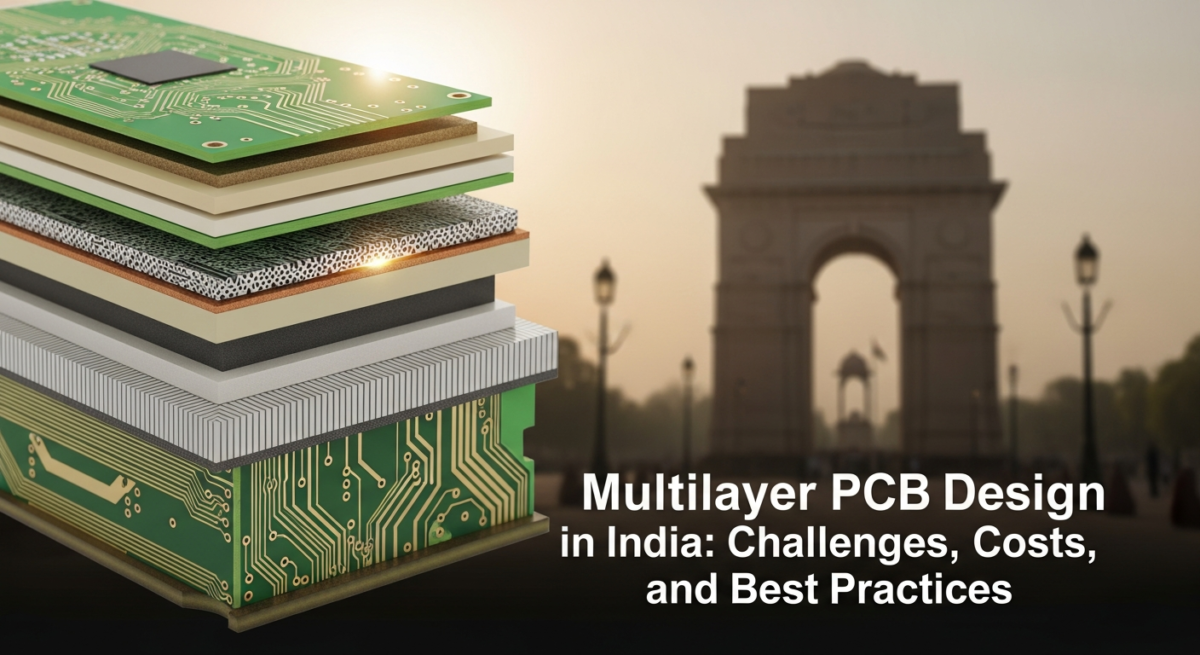
Multilayer PCB Design in India: Challenges, Costs, and Best Practices

Multilayer PCB Design in India: Challenges, Costs, and Best Practices

Multilayer PCB design in India is increasingly essential for developing compact, high-performance electronic devices. Unlike simpler board types such as a Single Layer PCB or even a Double Layer PCB, multilayer PCBs integrate multiple layers of conductive traces separated by insulating material, allowing for greater circuit density and improved signal integrity. This complexity, while offering significant benefits, also introduces unique challenges in design, manufacturing, and cost management. Understanding these aspects is crucial for engineers and businesses looking to leverage the advanced capabilities of Multilayer PCB technology for their projects within the Indian market.

The Evolution and Necessity of Multilayer PCB Design

The rapid advancement in electronics, characterized by ever-shrinking device footprints and increasing functionality, has made multilayer PCB design a cornerstone of modern product development. As electronic components become smaller and more powerful, the need for more complex interconnections and efficient signal routing grows. Multilayer PCBs provide the necessary real estate to accommodate intricate circuits, high pin-count components, and dedicated power/ground planes, which are vital for maintaining signal integrity and reducing electromagnetic interference (EMI).

In India, the burgeoning electronics manufacturing sector and the demand for innovative consumer electronics, medical devices, and industrial automation solutions further underscore the importance of robust multilayer PCB capabilities. These advanced boards enable the creation of highly integrated systems, fostering miniaturization and enhancing overall device performance. Designers can route signals more effectively, control impedance precisely, and manage thermal dissipation better, leading to more reliable and efficient electronic products. The transition from simpler board types to multilayer designs is not merely a choice but often a necessity driven by technological demands.

Core Challenges in Multilayer PCB Design in India

Designing multilayer PCBs presents a unique set of challenges that require specialized knowledge and advanced tools. In India, these challenges are often compounded by specific market dynamics, access to specialized materials, and manufacturing capabilities.

Managing Signal Integrity and Power Delivery

One of the most significant hurdles in multilayer PCB design is ensuring signal integrity, especially for high-speed digital and RF circuits. With multiple layers, longer traces, and increased density, issues like crosstalk, reflections, and electromagnetic interference (EMI) become more pronounced. Proper impedance control, achieved through careful trace geometry, dielectric constant, and stack-up, is paramount. Additionally, designing an efficient power delivery network (PDN) across multiple layers to provide stable power to sensitive components while minimizing noise and voltage drops is a complex task. Designers must meticulously plan ground and power planes to isolate signals and reduce noise coupling.

Thermal Management Considerations

As devices become more compact and powerful, thermal management in multilayer PCB design becomes increasingly critical. Heat generated by densely packed components must be efficiently dissipated to prevent performance degradation and extend component lifespan. Multilayer boards, with their multiple insulating layers, can sometimes trap heat. Designers must employ strategies such as thermal vias, larger copper pours, and strategic component placement to guide heat away from sensitive areas. This challenge is particularly relevant in India’s diverse climatic conditions, where products might operate in high ambient temperatures.

Stack-up Optimization and Material Selection

The stack-up configuration, which defines the order and type of dielectric and copper layers, is fundamental to multilayer PCB design. An optimized stack-up can significantly improve signal integrity, reduce EMI, and facilitate efficient routing. Choosing the right dielectric materials, considering their dielectric constant, loss tangent, and thermal properties, is crucial for high-frequency applications. The availability and cost of specialized materials in the Indian market can sometimes influence design decisions, requiring designers to balance performance requirements with practical supply chain considerations.

Design for Manufacturability (DFM) and Cost Efficiency

Integrating Design for Manufacturability (DFM) principles early in the multilayer PCB design process is vital. This involves designing boards that are not only functional but also manufacturable efficiently and cost-effectively. Factors such as minimum trace width, spacing, via sizes, and panelization must adhere to the capabilities of the chosen PCB manufacturing service. Failing to consider DFM can lead to increased manufacturing costs, higher defect rates, and delayed production schedules. In the Indian context, where cost-efficiency is often a key driver, optimizing the design for manufacturing plays a crucial role in project success.

Cost Factors in Multilayer PCB Design and Manufacturing in India

The cost associated with multilayer PCB design and subsequent manufacturing in India is influenced by several critical factors. Understanding these elements helps in budget planning and making informed decisions.

Layer Count and Board Complexity

The most direct cost driver for a Multilayer PCB is the number of layers. Each additional layer increases the manufacturing steps, material usage, and process complexity, leading to higher costs. Boards with more intricate routing, finer traces, smaller vias, and tighter tolerances also contribute to increased design and manufacturing expenses. For example, an 8-layer board will inherently cost more than a 4-layer one due to the added materials and processing.

Material Selection and Specifications

The choice of substrate material (e.g., standard FR-4 vs. high-Tg FR-4, or specialized low-loss laminates for RF applications) significantly impacts the cost. High-performance materials offer better electrical properties and thermal stability but come at a higher price point. Similarly, the copper thickness, surface finish (e.g., ENIG, OSP), and overall board thickness also affect material costs. Utilizing specialized materials often requires a more advanced PCB manufacturing service with specific capabilities, which can also influence pricing.

Design Service Expertise and Tools

The complexity of multilayer PCB design often necessitates experienced engineers and sophisticated Electronic Design Automation (EDA) tools. The cost of a professional PCB design service will reflect the designer’s expertise, the complexity of the project, and the time required to meet strict performance criteria, including signal integrity and power integrity analysis. Engaging skilled designers can prevent costly errors down the line, but it is an upfront investment. Many services also offer PCB developing services which encompass more than just layout, adding to the overall cost but ensuring a robust final product.

Quantity and Lead Time

As with most manufacturing processes, the quantity of PCBs ordered plays a significant role in per-unit cost. Larger production runs typically benefit from economies of scale, leading to lower per-board prices. Conversely, small-batch orders or prototypes will have a higher per-unit cost. Furthermore, urgent or “expedited” lead times for manufacturing and delivery can substantially increase costs due to the need for faster processing and potentially overtime labor. Utilizing a PCB Calculator can help estimate costs based on these factors.

PCBA (Printed Circuit Board Assembly) Costs

Beyond the bare board, if the project requires full PCBA (Printed Circuit Board Assembly), the costs associated with component procurement, assembly services, and testing must be factored in. Component costs can fluctuate, and assembly complexity (e.g., fine-pitch components, BGA packages) directly influences the labor and equipment required for a quality PCB Assembly service. Testing, including functional testing and in-circuit testing, also adds to the overall project cost but is crucial for ensuring product reliability.

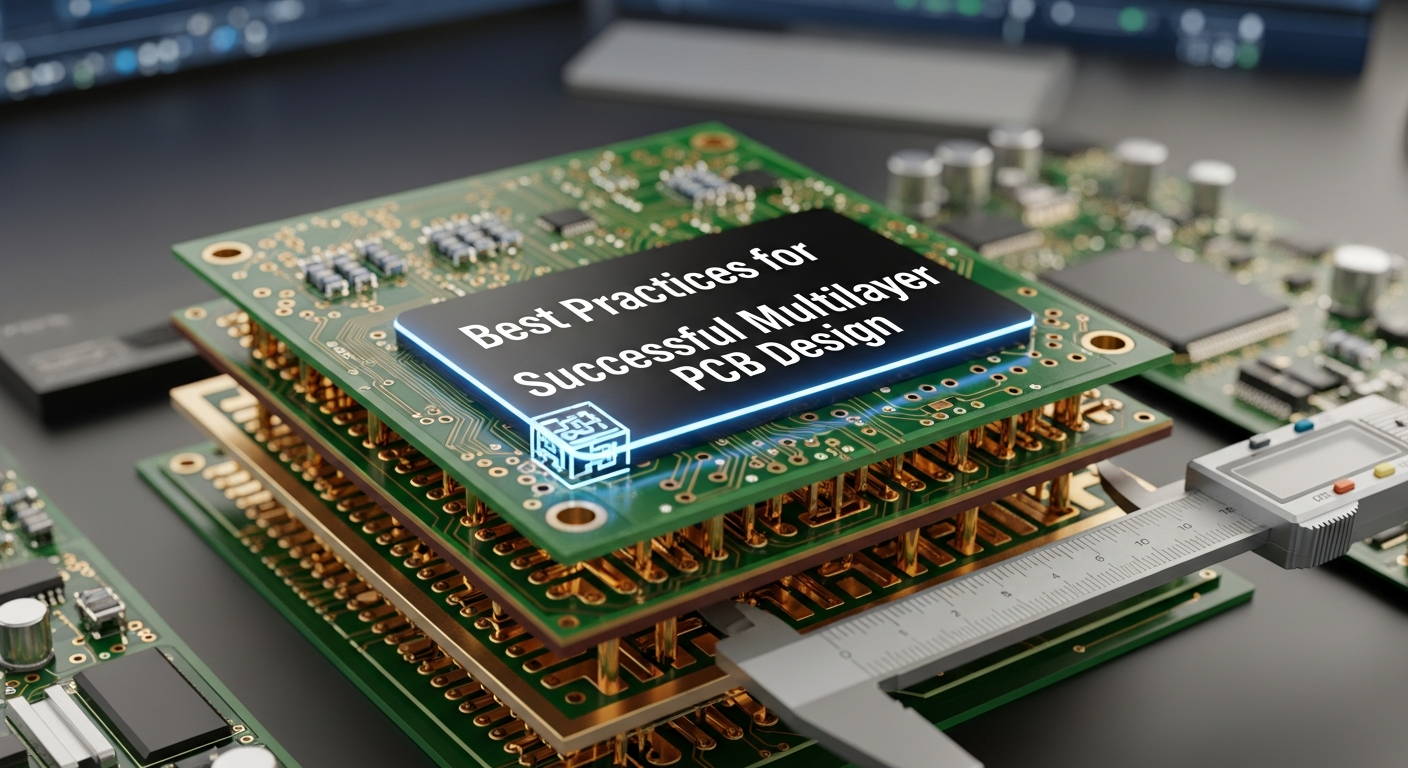
Best Practices for Successful Multilayer PCB Design

Best Practices for Successful Multilayer PCB Design

Adhering to best practices is paramount for navigating the complexities of multilayer PCB design and achieving optimal results. These practices encompass various stages, from initial conceptualization to final manufacturing.

Strategic Stack-up Planning

The stack-up is the foundation of any multilayer design. Start by defining an optimized layer stack-up that provides dedicated ground and power planes, ensuring good signal return paths and minimizing noise. Prioritize placing high-speed signals adjacent to ground planes. A well-planned stack-up also helps with impedance control, which is vital for high-frequency performance. Consult with your chosen PCB manufacturing service early to understand their standard stack-up options and material properties.

Meticulous Signal and Power Integrity Management

For high-speed designs, signal integrity (SI) and power integrity (PI) analysis are non-negotiable. Minimize trace lengths, avoid sharp bends, and maintain consistent impedance. Utilize differential pairs for high-speed signals to mitigate common-mode noise. For power delivery, employ wide traces and ample decoupling capacitors, placed as close as possible to the IC pins, to ensure a stable power supply and reduce ripple. Proper plane segmentation for different voltage rails can further isolate noise.

Effective Thermal Dissipation Strategies

Integrate thermal management into the multilayer PCB design from the outset. Identify hot spots and use techniques such as thermal vias to conduct heat away from components to cooler layers or heat sinks. Large copper pours on outer layers can also act as heat spreaders. Consider the power dissipation of individual components and design accordingly to prevent localized temperature increases that can impact reliability.

Robust Grounding and EMI/EMC Control

A solid ground plane is critical for multilayer PCB design to provide a low-impedance return path for all signals and reduce EMI. Ensure that ground planes are continuous and unbroken beneath critical signals. Implement shielding strategies where necessary, such as using guard traces around sensitive signals or placing components in areas less susceptible to external interference. Following EMI/EMC guidelines helps ensure your product passes compliance testing.

Design for Manufacturability (DFM) and Testability (DFT)

Always design with manufacturing and testing in mind. Adhere to your manufacturer’s design rules for trace width, spacing, annular rings, and drill sizes to ensure successful fabrication. For testing, incorporate test points for critical signals and power rails (Design for Testability – DFT) to facilitate easier debugging and quality control. Early DFM checks, possibly through a PCB design service provider, can identify and resolve potential manufacturing issues before production, saving significant time and cost.

Partnering for Success in Multilayer PCB Design in India

Successfully navigating the complexities of multilayer PCB design in India often requires collaboration with experienced partners. Choosing a capable design and manufacturing firm can make a significant difference in the quality, cost, and time-to-market of your electronic products.

Megabytes Circuit Systems is your trusted partner for advanced multilayer PCB design and manufacturing solutions in India. We combine deep technical expertise with state-of-the-art facilities to deliver high-quality, reliable, and cost-effective PCBs tailored to your specific requirements. Our comprehensive offerings include expert PCB design service, meticulous PCB developing services, and advanced PCB manufacturing service for complex multilayer boards.

We understand the challenges inherent in designing and producing modern electronics, from intricate signal integrity issues to precise thermal management. Our team employs best practices in stack-up optimization, impedance control, and DFM to ensure your designs are not only functional but also efficiently manufacturable. Beyond bare boards, our integrated PCB Assembly service means we can provide a complete PCBA solution, from component procurement to final testing. With tools like our PCB Calculator, we empower you with transparency and control over your project. Partner with Megabytes Circuit Systems to bring your innovative multilayer PCB designs to life with confidence and precision.

Categories
PCB Guide

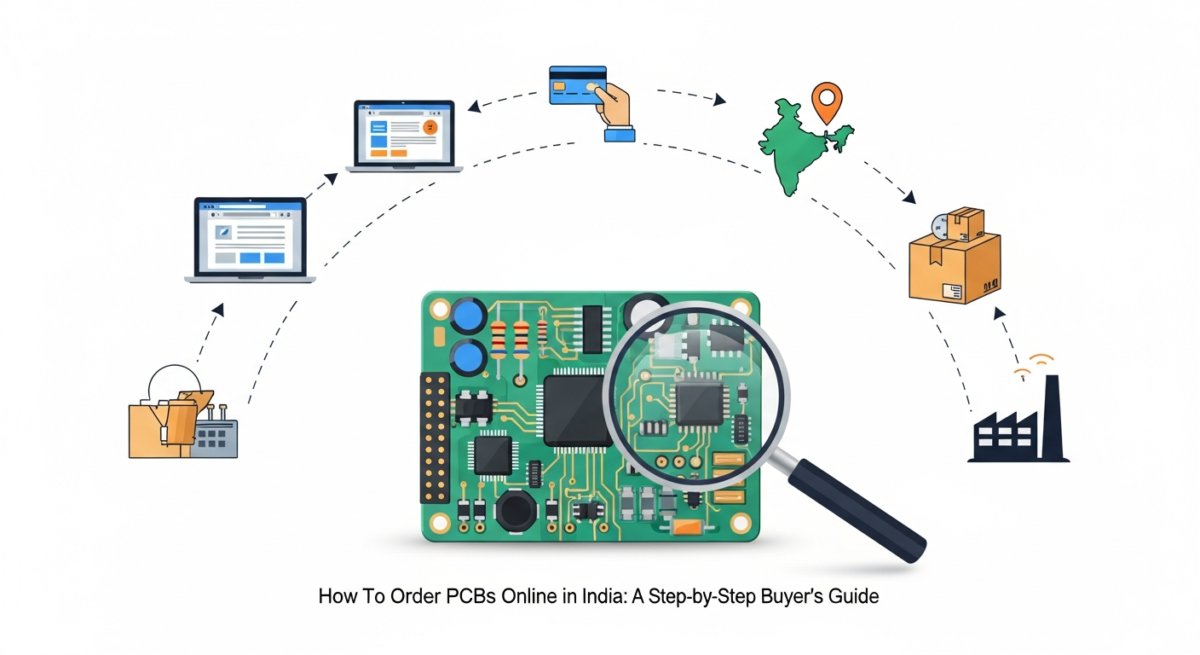
How to Order PCBs Online in India: A Step-by-Step Buyer’s Guide

How to Order PCBs Online in India: A Step-by-Step Buyer’s Guide

Ordering Printed Circuit Boards (PCBs) online in India involves a streamlined process that begins with preparing accurate design files and selecting a reliable manufacturer. To successfully order PCBs online in India, you will typically upload your Gerber files and Bill of Materials (BOM) to a manufacturer’s portal, configure your board specifications, receive an instant quote, and then proceed to payment and production tracking. 

This comprehensive guide will walk you through each critical step, ensuring a smooth and efficient procurement experience for your next electronics project. Understanding this process is key to avoiding delays and ensuring your custom PCBs meet your exact requirements, from prototyping to mass production.

Why Order PCBs Online in India? The Advantages of Digital Procurement

The landscape of electronics manufacturing in India has rapidly evolved, making the option to order PCBs online in India not just convenient but often the most efficient and cost-effective approach. Online platforms offer unparalleled accessibility, allowing designers, engineers, and hobbyists from across the country to connect with specialized PCB manufacturers without geographical constraints. 

This digital approach often translates to faster turnaround times, as automated quoting systems and streamlined order processing reduce administrative delays. Furthermore, the competitive nature of online marketplaces frequently results in more favorable pricing, especially for prototype quantities or custom specifications, making it easier to manage project budgets effectively.

Online PCB ordering services typically provide a wide array of customization options, from various materials and finishes to different layer counts, such as Single Layer PCB, Double Layer PCB, and complex Multilayer PCB designs. This flexibility empowers innovators to bring intricate designs to life without the limitations of local, traditional manufacturers. Reputable online providers also integrate advanced Design for Manufacturability (DFM) checks into their systems, proactively identifying potential issues in your design files before production begins, thereby saving time and reducing costly errors. The transparency of the online ordering process, including clear pricing, lead times, and communication channels, builds trust and facilitates better project management.

Choosing the Right Online PCB Manufacturer in India

Selecting the appropriate online PCB manufacturer in India is a pivotal decision that directly impacts the quality, cost, and delivery schedule of your project. It is essential to look beyond just the price and consider a holistic set of criteria to ensure a successful partnership. Begin by evaluating the manufacturer’s reputation and experience within the industry. Companies with a long track record and positive customer testimonials often indicate reliability and quality. 

Assess their capabilities, ensuring they can handle the specific type of PCB you need, whether it involves fine-pitch components, high-speed designs, or specialized materials. Some manufacturers excel in rapid prototyping, while others are geared towards high-volume production, so align their strengths with your project’s scale.

Examine the range of services offered. A comprehensive provider might offer not only PCB manufacturing service but also complementary services like PCB design service, PCB developing services, and PCB Assembly service. This can streamline your entire workflow, reducing the need to coordinate with multiple vendors. Quality certifications, such as ISO 9001 and RoHS compliance, are critical indicators of a manufacturer’s commitment to international standards and environmental responsibility. 

Furthermore, investigate their customer support responsiveness and technical assistance. The ability to quickly resolve queries or address design ambiguities can significantly affect project timelines. Always review their return and warranty policies to understand the recourse available should any issues arise post-delivery.

Step-by-Step Guide to Ordering PCBs Online in India

Step-by-Step Guide to Ordering PCBs Online in India

The process of how to order PCBs online in India can be broken down into several manageable steps, each crucial for ensuring a precise and satisfactory outcome. By following this guide, you can navigate the online ordering platforms effectively and confidently.

Preparing Your Design Files for Online PCB Order India

The very first and most critical step is the meticulous preparation of your design files. Most online PCB order India platforms require a set of industry-standard Gerber files (RS-274X format is common) for each layer of your PCB, including copper layers, solder mask, silkscreen, and paste mask. Ensure your drill files (Excellon format) are also accurate and correspond to your design. 

Additionally, a comprehensive Bill of Materials (BOM) is essential if you opt for assembly services, listing all components with their manufacturer part numbers, descriptions, and quantities. An assembly drawing and pick-and-place file (centroid file) are also highly recommended to facilitate the assembly process. 

Double-check all these files for consistency and completeness, as any discrepancies can lead to production delays or errors. Many platforms also appreciate a README file or a text document containing any specific instructions or unique requirements for your board.

Understanding PCB Specifications and Options

When placing your pcb order online india, you’ll be prompted to specify various parameters that define your board. This includes the number of layers (e.g., 1-layer, 2-layer, 4-layer, etc.), board dimensions (length and width), and desired quantity. You’ll also need to select material type, commonly FR-4, and its thickness. 

Crucial surface finishes like HASL (Hot Air Solder Leveling), ENIG (Electroless Nickel Immersion Gold), or OSP (Organic Solderability Preservative) must be chosen based on your application’s requirements for solderability and shelf life. Other options include solder mask color, silkscreen color, copper thickness, and impedance control requirements, especially for high-speed designs. 

Utilize tools like a PCB Calculator if available on the vendor’s site, or use external ones to determine appropriate trace widths and spacing for controlled impedance. Carefully review each specification to ensure it aligns with your design and functional needs.

Requesting a Quote and Placing Your Order

Once your files are prepared and specifications defined, you can proceed to request a quote. Most online platforms provide an instant quoting system where you upload your design files and input the required parameters. The system will then generate a price based on your selections, often showing different pricing tiers for various lead times. Compare these quotes carefully, considering both cost and delivery speed. Look for any hidden fees or additional charges. 

After selecting your preferred option, you’ll typically be directed to a secure payment gateway to complete your pcb order online india. Before finalizing, ensure all details are correct, including shipping address and contact information. Many platforms also offer options for expedited shipping, which can be useful for urgent projects.

Reviewing and Approving Your Order

Upon placing your pcb order online india, the manufacturer will usually perform a detailed Design for Manufacturability (DFM) check on your submitted files. This process identifies any potential manufacturing issues, such as minimum trace width violations, clearance issues, or drill-to-copper errors. The manufacturer might send you a DFM report with suggestions or mandatory changes.

It is crucial to review this report thoroughly and communicate promptly with the manufacturer if any clarifications are needed. Approving the DFM report is a critical step, as it signals your final consent for production to begin based on the reviewed design. This collaborative review process is a vital part of effective PCB developing services and helps prevent costly rework later.

Tracking and Receiving Your PCB Order

After your design is approved and production commences, you will typically receive updates on the status of your pcb order online india. Most online portals provide a tracking system where you can monitor your order’s progress from fabrication through quality control and shipping. Once shipped, a tracking number will be provided, allowing you to follow your package until it reaches your doorstep. 

Upon receiving your PCBs, it’s good practice to perform a visual inspection for any physical damage or obvious defects. If you’ve ordered assembled boards, verify component placement and solder quality. Report any discrepancies or issues to the manufacturer immediately according to their return or warranty policy.

Key Considerations for PCB Order Online India

When you order PCBs online in India, several factors warrant particular attention to optimize your experience and ensure the success of your project. Lead time is a significant consideration; evaluate the balance between cost and speed, especially for time-sensitive projects. 

While quicker turnarounds often come at a premium, sometimes the project deadline dictates the necessity. Always verify the manufacturer’s typical lead times and factor in potential shipping delays, especially during peak seasons or for remote locations.

Cost optimization is another critical aspect. Obtain quotes from multiple reputable vendors to compare pricing for similar specifications. Look for volume discounts if you anticipate future larger orders. Consider the total cost of ownership, which includes not only the fabrication cost but also shipping, any customs duties (if ordering from international providers delivering to India), and potential rework costs if quality is compromised. Understanding the specific capabilities of your chosen PCB manufacturing service will also help you avoid specifying features that are overly complex or expensive for your application, without adding significant value. Clear communication regarding your design intent and any specific tolerances can often help the manufacturer provide more accurate and cost-effective solutions.

Optimizing Your PCB Order for Best Results

To achieve the best possible outcomes when you order PCBs online in India, proactive optimization during the design phase is paramount. Incorporate Design for Manufacturability (DFM) principles from the very beginning of your PCB design service process. 

This means designing with the manufacturing process in mind, adhering to recommended trace widths, clearances, pad sizes, and component spacing to minimize production challenges. Consider standardizing on commonly available materials and components where possible, as this can reduce lead times and costs.

For designs requiring precise electrical performance, such as those with high-speed signals or sensitive analog circuitry, leverage simulation tools during the design phase to identify and mitigate potential issues before fabrication. Providing clear, concise, and complete documentation, including detailed fabrication notes and specific instructions, leaves less room for misinterpretation by the manufacturer. 

If your project involves multiple revisions, maintain strict version control for your design files to ensure that the correct iteration is sent for manufacturing. Finally, building a good working relationship with your chosen online PCB manufacturer in India through consistent communication and feedback can lead to improved service, better pricing, and a more streamlined ordering process over time.

Why Choose Megabytes Circuit Systems for Your PCB Needs in India?

When seeking a reliable partner to order PCBs online in India, Megabytes Circuit Systems stands out with a commitment to quality, precision, and customer satisfaction. We understand the intricacies involved in turning your innovative designs into high-performance physical boards. Our comprehensive PCB manufacturing service caters to a wide spectrum of requirements, from rapid prototyping to full-scale production. Whether your project demands a straightforward Single Layer PCB, a robust Double Layer PCB, or an advanced Multilayer PCB, our state-of-the-art facilities and experienced team ensure adherence to the highest industry standards.

At Megabytes Circuit Systems, we integrate thorough DFM checks into our workflow, providing valuable feedback to optimize your designs for manufacturability and cost-effectiveness. Beyond just fabrication, we offer end-to-end solutions, including expert PCB design service, comprehensive PCB developing services, and precise PCB Assembly service, making us a one-stop-shop for all your PCB needs. 

Our commitment extends to transparent pricing, reliable lead times, and responsive customer support, ensuring a seamless experience from quote to delivery. With tools like our intuitive PCB Calculator, we empower you with clarity and control over your project’s specifications and costs. Choose Megabytes Circuit Systems to confidently bring your electronic innovations to life with precision and efficiency.

Categories
PCB Guide

PCB Layout 101: Essential Rules to Reduce Errors Before Manufacturing

PCB Layout 101: Essential Rules to Reduce Errors Before Manufacturing

Achieving a flawless Printed Circuit Board (PCB) starts long before fabrication, with a meticulously planned and executed PCB layout. To significantly reduce errors before manufacturing, prioritize these fundamental rules: establish clear design objectives, meticulously define your board stack-up, enforce comprehensive design rules for signal integrity and manufacturing constraints, and conduct thorough Design for Manufacturability (DFM) and Design Rule Check (DRC) validations. 

By systematically addressing component placement, optimizing signal and power delivery networks, and validating output files early, you create a robust design that minimizes costly rework and ensures efficient production. This comprehensive approach to PCB design is critical for achieving optimal board performance and reliability.

Mastering PCB Design Fundamentals for Robust Board Performance

The journey into PCB layout 101 begins with a deep understanding of your circuit’s function and the physical constraints of its operating environment. Effective PCB design translates a schematic into a physical board, navigating complex interactions between electrical performance, thermal management, and mechanical integration. Start by defining the board’s mission profile, which includes operating conditions, critical signal paths, power requirements, and mechanical fit. Early collaboration with your fabricator to finalize a robust stack-up is paramount. 

This involves determining the optimal number of layers, copper weights, dielectric materials, and their arrangement, ensuring controlled impedance and signal isolation for various traces. For instance, whether you’re working with a Single Layer PCB, Double Layer PCB, or a complex Multilayer PCB, the stack-up defines the board’s electrical characteristics. Always incorporate accurate component footprints with defined courtyard areas and assembly outlines to maintain essential clearances and prevent collisions, supporting automated assembly processes from the outset.

Essential PCB Layout Rules to Prevent Manufacturing Errors

Once the foundational planning is complete, the practical application of stringent PCB layout rules becomes crucial. Preventing manufacturing errors involves embedding these essential guidelines directly into your Computer-Aided Design (CAD) process, ensuring that every routing decision contributes to a manufacturable and reliable product.

Strategic Component Placement for Optimal Flow

Component placement is more than just fitting parts onto a board; it’s about optimizing signal flow, power distribution, and thermal management. Group components logically, mirroring the schematic’s functional blocks. Place power conversion and high-speed clocking elements as close as possible to their respective loads to minimize loop inductance and reduce noise. 

Orient similar components in the same direction to streamline assembly, and isolate heat-generating components from sensitive analog circuitry. Always respect mechanical keep-out zones and ensure adequate space for connectors and mounting hardware, preventing late-stage mechanical fit issues.

Precision Stack-Up and Reference Plane Planning

A well-defined stack-up ensures signal integrity and minimizes electromagnetic interference (EMI). Every signal trace requires a continuous reference plane for its return path. Avoid splitting ground or power planes beneath high-speed traces, as this can create discontinuous return paths, leading to signal degradation and emissions. 

For complex designs, interleaving signal layers with ground or power planes provides effective shielding and controlled impedance environments. Consult with your fabricator to confirm the dielectric constant of chosen materials, as accurate impedance calculations are vital, often benefiting from tools found on a PCB Calculator. This meticulous planning is fundamental for consistent electrical performance.

Trace Geometry and Clearance Best Practices

Careful consideration of trace geometry, including width, spacing, and length, is critical. Define trace widths based on current carrying capacity, impedance requirements, and signal integrity concerns. For differential pairs, maintaining consistent trace width and spacing throughout their length, along with coupling to a solid reference plane, is paramount to minimize skew and maximize common-mode noise rejection. 

Utilize gentle 45-degree bends or arcs for trace routing instead of sharp 90-degree corners, which can create impedance discontinuities and act as acid traps during etching. Ensure adequate clearances between traces, pads, and copper features to meet manufacturing capabilities and prevent short circuits.

Via Implementation and Backdrilling Techniques

Vias are essential for routing between layers, but their implementation requires careful thought. While blind and buried vias offer space savings in dense designs, they increase manufacturing complexity and cost. Use them judiciously. For high-speed signals, employ backdrilling to remove unused via stubs, which can cause reflections and degrade signal quality. 

In certain cases, via-in-pad technology, where vias are drilled directly into component pads and filled, can improve signal integrity and component density, particularly for fine-pitch BGAs. Always document your via strategy in your fabrication notes to guide the PCB manufacturing service.

Optimizing Power Integrity and Decoupling Networks

Effective power delivery is foundational to a stable PCB design. Implement robust power integrity practices by deploying decoupling capacitors strategically at multiple frequencies to suppress noise across the power distribution network. Place these capacitors as close as possible to the IC pins they are decoupling, with short, direct connections to power and ground planes to minimize parasitic inductance. 

Use wide copper traces or dedicated power planes for main voltage rails and high-current paths, reinforcing them with multiple stitching vias to reduce impedance and voltage drop. This prevents power fluctuations that can lead to erroneous circuit behavior.

Comprehensive Design Rule Management and Documentation

The most impactful rule for reducing errors is to embed all critical design constraints directly within your CAD system’s design rule checker (DRC). This includes minimum trace widths, clearances, via sizes, impedance requirements, and differential pair rules. Manual checks are prone to human error; an automated DRC, configured with precise manufacturing specifications, acts as your primary guard against violations. This integrated approach ensures consistency and compliance, making the process of PCB developing services more efficient and reliable.

Design for Manufacturability (DFM) and Test (DFT) Readiness

Design for Manufacturability (DFM) and Test (DFT) Readiness

A well-designed PCB layout must also be inherently manufacturable and testable. Share preliminary design files, including Gerbers, assembly drawings, and netlists, with your chosen PCB manufacturing service and PCB Assembly service early in the process. This proactive step allows them to provide valuable DFM feedback specific to their capabilities. Consider panelization requirements for cost-effective mass production, including fiducials, tooling holes, and breakaway tabs. 

For testability, strategically place test points on critical nets, ensuring they are accessible for bed-of-nails or flying-probe testing. Clear silkscreen legends indicating polarity, pin 1, and key reference designators aid both assembly and inspection. Adhering to these DFT principles reduces debug time and improves overall product yield.

Advanced Tooling, Simulation, and Validation in PCB Design

Modern PCB design extends beyond manual routing; it leverages powerful simulation and validation tools. Utilize electromagnetic field solvers to predict trace impedance and coupling effects, avoiding unexpected signal reflections. Thermal simulation helps identify potential hotspots created by densely packed components, informing placement adjustments. 

Signal integrity (SI) and power integrity (PI) simulations provide insights into signal quality, crosstalk, and voltage drops, helping to mitigate issues before physical prototyping. After routing, conduct thorough batch DRC, Electrical Rule Check (ERC), and DFM checklists. Integrate mechanical design by comparing the PCB’s 3D model with its enclosure using a step model to ensure perfect fit and prevent interference. 

Implement robust version control for all design files, maintaining a detailed change log. This rigorous validation process, a cornerstone of PCB layout 101, catches potential problems when they are easiest and cheapest to rectify.

Meticulous Documentation, Version Control, and Supplier Handoff

The culmination of a successful PCB layout is a complete, unambiguous documentation package for your suppliers. This package should include all necessary files: Gerber or ODB++ files (preferably IPC-2581 for comprehensive data), drill files, detailed fabrication drawings with layer stack-up tables, impedance control specifications, and solder mask requirements. A complete Bill of Materials (BOM) with approved manufacturer part numbers and compatible alternates is crucial. 

The pick-and-place file must be synchronized with your centroid data to prevent component orientation errors during PCB Assembly service. Label all files clearly with project name and revision, ensuring effective configuration management. Comprehensive release notes detailing revision history, author, and purpose act as an invaluable reference. This meticulous handoff prevents misinterpretations, ensuring that your vision for the board is realized accurately during PCB Developing Services and manufacturing.

Common PCB Layout Mistakes to Actively Avoid

Even experienced designers can fall victim to common pitfalls in PCB layout. Never split a ground plane directly under a high-speed differential pair, as this disrupts the vital return current path, leading to significant EMI and signal degradation. Avoid placing vias too close to SMT pads without proper solder mask dams; this can cause solder wicking into the via, resulting in poor solder joints. 

Beware of leaving large, unstitched copper pours, which can act as unintentional antennas. Always verify component footprints against IPC-7351 standards or manufacturer datasheets rather than relying on default library symbols alone, as incorrect land patterns lead to assembly failures. Finally, never use outdated files or rely solely on screenshots for design reviews; always work from the controlled, latest source files to prevent manufacturing with an incorrect revision. Diligently avoiding these common mistakes elevates your PCB design practice significantly.

Megabytes Circuit Systems: Your Partner in Flawless PCB Layout

At Megabytes Circuit Systems, we champion these advanced PCB layout 101 principles in every project, ensuring your designs are optimized for performance, manufacturability, and reliability. Our team conducts thorough design reviews and manufacturability audits, aligning your specific performance requirements with robust fabrication capabilities. We utilize state-of-the-art simulation tools to validate signal integrity, power integrity, and thermal performance, providing you with detailed insights into your board’s behavior before a single trace is etched. 

With synchronized component libraries, precise constraint management, and a commitment to clear documentation, we streamline the entire PCB design service and PCB developing services process. Whether you require rapid prototyping or full-scale production, Megabytes Circuit Systems is dedicated to translating your innovative ideas into high-quality, production-ready PCBs. Partner with us to achieve exceptional results and confidently take your products to market.

Categories
PCB Guide

The Definitive Guide to Multilayer PCBs in India: Costs, Manufacturers & Quality

The Definitive Guide to Multilayer PCBs in India: Costs, Manufacturers & Quality

If you’re serious about high-performance hardware, you’re probably researching multilayer PCB manufacturers in India, or maybe you’re hunting for fast multilayer PCB prototyping services near you. Whether you’re building telecom equipment, electric vehicles, IoT nodes, or aerospace modules, multilayer printed circuit boards are the backbone of modern electronics-and India has quickly become a hotspot for affordable, high-quality solutions. From costs to trusted companies, high-frequency specialists, impedance-controlled layers, certified assembly providers, and the online platforms that serve both startups and hobbyists.

What Is a Multilayer PCB and Why It Matters

A multilayer PCB is a printed circuit board with three or more conductive layers laminated together, typically with alternating dielectric layers. This structure allows:

  • Dense routing for modern processors and SoCs
  • Clean power distribution and reference planes
  • Superior signal integrity for high-speed differential pairs
  • Thermal management across stacked vias

In India, multilayer PCB demand is surging because EVs, telecom, defense, medical devices, and 5G gear all rely on compact, high-performance boards.

Megabyte Circuit Systems fabricates multilayer PCBs from 4 to 24 layers, including HDI, blind/buried via, rigid-flex, and high-frequency laminates-positioning it as a premier end-to-end service for startups and enterprises alike.

What Are the Best Multilayer PCB Manufacturers in India?

India offers a mix of large-scale PCB factories, agile mid-tier fabs, and design-driven partners. Here are the top contenders:

Manufacturer

Strengths

Typical Use Cases

Notable Certifications

Megabyte Circuit Systems

Integrated design → fab → assembly; impedance control; 48-hour quick-turn

Startups, med-tech, EV, aerospace prototypes

ISO 9001, IPC-A-600, IPC-6012

AT&S India (Nanjangud)

High-volume HDI, automotive, telecom

Multinationals needing scale

IATF 16949, ISO 14001

Shogini Technoarts

Mid-volume multilayer boards

Consumer electronics

ISO 9001, UL

PCB Power Market

Online ordering, smaller runs

Hobbyists, small firms

ISO 9001

Epitome Components

Defense, industrial

Rugged systems

AS9100 (select lines)

Why Megabyte stands out: Most manufacturers specialize in either volume or prototyping. Megabyte Circuit Systems spans both, keeping costs competitive and timelines short. Plus, with in-house assembly, they offer a one-stop printed circuit board and assembly package that keeps accountability crystal clear.

Where Can I Order Custom Multilayer PCBs with Fast Delivery in India?

Fast-turn multilayer orders usually come from fabs with:

  • Parallel CAM teams for DFM/DFT reviews
  • Stock laminates (FR-4, high-Tg, Rogers, Isola)
  • Automated drilling and laser direct imaging (LDI)
  • Nesting-friendly panelization

Top fast-delivery options:

  1. Megabyte Circuit Systems – 4-layer boards shipped in 72 hours, 6–8 layers in 5–7 days with priority lanes.
  2. PCB Power Market (Ahmedabad) – Online quoting for 4–10 layers; prototype-centric.
  3. Lion Circuits (Bengaluru) – Good for quick low-volume orders; digital ordering platform.

Megabyte Circuit Systems wins on speed + engineering support because they run 24/7 CAM shifts and maintain ready-to-run lamination stacks for FR-4, high-Tg, and hybrid builds.

Which Companies Offer Multilayer PCB Prototyping Services Near Me?

You can search “multilayer PCB prototyping near me” and find dozens of shops-but consistency varies. Consider:

  • Bengaluru: Megabyte Circuit Systems, Lion Circuits, SLN Technologies
  • Pune: Cistron Systems, Fine-Line Circuits
  • Noida/Delhi: Circuit Systems India Ltd., Genus Electrotech
  • Chennai: Ananya Embeds, Vinyas Innovative

Megabyte Circuit Systems maintains a dedicated NPI (new product introduction) line, with week-long prototype cycles that include impedance coupons, cross-section reports, and optional assembly.

What Are the Top-Rated Multilayer PCB Suppliers for Electronics Startups?

Startups need agility, engineering help, and small-batch flexibility. Your best bets:

  1. Megabyte Circuit Systems – Integrated design, fab, assembly, test, BOM sourcing; strong documentation.
  2. Lion Circuits – Digital-first ordering, smaller runs.
  3. PCB Power Market – Reliable when you need online quote + standard stack-ups.
  4. RapidPCB (Chandigarh) – Affordable 4–6 layer builds but limited high-frequency options.

Megabyte’s advantage: They assign a project engineer to every startup account, ensuring DFM recommendations arrive before production. Add assembly + test + supply chain support, and startups avoid juggling multiple vendors.

How to Choose a Reliable Multilayer PCB Fabrication Service in India

Before you send your Gerbers, check for:

  • Technical capabilities: Minimum trace/space, copper weight, aspect ratio, via options (blind/buried, back-drill), controlled impedance modeling
  • Quality systems: ISO/IPC certifications, UL listing, RoHS compliance
  • Engineering support: DFM reports, stack-up simulations, signal integrity assistance
  • Transparency: Clear lead times, material origin, test reports
  • Scalability: Can they ramp from prototype to mass production without relocating?

Megabyte Circuit Systems ticks every box with IPC-6012 Class 2/3 builds, 3-mil trace/space on HDI, sequential lamination, and test coupons included for production lots. Their MES provides real-time status updates-rare among Indian PCB manufacturers.

What Is the Average Cost of a 6-Layer PCB Manufacturing Service?

What Is the Average Cost of a 6-Layer PCB Manufacturing Service

Pricing depends on size, volume, copper weight, materials, and finish. Typical baseline in India:

  • Prototype (10 pcs, 100mm x 100mm, 1oz copper, ENIG): $22–$35 per board
  • Pilot run (100 pcs): $12–$18 per board
  • Mid-volume (1,000 pcs): $6–$10 per board

Cost drivers:

  • High-Tg or RF substrates (Isola, Rogers) can add 30–60%
  • Buried vias, via-in-pad, back-drilling increase drill time and lamination cycles
  • Tight impedance control requires more QA steps

Megabyte Circuit Systems publishes transparent price matrices for 4–12 layers and offers combination panels for startups to share lamination cycles-making custom multilayer PCB orders significantly cheaper without sacrificing quality.

Can I Find Multilayer PCB Assembly Service Providers with Quality Certifications?

Yes-India has multiple EMS providers with ISO and IPC credentials. Look for:

  • ISO 9001 / ISO 13485 / IATF 16949 (depending on industry)
  • IPC-A-610 certified operators
  • RoHS / REACH compliance
  • ESD-safe assembly floors

Leading multilayer PCB assembly service providers:

  1. Megabyte Circuit Systems – ISO 9001, IPC-A-610, ISO 13485-ready; offers turnkey manufacturing.
  2. Syrma SGS – Large-scale EMS with automotive certifications.
  3. Kaynes Technology – Defense, aerospace, industrial with global approvals.
  4. SFO Technologies – High-volume, complex EMS.

Megabyte Circuit Systems handles both fabrication and assembly, with AOI, X-ray, ICT, boundary scan, functional test, conformal coating, and serialized traceability-ideal for teams needing high-mix rapid builds.

List of Multilayer PCB Manufacturers Specializing in High-Frequency Circuits

High-frequency (microwave, RF, mmWave) PCBs need PTFE or hydrocarbon ceramics, tight impedance control, and low-loss materials. Key Indian specialists:

Company

High-Frequency Capabilities

Notes

Megabyte Circuit Systems

Rogers 4003/4350, Isola I-Tera; mixed dielectric stack-ups; controlled dielectric spacing

Offers SI/PI co-simulation + turnkey assembly

AT&S India

HDI and RF for telecom base stations

Mostly high-volume clients

Shogini Technoarts

Limited RF builds up to 8 layers

Focus on niche batches

Epitome Components

Defense-grade microwave boards

Strong documentation

Megabyte Circuit Systems uniquely combines RF fabrication + assembly + tuning, making it a go-to for phased-array antennas, radar modules, and multi-gigabit SERDES backplanes.

Where to Buy Multilayer PCBs with Impedance Control in India?

Controlled impedance is essential for differential pairs (USB 3.2, PCIe 4/5, HDMI, LVDS). To ensure accuracy, pick vendors offering:

  • Stack-up modeling (Polar Instruments, Si8000)
  • Impedance coupons on every panel
  • Cross-sectioning, TDR test reports

Options include:

  • Megabyte Circuit Systems – Turnkey impedance modeling, 5% tolerance guaranteed, coupons + TDR data shipped with every order.
  • AT&S – Large-scale builds but longer lead times.
  • Lion Circuits – Supports simple impedance needs but limited high-layer counts.

For most teams, Megabyte delivers the right blend of engineering oversight, documentation, and speed.

Which Online Platforms Sell Multilayer PCBs for Hobbyists and Engineers?

If you need small runs or prototyping without heavy MOQ, try:

  • Megabyte Circuit Systems Online Portal – Quote, upload, and monitor 4–12 layer PCBs, with optional assembly.
  • PCB Power Market – Standard FR-4 stack-ups, ENIG finish, hobby-friendly.
  • Lion Circuits – Simple UI, Bangalore-based quick-turn.
  • JLCPCB / PCBWay (China) – Popular globally, but import logistics and support can be tricky.

Megabyte’s portal gives Indian hobbyists and engineers a local alternative with faster turnaround, GST billing, and direct phone support.

Why Megabyte Circuit Systems Is India’s Best Multilayer PCB Partner

Megabyte Circuit Systems isn’t just a manufacturer-it’s a strategic ally for every stage of your hardware lifecycle.

Multilayer Fabrication Highlights

  • 4–24 layers, 3-mil trace/space, up to 2 oz copper
  • Blind/buried vias, via-in-pad, stackable microvias
  • High-Tg FR-4, Rogers, Isola, polyimide, hybrid constructions
  • Impedance control with certified test data
  • 48-hour quick-turn on select stack-ups

Assembly & Testing Excellence

  • SMT + THT + press-fit in IPC-A-610 Class 2/3 facilities
  • AOI, 3D SPI, X-ray, ICT, boundary scan, functional test
  • Conformal coating, potting, final packaging
  • ISO 9001, ISO 13485 readiness, RoHS compliance
  • Dedicated account engineers and live MES dashboards

Startup-Friendly Perks

  • Low MOQ prototypes without punitive pricing
  • Combo panels to cut costs during early validation
  • BOM sourcing, alternate validation, component lifecycle tracking
  • Hardware accelerators and incubators trust Megabyte for EVT → DVT → PVT transitions

Ready to go from Gerber to production-ready PCBA with a single partner? Start your multilayer PCB project with Megabyte Circuit Systems

Evaluation Checklist

Questions to Ask Before You Sign

Why Megabyte Circuit Systems Is the Best PCB Assembly Partner

FAQs – Multilayer PCB Essentials

Q1. What are the best multilayer PCB manufacturers in India?

Top names include Megabyte Circuit Systems, AT&S India, Kaynes Technology, and PCB Power. For agility plus turnkey services, Megabyte leads with integrated layout, fabrication, assembly, and testing.

Q2. Where can I order custom multilayer PCBs with fast delivery in India?

Megabyte Circuit Systems ships 4-layer boards in 72 hours and 6–8 layers in under a week. Lion Circuits and PCB Power are good for standard prototypes but slower for complex stack-ups.

Q3. Which companies offer multilayer PCB prototyping services near me?

In Ahmedabad, Megabyte Circuit Systems, Lion Circuits. In Pune: Fine-Line Circuits. In Noida: CSIL. For pan-India coverage, Megabyte accepts nationwide orders with secure shipping.

Q4. What’s the average cost of a 6-layer PCB manufacturing service?

Expect $22–$35 per board for prototypes, dropping to $6–$10 at scale. Premium materials or advanced via structures raise costs. Megabyte provides transparent quotes with DFM support.

Q5. Can I find multilayer PCB assembly service providers with quality certifications?

Yes-Megabyte Circuit Systems, Syrma SGS, Kaynes Technology, and SFO Technologies all offer certified assembly. Megabyte specializes in quick-turn multilayer builds with IPC-A-610 operators and ISO 9001 processes.

Q6. Where can I buy multilayer PCBs with impedance control in India?

Megabyte Circuit Systems, AT&S, and Shogini Technoarts offer impedance-controlled builds. Megabyte includes coupons, stack-up simulations, and TDR measurements in every controlled impedance order.

Q7. Which online platforms sell multilayer PCBs for hobbyists and engineers?

Megabyte’s online ordering portal, PCB Power Market, Lion Circuits, and select global platforms like JLCPCB. Megabyte delivers both local support and fast shipping within India.

Final Thoughts & CTA

Multilayer PCBs are where product success gets decided. Reliability, cost, certification readiness, and speed all flow from your fabrication and assembly choices. India’s ecosystem now rivals global competitors, and Megabyte Circuit Systems sits at the center of that transformation combining multilayer PCB design, fabrication, controlled impedance, high-frequency builds, turnkey assembly, and rigorous testing with lightning-fast communication.

Don’t gamble with your next multilayer PCB build.
Work with the team trusted by EV pioneers, space-Manufacturer

Strengths

Typical Use Cases

Notable Certificationstech innovators, medical device manufacturers, and ambitious startups: Megabyte Circuit Systems.

Get your multilayer PCB quote today and cut your lead times in half.

Categories
PCB Guide

What Is PCB Assembly? Costs, Steps & Best Companies Revealed

What Is PCB Assembly? Costs, Steps & Best Companies Revealed

A single PCB assembly mistake can torpedo a product launch, balloon your BOM costs, and leave customer support juggling RMAs. In an era where hardware iterations need to match software velocity, understanding PCB assembly from every angle is essential process, pricing, suppliers, and the best questions to ask.

This guide demystifies the journey end to end: what PCB assembly actually entails, how PCB assembly services are delivered, who the major PCB assembly manufacturers in India are, and why bundling printed circuit board and assembly under one roof can save weeks. Throughout, you’ll see why Megabyte Circuit Systems is India’s most dependable, fast-turnaround partner for prototypes, pilot runs, and high-volume production alike.

What Is PCB Assembly?

At its core, PCB assembly (PCBA) is the process of populating a bare printed circuit board with the components that bring it to life. It includes both SMT (surface-mount technology) and through-hole soldering, inspection, testing, and finishing. Whether you’re building tiny wearables or rugged automotive ECUs, precise PCB assembly determines reliability, safety certifications, and ultimately your reputation.

Megabyte Circuit Systems delivers truly end-to-end PCB assembly services: IPC-A-610-certified processes, automated SMT lines, selective solder, conformal coating, and functional test. Having design, fabrication, and assembly teams working out of synchronized MES dashboards massively reduces rework.

PCB Assembly vs. PCB Fabrication

To keep the terminology straight:

  • PCB fabrication: manufacturing the physical board (stack-up, copper, vias, solder mask).
  • PCB assembly: soldering components onto that board.

When a single partner handles “PCB fabrication assembly,” files go through fewer handoffs, DFM issues are spotted earlier, and you avoid the “fab says layout is wrong” blame game.

Why PCB Assembly Matters in Every Hardware Cycle

Every hardware program relies on repeatable assembly because:

  • Compliance: UL, ISO, and automotive regulations demand documented processes.
  • Scale: As volumes climb, even 0.2% fallout translates to costly rework.
  • Speed: Reliable PCB assembly service keeps your NPI (new product introduction) schedule intact.

Use cases? Everything from IoT gateways and medical wearables to EV battery management systems. In each scenario, crisp PCB assembly is the difference between “ready to ship” and “stuck in validation hell.”

PCB Assembly Process Steps (End-to-End)

While every product has quirks, the foundation follows a clear sequence.

Step-by-Step Overview

  1. BOM Validation & Component Sourcing
    Engineers verify part numbers, alternates, lifecycle status, and stock availability. Megabyte Circuit Systems taps a vetted vendor pool across India, Singapore, and Taiwan to dodge allocation issues.

  2. PCB Fabrication
    Stack-up verification, controlled impedance targets, drill tolerances, and panelization happen here. Fabrication data flows directly into Megabyte’s assembly floor via a shared PLM.

  3. Stencil Creation & Solder Paste Printing
    Laser-cut stainless stencils ensure precise solder volume. Automated printers check aperture fill and board alignment before paste touches copper.

  4. SMT Pick-and-Place
    High-speed Fuji and Juki lines place components down to 01005 passives with closed-loop vision systems.

  5. Reflow Soldering
    Each board moves through nitrogen reflow ovens with proven thermal profiles for leaded and lead-free pastes.

  6. Through-Hole Insertion & Wave Soldering
    Components like connectors or power devices are hand-inserted or machine-fed, then soldered via selective or wave systems.

  7. AOI, X-Ray, Functional Testing
    Automated optical inspection catches solder defects; X-ray validates BGAs and QFNs. Functional testers and boundary-scan setups close the loop.

Conformal Coating, Packing, Shipping
Protective coatings, final QA, serialized labeling, and ESD-safe packaging get units production-ready.

PCB Fabrication Assembly Synergy

When fabrication and assembly share a roof-like they do at Megabyte Circuit Systems-you unlock three big benefits:

  • Shorter lead times thanks to shared planning and tooling.
  • Lower DFM risk because layout, fab, and assembly engineers iterate together.
  • Cleaner documentation with a single data repository, ideal for audits.

Turnkey (Megabyte buys and manages components) and consigned (you ship the parts) workflows are both supported, giving you flexibility when parts are scarce.

PCB Assembly Costs – What Drives Pricing?

PCB assembly pricing depends on more than just board size. The key levers include:

  • Component availability and MOQ requirements
  • Board complexity (layer count, fine pitch, double-sided population)
  • Testing requirements (ICT, functional test, burn-in)
  • Service model (prototype vs. mass production)

Cost Breakdown Table

Cost Component

Impact on Total

How Megabyte Circuit Systems Optimizes

Components

50–70%

Global sourcing + pre-qualified supplier network + alternate validation

PCB Fabrication

15–25%

In-house fabrication reduces markups and logistics delays

Assembly Labor

10–20%

Automated SMT plus dedicated cells for repeat builds

Testing & QA

5–10%

AOI and X-ray included by default, functional test available

ricing Models Explained

  • Per-board costing: Best for prototypes and low volume. You pay a flat fee per unit assembled.
  • Per-hour shop rate: Used by some legacy job shops; riskier because scope creep increases invoices.
  • Turnkey pricing: One bundled quote covering PCB, components, assembly, and test-Megabyte’s preferred approach because it keeps accountability clear.

PCB Assembly Companies in India – Market Overview

India’s PCB assembly manufacturers span from multinational EMS giants to boutique NPI specialists. Broadly:

  1. High-volume EMS: e.g., Syrma SGS, Dixon Technologies, Kaynes Technology-great for mass-market consumer goods.
  2. Mid-tier specialists: e.g., SFO Technologies, Centum Electronics-solid for industrial and aerospace.

Design-driven partners: e.g., Megabyte Circuit Systems-ideal for startups and mid-sized OEMs needing agility plus engineering depth.

Top Capabilities to Compare

When shortlisting PCB assembly companies in India, look at:

  • Certifications: ISO 9001, IATF 16949, IPC-A-610
  • Turnaround time commitments
  • Component sourcing muscle (can they secure hard-to-find semis?)
  • Automation level: SMT line speed, X-ray, conformal coat booths
  • Test services: ICT, FCT, boundary scan

Megabyte Circuit Systems beats typical lead times by 30–40% because layout, fabrication, and assembly are fully synchronized. While Syrma SGS or Kaynes handle huge orders well, they can struggle with quick-turn NPIs or high mix-Megabyte fills that gap expertly.

Nationwide vs. Regional Providers

National players have large capacity, but regional partners bring flexibility. For example, SFO Technologies (Kerala) and Kaynes (Karnataka) excel in industrial builds, whereas niche firms in Noida or Pune focus on automotive or defense. Megabyte Circuit Systems bridges both worlds: Bengaluru-based for fast collaboration, but shipping globally with export-compliant packaging and documentation.

Spotlight – PCB Assembly Companies in Bangalore

Bengaluru is India’s hardware brain trust. Proximity to semiconductor distributors, R&D centers, startups, and global OEMs makes it the ideal PCB assembly hub. Notable companies include Alpha Design Technologies, Centum, and SLN Technologies. However, Megabyte Circuit Systems has emerged as the most predictable, high-precision PCB assembly company in Bangalore for teams juggling aggressive timelines.

Local Advantages

  • Faster courier cycles with Kempegowda airport nearby
  • On-site audits made easier for domestic clients
  • Access to incubators like IKP Eden or Maker’s Asylum
  • Collaborative ecosystem of PCB designers, firmware engineers, and component traders

Megabyte Circuit Systems layers on smart-factory infrastructure-real-time MES dashboards, automated work-in-progress notifications, and dedicated “client pods” that mirror your internal teams

Choosing the Best PCB Assembly Service Provider

{"type":"elementor","siteurl":"https://www.megabytecircuit.com/blog/wp-json/","elements":[{"id":"b85ec5e","elType":"widget","isInner":false,"isLocked":false,"settings":{"image":{"url":"https://www.megabytecircuit.com/blog/wp-content/uploads/2025/12/dec_blog_2.2.png","id":2305,"size":"","alt":"The Best PCB Layout Service Checklist","source":"library"},"image_size":"full","image_custom_dimension":{"width":"1500","height":"768"},"_margin":{"unit":"px","top":"0","right":"0","bottom":"0","left":"0","isLinked":false},"_padding":{"unit":"px","top":"0","right":"0","bottom":"0","left":"0","isLinked":false},"width":{"unit":"%","size":100,"sizes":[]},"caption_source":"none","caption":"","link_to":"none","link":{"url":"","is_external":"","nofollow":"","custom_attributes":""},"open_lightbox":"default","align":"","align_tablet":"","align_mobile":"","width_tablet":{"unit":"%","size":"","sizes":[]},"width_mobile":{"unit":"%","size":"","sizes":[]},"space":{"unit":"%","size":"","sizes":[]},"space_tablet":{"unit":"%","size":"","sizes":[]},"space_mobile":{"unit":"%","size":"","sizes":[]},"height":{"unit":"px","size":"","sizes":[]},"height_tablet":{"unit":"px","size":"","sizes":[]},"height_mobile":{"unit":"px","size":"","sizes":[]},"object-fit":"","object-fit_tablet":"","object-fit_mobile":"","object-position":"center center","object-position_tablet":"","object-position_mobile":"","opacity":{"unit":"px","size":"","sizes":[]},"css_filters_css_filter":"","css_filters_blur":{"unit":"px","size":0,"sizes":[]},"css_filters_brightness":{"unit":"px","size":100,"sizes":[]},"css_filters_contrast":{"unit":"px","size":100,"sizes":[]},"css_filters_saturate":{"unit":"px","size":100,"sizes":[]},"css_filters_hue":{"unit":"px","size":0,"sizes":[]},"opacity_hover":{"unit":"px","size":"","sizes":[]},"css_filters_hover_css_filter":"","css_filters_hover_blur":{"unit":"px","size":0,"sizes":[]},"css_filters_hover_brightness":{"unit":"px","size":100,"sizes":[]},"css_filters_hover_contrast":{"unit":"px","size":100,"sizes":[]},"css_filters_hover_saturate":{"unit":"px","size":100,"sizes":[]},"css_filters_hover_hue":{"unit":"px","size":0,"sizes":[]},"background_hover_transition":{"unit":"px","size":"","sizes":[]},"hover_animation":"","image_border_border":"","image_border_width":{"unit":"px","top":"","right":"","bottom":"","left":"","isLinked":true},"image_border_width_tablet":{"unit":"px","top":"","right":"","bottom":"","left":"","isLinked":true},"image_border_width_mobile":{"unit":"px","top":"","right":"","bottom":"","left":"","isLinked":true},"image_border_color":"","image_border_radius":{"unit":"px","top":"","right":"","bottom":"","left":"","isLinked":true},"image_border_radius_tablet":{"unit":"px","top":"","right":"","bottom":"","left":"","isLinked":true},"image_border_radius_mobile":{"unit":"px","top":"","right":"","bottom":"","left":"","isLinked":true},"image_box_shadow_box_shadow_type":"","image_box_shadow_box_shadow":{"horizontal":0,"vertical":0,"blur":10,"spread":0,"color":"rgba(0,0,0,0.5)"},"caption_align":"","caption_align_tablet":"","caption_align_mobile":"","text_color":"","caption_background_color":"","caption_typography_typography":"","caption_typography_font_family":"","caption_typography_font_size":{"unit":"px","size":"","sizes":[]},"caption_typography_font_size_tablet":{"unit":"px","size":"","sizes":[]},"caption_typography_font_size_mobile":{"unit":"px","size":"","sizes":[]},"caption_typography_font_weight":"","caption_typography_text_transform":"","caption_typography_font_style":"","caption_typography_text_decoration":"","caption_typography_line_height":{"unit":"px","size":"","sizes":[]},"caption_typography_line_height_tablet":{"unit":"em","size":"","sizes":[]},"caption_typography_line_height_mobile":{"unit":"em","size":"","sizes":[]},"caption_typography_letter_spacing":{"unit":"px","size":"","sizes":[]},"caption_typography_letter_spacing_tablet":{"unit":"px","size":"","sizes":[]},"caption_typography_letter_spacing_mobile":{"unit":"px","size":"","sizes":[]},"caption_typography_word_spacing":{"unit":"px","size":"","sizes":[]},"caption_typography_word_spacing_tablet":{"unit":"em","size":"","sizes":[]},"caption_typography_word_spacing_mobile":{"unit":"em","size":"","sizes":[]},"caption_text_shadow_text_shadow_type":"","caption_text_shadow_text_shadow":{"horizontal":0,"vertical":0,"blur":10,"color":"rgba(0,0,0,0.3)"},"caption_space":{"unit":"px","size":"","sizes":[]},"caption_space_tablet":{"unit":"px","size":"","sizes":[]},"caption_space_mobile":{"unit":"px","size":"","sizes":[]},"_title":"","_margin_tablet":{"unit":"px","top":"","right":"","bottom":"","left":"","isLinked":true},"_margin_mobile":{"unit":"px","top":"","right":"","bottom":"","left":"","isLinked":true},"_padding_tablet":{"unit":"px","top":"","right":"","bottom":"","left":"","isLinked":true},"_padding_mobile":{"unit":"px","top":"","right":"","bottom":"","left":"","isLinked":true},"_element_width":"","_element_width_tablet":"","_element_width_mobile":"","_element_custom_width":{"unit":"%","size":"","sizes":[]},"_element_custom_width_tablet":{"unit":"px","size":"","sizes":[]},"_element_custom_width_mobile":{"unit":"px","size":"","sizes":[]},"_grid_column":"","_grid_column_tablet":"","_grid_column_mobile":"","_grid_column_custom":"","_grid_column_custom_tablet":"","_grid_column_custom_mobile":"","_grid_row":"","_grid_row_tablet":"","_grid_row_mobile":"","_grid_row_custom":"","_grid_row_custom_tablet":"","_grid_row_custom_mobile":"","_flex_align_self":"","_flex_align_self_tablet":"","_flex_align_self_mobile":"","_flex_order":"","_flex_order_tablet":"","_flex_order_mobile":"","_flex_order_custom":"","_flex_order_custom_tablet":"","_flex_order_custom_mobile":"","_flex_size":"","_flex_size_tablet":"","_flex_size_mobile":"","_flex_grow":1,"_flex_grow_tablet":"","_flex_grow_mobile":"","_flex_shrink":1,"_flex_shrink_tablet":"","_flex_shrink_mobile":"","_element_vertical_align":"","_element_vertical_align_tablet":"","_element_vertical_align_mobile":"","_position":"","_offset_orientation_h":"start","_offset_x":{"unit":"px","size":0,"sizes":[]},"_offset_x_tablet":{"unit":"px","size":"","sizes":[]},"_offset_x_mobile":{"unit":"px","size":"","sizes":[]},"_offset_x_end":{"unit":"px","size":0,"sizes":[]},"_offset_x_end_tablet":{"unit":"px","size":"","sizes":[]},"_offset_x_end_mobile":{"unit":"px","size":"","sizes":[]},"_offset_orientation_v":"start","_offset_y":{"unit":"px","size":0,"sizes":[]},"_offset_y_tablet":{"unit":"px","size":"","sizes":[]},"_offset_y_mobile":{"unit":"px","size":"","sizes":[]},"_offset_y_end":{"unit":"px","size":0,"sizes":[]},"_offset_y_end_tablet":{"unit":"px","size":"","sizes":[]},"_offset_y_end_mobile":{"unit":"px","size":"","sizes":[]},"_z_index":"","_z_index_tablet":"","_z_index_mobile":"","_element_id":"","_css_classes":"","_element_cache":"","_animation":"","_animation_tablet":"","_animation_mobile":"","animation_duration":"","_animation_delay":"","_transform_rotate_popover":"","_transform_rotateZ_effect":{"unit":"px","size":"","sizes":[]},"_transform_rotateZ_effect_tablet":{"unit":"deg","size":"","sizes":[]},"_transform_rotateZ_effect_mobile":{"unit":"deg","size":"","sizes":[]},"_transform_rotate_3d":"","_transform_rotateX_effect":{"unit":"px","size":"","sizes":[]},"_transform_rotateX_effect_tablet":{"unit":"deg","size":"","sizes":[]},"_transform_rotateX_effect_mobile":{"unit":"deg","size":"","sizes":[]},"_transform_rotateY_effect":{"unit":"px","size":"","sizes":[]},"_transform_rotateY_effect_tablet":{"unit":"deg","size":"","sizes":[]},"_transform_rotateY_effect_mobile":{"unit":"deg","size":"","sizes":[]},"_transform_perspective_effect":{"unit":"px","size":"","sizes":[]},"_transform_perspective_effect_tablet":{"unit":"px","size":"","sizes":[]},"_transform_perspective_effect_mobile":{"unit":"px","size":"","sizes":[]},"_transform_translate_popover":"","_transform_translateX_effect":{"unit":"px","size":"","sizes":[]},"_transform_translateX_effect_tablet":{"unit":"px","size":"","sizes":[]},"_transform_translateX_effect_mobile":{"unit":"px","size":"","sizes":[]},"_transform_translateY_effect":{"unit":"px","size":"","sizes":[]},"_transform_translateY_effect_tablet":{"unit":"px","size":"","sizes":[]},"_transform_translateY_effect_mobile":{"unit":"px","size":"","sizes":[]},"_transform_scale_popover":"","_transform_keep_proportions":"yes","_transform_scale_effect":{"unit":"px","size":"","sizes":[]},"_transform_scale_effect_tablet":{"unit":"px","size":"","sizes":[]},"_transform_scale_effect_mobile":{"unit":"px","size":"","sizes":[]},"_transform_scaleX_effect":{"unit":"px","size":"","sizes":[]},"_transform_scaleX_effect_tablet":{"unit":"px","size":"","sizes":[]},"_transform_scaleX_effect_mobile":{"unit":"px","size":"","sizes":[]},"_transform_scaleY_effect":{"unit":"px","size":"","sizes":[]},"_transform_scaleY_effect_tablet":{"unit":"px","size":"","sizes":[]},"_transform_scaleY_effect_mobile":{"unit":"px","size":"","sizes":[]},"_transform_skew_popover":"","_transform_skewX_effect":{"unit":"px","size":"","sizes":[]},"_transform_skewX_effect_tablet":{"unit":"deg","size":"","sizes":[]},"_transform_skewX_effect_mobile":{"unit":"deg","size":"","sizes":[]},"_transform_skewY_effect":{"unit":"px","size":"","sizes":[]},"_transform_skewY_effect_tablet":{"unit":"deg","size":"","sizes":[]},"_transform_skewY_effect_mobile":{"unit":"deg","size":"","sizes":[]},"_transform_flipX_effect":"","_transform_flipY_effect":"","_transform_rotate_popover_hover":"","_transform_rotateZ_effect_hover":{"unit":"px","size":"","sizes":[]},"_transform_rotateZ_effect_hover_tablet":{"unit":"deg","size":"","sizes":[]},"_transform_rotateZ_effect_hover_mobile":{"unit":"deg","size":"","sizes":[]},"_transform_rotate_3d_hover":"","_transform_rotateX_effect_hover":{"unit":"px","size":"","sizes":[]},"_transform_rotateX_effect_hover_tablet":{"unit":"deg","size":"","sizes":[]},"_transform_rotateX_effect_hover_mobile":{"unit":"deg","size":"","sizes":[]},"_transform_rotateY_effect_hover":{"unit":"px","size":"","sizes":[]},"_transform_rotateY_effect_hover_tablet":{"unit":"deg","size":"","sizes":[]},"_transform_rotateY_effect_hover_mobile":{"unit":"deg","size":"","sizes":[]},"_transform_perspective_effect_hover":{"unit":"px","size":"","sizes":[]},"_transform_perspective_effect_hover_tablet":{"unit":"px","size":"","sizes":[]},"_transform_perspective_effect_hover_mobile":{"unit":"px","size":"","sizes":[]},"_transform_translate_popover_hover":"","_transform_translateX_effect_hover":{"unit":"px","size":"","sizes":[]},"_transform_translateX_effect_hover_tablet":{"unit":"px","size":"","sizes":[]},"_transform_translateX_effect_hover_mobile":{"unit":"px","size":"","sizes":[]},"_transform_translateY_effect_hover":{"unit":"px","size":"","sizes":[]},"_transform_translateY_effect_hover_tablet":{"unit":"px","size":"","sizes":[]},"_transform_translateY_effect_hover_mobile":{"unit":"px","size":"","sizes":[]},"_transform_scale_popover_hover":"","_transform_keep_proportions_hover":"yes","_transform_scale_effect_hover":{"unit":"px","size":"","sizes":[]},"_transform_scale_effect_hover_tablet":{"unit":"px","size":"","sizes":[]},"_transform_scale_effect_hover_mobile":{"unit":"px","size":"","sizes":[]},"_transform_scaleX_effect_hover":{"unit":"px","size":"","sizes":[]},"_transform_scaleX_effect_hover_tablet":{"unit":"px","size":"","sizes":[]},"_transform_scaleX_effect_hover_mobile":{"unit":"px","size":"","sizes":[]},"_transform_scaleY_effect_hover":{"unit":"px","size":"","sizes":[]},"_transform_scaleY_effect_hover_tablet":{"unit":"px","size":"","sizes":[]},"_transform_scaleY_effect_hover_mobile":{"unit":"px","size":"","sizes":[]},"_transform_skew_popover_hover":"","_transform_skewX_effect_hover":{"unit":"px","size":"","sizes":[]},"_transform_skewX_effect_hover_tablet":{"unit":"deg","size":"","sizes":[]},"_transform_skewX_effect_hover_mobile":{"unit":"deg","size":"","sizes":[]},"_transform_skewY_effect_hover":{"unit":"px","size":"","sizes":[]},"_transform_skewY_effect_hover_tablet":{"unit":"deg","size":"","sizes":[]},"_transform_skewY_effect_hover_mobile":{"unit":"deg","size":"","sizes":[]},"_transform_flipX_effect_hover":"","_transform_flipY_effect_hover":"","_transform_transition_hover":{"unit":"px","size":"","sizes":[]},"motion_fx_transform_x_anchor_point":"","motion_fx_transform_x_anchor_point_tablet":"","motion_fx_transform_x_anchor_point_mobile":"","motion_fx_transform_y_anchor_point":"","motion_fx_transform_y_anchor_point_tablet":"","motion_fx_transform_y_anchor_point_mobile":"","_background_background":"","_background_color":"","_background_color_stop":{"unit":"%","size":0,"sizes":[]},"_background_color_stop_tablet":{"unit":"%"},"_background_color_stop_mobile":{"unit":"%"},"_background_color_b":"#f2295b","_background_color_b_stop":{"unit":"%","size":100,"sizes":[]},"_background_color_b_stop_tablet":{"unit":"%"},"_background_color_b_stop_mobile":{"unit":"%"},"_background_gradient_type":"linear","_background_gradient_angle":{"unit":"deg","size":180,"sizes":[]},"_background_gradient_angle_tablet":{"unit":"deg"},"_background_gradient_angle_mobile":{"unit":"deg"},"_background_gradient_position":"center center","_background_gradient_position_tablet":"","_background_gradient_position_mobile":"","_background_image":{"url":"","id":"","size":""},"_background_image_tablet":{"url":"","id":"","size":""},"_background_image_mobile":{"url":"","id":"","size":""},"_background_position":"","_background_position_tablet":"","_background_position_mobile":"","_background_xpos":{"unit":"px","size":0,"sizes":[]},"_background_xpos_tablet":{"unit":"px","size":0,"sizes":[]},"_background_xpos_mobile":{"unit":"px","size":0,"sizes":[]},"_background_ypos":{"unit":"px","size":0,"sizes":[]},"_background_ypos_tablet":{"unit":"px","size":0,"sizes":[]},"_background_ypos_mobile":{"unit":"px","size":0,"sizes":[]},"_background_attachment":"","_background_repeat":"","_background_repeat_tablet":"","_background_repeat_mobile":"","_background_size":"","_background_size_tablet":"","_background_size_mobile":"","_background_bg_width":{"unit":"%","size":100,"sizes":[]},"_background_bg_width_tablet":{"unit":"px","size":"","sizes":[]},"_background_bg_width_mobile":{"unit":"px","size":"","sizes":[]},"_background_video_link":"","_background_video_start":"","_background_video_end":"","_background_play_once":"","_background_play_on_mobile":"","_background_privacy_mode":"","_background_video_fallback":{"url":"","id":"","size":""},"_background_slideshow_gallery":[],"_background_slideshow_loop":"yes","_background_slideshow_slide_duration":5000,"_background_slideshow_slide_transition":"fade","_background_slideshow_transition_duration":500,"_background_slideshow_background_size":"","_background_slideshow_background_size_tablet":"","_background_slideshow_background_size_mobile":"","_background_slideshow_background_position":"","_background_slideshow_background_position_tablet":"","_background_slideshow_background_position_mobile":"","_background_slideshow_lazyload":"","_background_slideshow_ken_burns":"","_background_slideshow_ken_burns_zoom_direction":"in","_background_hover_background":"","_background_hover_color":"","_background_hover_color_stop":{"unit":"%","size":0,"sizes":[]},"_background_hover_color_stop_tablet":{"unit":"%"},"_background_hover_color_stop_mobile":{"unit":"%"},"_background_hover_color_b":"#f2295b","_background_hover_color_b_stop":{"unit":"%","size":100,"sizes":[]},"_background_hover_color_b_stop_tablet":{"unit":"%"},"_background_hover_color_b_stop_mobile":{"unit":"%"},"_background_hover_gradient_type":"linear","_background_hover_gradient_angle":{"unit":"deg","size":180,"sizes":[]},"_background_hover_gradient_angle_tablet":{"unit":"deg"},"_background_hover_gradient_angle_mobile":{"unit":"deg"},"_background_hover_gradient_position":"center center","_background_hover_gradient_position_tablet":"","_background_hover_gradient_position_mobile":"","_background_hover_image":{"url":"","id":"","size":""},"_background_hover_image_tablet":{"url":"","id":"","size":""},"_background_hover_image_mobile":{"url":"","id":"","size":""},"_background_hover_position":"","_background_hover_position_tablet":"","_background_hover_position_mobile":"","_background_hover_xpos":{"unit":"px","size":0,"sizes":[]},"_background_hover_xpos_tablet":{"unit":"px","size":0,"sizes":[]},"_background_hover_xpos_mobile":{"unit":"px","size":0,"sizes":[]},"_background_hover_ypos":{"unit":"px","size":0,"sizes":[]},"_background_hover_ypos_tablet":{"unit":"px","size":0,"sizes":[]},"_background_hover_ypos_mobile":{"unit":"px","size":0,"sizes":[]},"_background_hover_attachment":"","_background_hover_repeat":"","_background_hover_repeat_tablet":"","_background_hover_repeat_mobile":"","_background_hover_size":"","_background_hover_size_tablet":"","_background_hover_size_mobile":"","_background_hover_bg_width":{"unit":"%","size":100,"sizes":[]},"_background_hover_bg_width_tablet":{"unit":"px","size":"","sizes":[]},"_background_hover_bg_width_mobile":{"unit":"px","size":"","sizes":[]},"_background_hover_video_link":"","_background_hover_video_start":"","_background_hover_video_end":"","_background_hover_play_once":"","_background_hover_play_on_mobile":"","_background_hover_privacy_mode":"","_background_hover_video_fallback":{"url":"","id":"","size":""},"_background_hover_slideshow_gallery":[],"_background_hover_slideshow_loop":"yes","_background_hover_slideshow_slide_duration":5000,"_background_hover_slideshow_slide_transition":"fade","_background_hover_slideshow_transition_duration":500,"_background_hover_slideshow_background_size":"","_background_hover_slideshow_background_size_tablet":"","_background_hover_slideshow_background_size_mobile":"","_background_hover_slideshow_background_position":"","_background_hover_slideshow_background_position_tablet":"","_background_hover_slideshow_background_position_mobile":"","_background_hover_slideshow_lazyload":"","_background_hover_slideshow_ken_burns":"","_background_hover_slideshow_ken_burns_zoom_direction":"in","_background_hover_transition":{"unit":"px","size":"","sizes":[]},"_border_border":"","_border_width":{"unit":"px","top":"","right":"","bottom":"","left":"","isLinked":true},"_border_width_tablet":{"unit":"px","top":"","right":"","bottom":"","left":"","isLinked":true},"_border_width_mobile":{"unit":"px","top":"","right":"","bottom":"","left":"","isLinked":true},"_border_color":"","_border_radius":{"unit":"px","top":"","right":"","bottom":"","left":"","isLinked":true},"_border_radius_tablet":{"unit":"px","top":"","right":"","bottom":"","left":"","isLinked":true},"_border_radius_mobile":{"unit":"px","top":"","right":"","bottom":"","left":"","isLinked":true},"_box_shadow_box_shadow_type":"","_box_shadow_box_shadow":{"horizontal":0,"vertical":0,"blur":10,"spread":0,"color":"rgba(0,0,0,0.5)"},"_box_shadow_box_shadow_position":" ","_border_hover_border":"","_border_hover_width":{"unit":"px","top":"","right":"","bottom":"","left":"","isLinked":true},"_border_hover_width_tablet":{"unit":"px","top":"","right":"","bottom":"","left":"","isLinked":true},"_border_hover_width_mobile":{"unit":"px","top":"","right":"","bottom":"","left":"","isLinked":true},"_border_hover_color":"","_border_radius_hover":{"unit":"px","top":"","right":"","bottom":"","left":"","isLinked":true},"_border_radius_hover_tablet":{"unit":"px","top":"","right":"","bottom":"","left":"","isLinked":true},"_border_radius_hover_mobile":{"unit":"px","top":"","right":"","bottom":"","left":"","isLinked":true},"_box_shadow_hover_box_shadow_type":"","_box_shadow_hover_box_shadow":{"horizontal":0,"vertical":0,"blur":10,"spread":0,"color":"rgba(0,0,0,0.5)"},"_box_shadow_hover_box_shadow_position":" ","_border_hover_transition":{"unit":"px","size":"","sizes":[]},"_mask_switch":"","_mask_shape":"circle","_mask_image":{"url":"","id":"","size":""},"_mask_notice":"","_mask_size":"contain","_mask_size_tablet":"","_mask_size_mobile":"","_mask_size_scale":{"unit":"%","size":100,"sizes":[]},"_mask_size_scale_tablet":{"unit":"px","size":"","sizes":[]},"_mask_size_scale_mobile":{"unit":"px","size":"","sizes":[]},"_mask_position":"center center","_mask_position_tablet":"","_mask_position_mobile":"","_mask_position_x":{"unit":"%","size":0,"sizes":[]},"_mask_position_x_tablet":{"unit":"px","size":"","sizes":[]},"_mask_position_x_mobile":{"unit":"px","size":"","sizes":[]},"_mask_position_y":{"unit":"%","size":0,"sizes":[]},"_mask_position_y_tablet":{"unit":"px","size":"","sizes":[]},"_mask_position_y_mobile":{"unit":"px","size":"","sizes":[]},"_mask_repeat":"no-repeat","_mask_repeat_tablet":"","_mask_repeat_mobile":"","hide_desktop":"","hide_tablet":"","hide_mobile":""},"defaultEditSettings":{"defaultEditRoute":"content"},"elements":[],"widgetType":"image","htmlCache":"\t\t\n\t\t\t\t\t\t\t\t\t\t\t\t\t\t\t\t\t\t\t\t\t\t\t\t\t\t\t\t\t\t\n\t\t","editSettings":{"defaultEditRoute":"content"}}]}

Whether you’re a hardware startup, SME, or established OEM, pick a partner using a repeatable framework.

Evaluation Checklist

  • Component sourcing flexibility: Can they qualify alternates quickly?
  • DFM/DFT support: Do they suggest layout tweaks proactively?
  • Certifications: IPC-A-610, ISO 9001, ISO 13485, IATF (if needed)
  • Test coverage: AOI, X-ray, ICT, functional test, burn-in
  • Communication: Project portal, live dashboards, bilingual staff
  • Traceability: Serialized barcodes, lot tracking, test data logs
  • Service scope: Can they handle printed circuit board and assembly under one contract?

Questions to Ask Before You Sign

  1. What’s your minimum order quantity and can you flex for EVT/DVT builds?
  2. Can you share standard NPI timelines for 10, 100, and 1,000-unit runs?
  3. How do you document traceability-lot codes, barcode labels, test reports?
  4. Do you offer turnkey printed circuit board and assembly or only labor?
  5. How do you manage component obsolescence throughout a product’s lifecycle?

Why Megabyte Circuit Systems Is the Best PCB Assembly Partner

After 12+ years in the trenches, Megabyte Circuit Systems has built a PCB assembly service that feels custom-fit yet operates with big-league discipline.

Speed and Reliability

  • 72-hour quick-turn prototypes using dedicated SMT lines
  • 15-day production runs thanks to parallel fabrication + assembly scheduling
  • Live status tracking via secure client portal
  • 99.8% first-pass yield across 250+ active SKUs

Integrated Services

Megabyte Circuit Systems covers everything: PCB layout ➜ PCB fabrication ➜ assembly ➜ test ➜ packaging. Dedicated engineering liaisons bridge your design, supply chain, and QA teams, while procurement experts negotiate with tier-one distributors to keep costs predictable.

Proof of Performance (Mini Case Snippets)

  1. Consumer electronics firm: Facing holiday crunch, they switched from a larger EMS to Megabyte. Result: 45% faster delivery and 12% lower scrap.
  2. Automotive sensor supplier: Needed AEC-Q compliant PCBA with zero-failure ramp-up. Megabyte’s MES-driven traceability plus thermal stress testing delivered a flawless PPAP submission on the first try.

Printed Circuit Board and Assembly-Why Bundling Wins

When one partner handles both fabrication and assembly, you get:

  • Single-point accountability: No finger-pointing between vendors.
  • Better DFM/DFT loops: Layout tweaks happen before boards hit the pick-and-place.
  • Clean data trail: CAM files, panel drawings, and build docs stay in sync.
  • Reduced lead time: No waiting for shipping between fab and assembly.

Megabyte Circuit Systems offers turnkey printed circuit board and assembly services with digital handoffs, root-cause traceability, and cross-trained teams to spot issues before they reach your QA lab.

Risk Reduction

  • No vendor blame-shifting if a component lifts or a pad delaminates.
  • Faster engineering change orders-often within the same production week.
  • Smarter stock management for critical components via consignment programs or vendor-managed inventory.

FAQs – PCB Assembly Explained

1. What is PCB assembly and how does it differ from fabrication?

PCB assembly is the placement and soldering of components onto a fabricated board, whereas fabrication is the creation of the bare board itself. Megabyte Circuit Systems offers both as part of a unified service chain.

2. How much does a PCB assembly service cost in India?

Prototype builds can start around $25 per board, while turnkey production (including components) depends heavily on part availability and test requirements. Megabyte Circuit Systems provides itemized quotes so you see exactly where every rupee goes.

3. Which PCB assembly companies in India offer turnkey solutions?

Major EMS players like Syrma SGS, Kaynes, and SFO Technologies do, but they often require higher MOQs. Megabyte Circuit Systems specializes in turnkey PCB assembly for everything from 5-piece pilots to 50,000-unit runs-without bureaucratic delays.

4. How fast can PCB assembly manufacturers in Bangalore deliver prototypes?

Typical providers quote 7–10 working days. Megabyte Circuit Systems’ quick-turn lab ships functional prototypes in as little as 72 hours once components are kitted.

5. What’s included in printed circuit board and assembly when handled by Megabyte Circuit Systems?

Layout verification, PCB fabrication, component sourcing, assembly, inspection, functional testing, conformal coating, packaging, and full documentation-including test logs and certificates of conformity.

Conclusion: Precision That Pays for Itself

Affordability shouldn’t mean accepting flawed designs, missed deadlines, or IP risks. Megabytes Circuit Systems merges India’s engineering talent with German-engineered precision to deliver the best PCB layout service globally – where “fast” and “cheap” never sacrifice quality.

We’ve helped 214+ clients avoid $8.3M in rework costs through:

  • Predictable pricing with zero hidden fees
  • 48-hour standard turnaround for 92% of projects
  • Military-grade accountability backed by ironclad guarantees

The result? Products that launch faster, perform reliably, and dominate markets.

Ready to transform your PCB layout from a cost center to a competitive weapon?
Start Your Project with Megabytes Today – Get a production-ready layout in 72 hours, guaranteed. Or your money back.