Categories
PCB Guide

How to Pick the Best PCB Board Manufacturers in India for Your Project

How to Pick the Best PCB Board Manufacturers in India for Your Project

Selecting the right partner from the sea of PCB board manufacturers in India isn’t just about finding the lowest price it’s about finding a team that won’t let your project fail at the finish line. In my 20+ years of hands-on experience at Megabyte Circuit Systems, I’ve seen hundreds of hardware engineers lose weeks of progress because of a poorly etched trace or a delaminated substrate.

In 2026, the Indian electronics landscape has shifted. With the “Make in India” initiative reaching its peak, you now have access to world-class fabrication right here in Ahmedabad and across the country. Whether you are a procurement manager at a Tier-1 industrial house or a startup founder building an IoT wearable, this guide will help you filter through the noise and identify the manufacturers that actually deliver on their promises of quality and lead time.

What Sets Leading PCB Board Manufacturers in India Apart?

Not all fabrication houses are created equal. When we talk about “top-tier” manufacturers, we aren’t just looking at the size of their factory. We are looking at their process control. A top manufacturer treats a Single Layer PCB with the same precision as a 12-layer high-density interconnect (HDI) board.

The best players in the industry differentiate themselves through:

  • IPC Class Adherence: Most local shops claim “high quality,” but the leaders strictly follow IPC-A-600 (Acceptability of Printed Boards) and IPC-6012
  • Material Transparency: They don’t swap out high-grade FR4 for inferior “no-name” laminates to save a few rupees.
  • DFM Support: A true partner will catch a clearance issue in your Gerber files before the copper is even etched. 

Quick Technical Summary:

Leading manufacturers distinguish themselves by strictly adhering to IPC Class 2 or Class 3 standards and providing comprehensive Design for Manufacturing (DFM) feedback. They utilize automated optical inspection (AOI) and flying probe testing to ensure 0% defect rates before shipping.

Top 10 PCB Board Manufacturers in India for 2026 (Expert Insight)

While the “best” manufacturer depends on your specific volume and complexity, these names consistently lead the market in 2026. I’ve categorized them based on their primary strengths from high-volume giants to specialized quick-turn prototype experts like us.

Manufacturer

Primary Specialization

Best For

Location

Megabyte Circuit Systems

Quick-Turn & Multilayer

Prototyping & Mid-Scale Production

Ahmedabad

AT&S India

High-End HDI & Med-Tech

Global Scale / High Complexity

Nanjangud

Ascent Circuits

Industrial & Automotive

Massive Volume Production

Hosur

Circuit Systems India (CSIL)

Multilayer Rigid PCBs

Telecom & Defense

Gandhinagar

Fine-Line Circuits

Precision Fabrication

High-Reliability / Aerospace

Mumbai

Shogini Electronics

Single/Double Sided

Rapid Consumer Electronics

Pune

Epitome Components

Large Volume Single-Sided

Home Appliances & Lighting

Ahmednagar

Genius Electrical

Power Electronics PCBs

Inverters & UPS Manufacturers

Gandhinagar

Sahasra Electronics

Integrated EMS

Full-Turnkey Solutions

Noida

CIPSA TEC

Multilayer Standard

Industrial Controls

Tumkur

One thing I always tell my clients is: “Don’t go to a high-volume giant for a 5-unit prototype, and don’t go to a prototype shop for 100,000 units.” Finding that “Goldilocks” zone for your specific batch size is the secret to cost-effective sourcing. For many of our clients in Gujarat, our PCB Manufacturing service provides that perfect middle ground between precision and speed.

5 Questions to Ask PCB Board Manufacturers in India Before Ordering
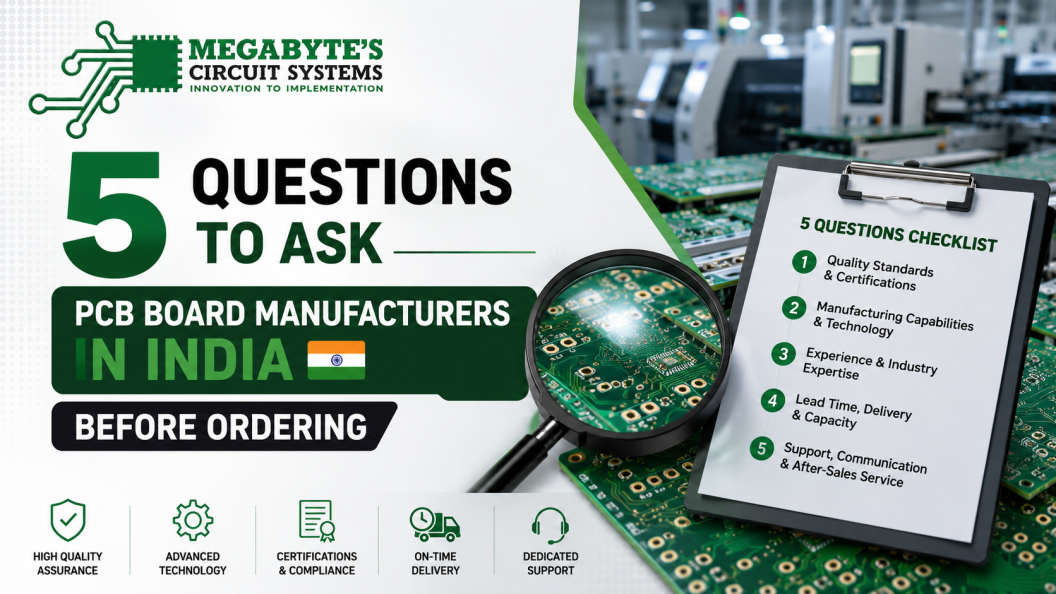
5 Questions to Ask PCB Board Manufacturers in India Before Ordering

Before you hit “upload” on your Gerber files, I recommend picking up the phone or sending a quick email with these five technical questions. Their answers will tell you more than any brochure ever could.

1. "What is your standard aspect ratio for plated through-holes (PTH)?"

If they can’t handle an aspect ratio of at least 8:1 or 10:1, they may struggle with complex Multilayer PCB designs.

2. "Do you perform 100% Netlist Testing?"

Some low-cost manufacturers only do “visual inspection.” In 2026, you should insist on an E-test (Flying Probe or Bed-of-Nails) against your original netlist.

3. "What are your minimum trace width and spacing capabilities?"

Standard production is usually 6/6 mil (0.15mm). If your IoT design requires 3/3 mil, you need to know if their imaging equipment (LDI vs. Film) can actually hold those tolerances without shorts.

4. "Which laminate brands do you stock?"

Ask for specific names like Kingboard, Shengyi, or Isola. If they are vague about the material, the thermal reliability of your board is at risk.

5. "Can you provide a DFM report before fabrication?"

A manufacturer that offers a PCB Design Service or a thorough DFM check is worth their weight in gold. They are your last line of defense against “unmanufacturable” designs.

Cost Breakdown from Top PCB Board Manufacturers in India

Costing is rarely a flat rate. At Megabyte Circuit Systems, we use a precise PCB Calculator to help engineers budget. However, understanding the “why” behind the price helps you optimize.

  • Layer Count: Moving from a Double Layer PCB to 4 layers typically increases the price by 60-80% due to the lamination and extra drilling processes.
  • Surface Finish: Lead-free HASL is the “standard” in India, but if you need ENIG (Electroless Nickel Immersion Gold) for fine-pitch components, expect a 10-20% price jump.
  • Copper Weight: Standard is 1oz (35μm). If you’re designing for high power and need 2oz or 3oz, the cost of raw material and etching time increases significantly.

Quick Technical Summary:

PCB costs in India are primarily driven by layer count, base material thickness, and surface finish (ENIG vs. HASL). To optimize costs, stick

to standard FR4 materials and 6/6 mil design rules whenever possible.

Engineering Checklist: Design for Manufacturing (DFM) for the Indian Market

We see this issue very often: a design looks perfect on the screen but fails on the factory floor. To ensure your boards are manufactured smoothly at any of the top PCB board manufacturers in India, follow this checklist:

  1. Drill to Copper Clearance: Ensure at least 8-10 mils of clearance between the hole wall and the nearest copper trace to prevent shorts during drilling.
  2. Solder Mask Expansion: Set a 2-3 mil expansion around pads. If it’s zero, you’ll get mask-on-pad issues that make PCB Assembly service a nightmare.
  3. Annular Rings: For a 0.3mm drill, ensure your pad is at least 0.6mm. Small annular rings lead to “breakouts” during the plating process.
  4. Silkscreen Legibility: Keep text height at 30 mils and stroke width at 6 mils. Anything smaller often becomes a blurry mess after the curtain coating process.

Quality Control Standards in 2026

When evaluating PCB board manufacturers in India, look for the “Big Three” certifications:

  • ISO 9001:2015: Ensures a consistent quality management system. 
  • UL Certification: Essential if you plan to export your product to the US or European markets.
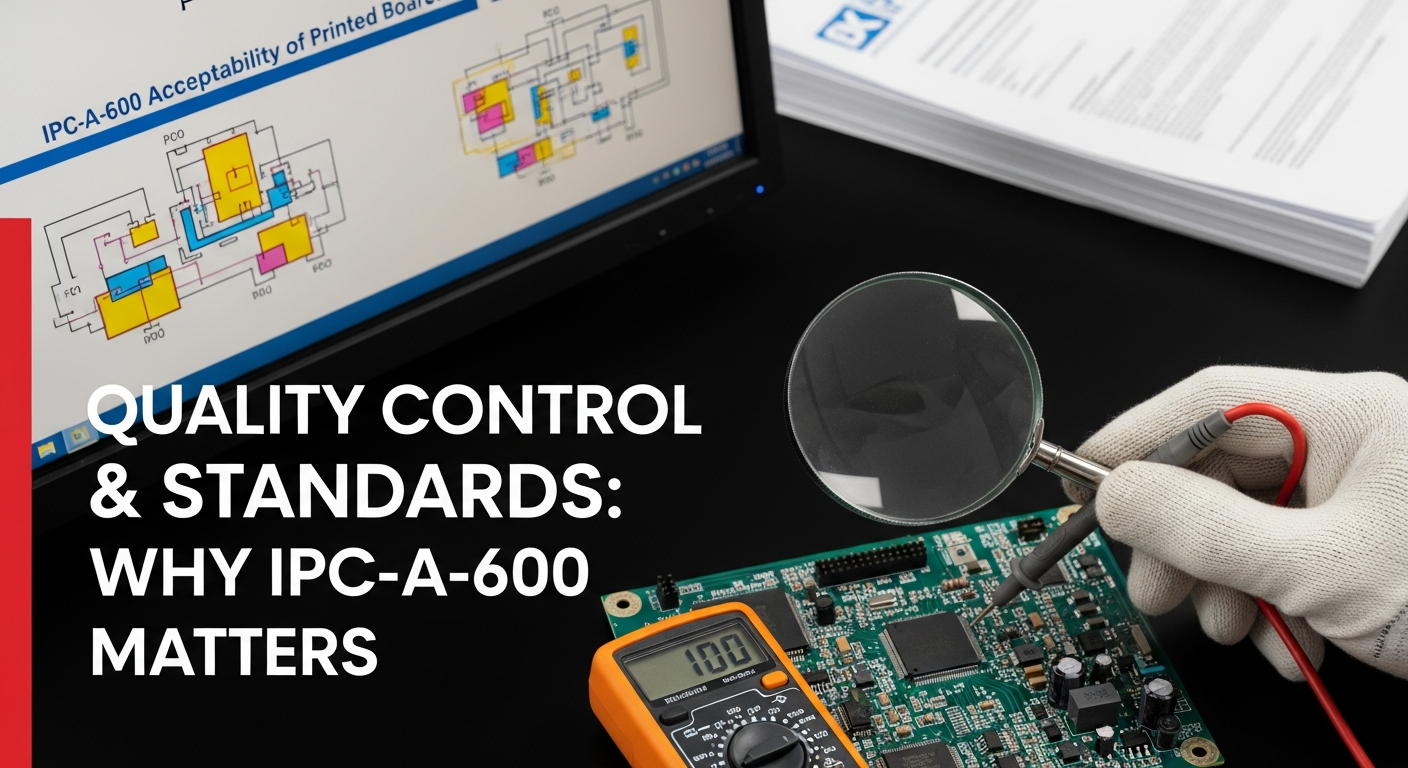
  • IPC-A-600 Compliance: The global “bible” for what a good PCB should look like.

At Megabyte, we integrate these standards into our PCB Developing Services. We don’t just “make” the board; we validate it using Cross-section analysis and Micro-sectioning when required for high-reliability industrial clients.

FAQs about PCB Board Manufacturers in India

1. What is the typical lead time for PCB prototyping in India?

For standard double-sided boards, most top manufacturers offer a “Quick-Turn” service of 2 to 5 days. For complex multilayer boards, expect 7 to 10 working days.

2. Can Indian manufacturers handle High-Density Interconnect (HDI) boards?

Yes, but the list of capable vendors shrinks. Only about the top 10-15% of manufacturers in India have the laser drilling and vacuum lamination equipment required for reliable HDI/Blind-Buried via production.

3. Is it cheaper to source PCBs from China or India in 2026?

For very high volumes (10,000+), China remains slightly cheaper. However, for prototypes and mid-scale production, Indian manufacturers are now highly competitive, especially when you factor in 2026 shipping costs, import duties, and the ease of local technical support.

4. What files do I need to provide for a quote?

You should provide your Gerber Files (RS-274X or X2 format), a NC Drill file, and a “ReadMe” text file specifying the board thickness, copper weight, and solder mask color.

5. How do I verify if a manufacturer is truly "Quality Certified"?

Don’t just take their word for it. Ask for a copy of their latest ISO or UL certificate and check the expiry date. Real experts won’t mind sharing their credentials.

Conclusion: Partner with a Manufacturer Who Understands Your Vision

Choosing from the many PCB board manufacturers in India is a decision that impacts your product’s reliability and your company’s reputation. While the “Top 10” list gives you a great starting point, the best manufacturer is the one that acts as an extension of your own engineering team.

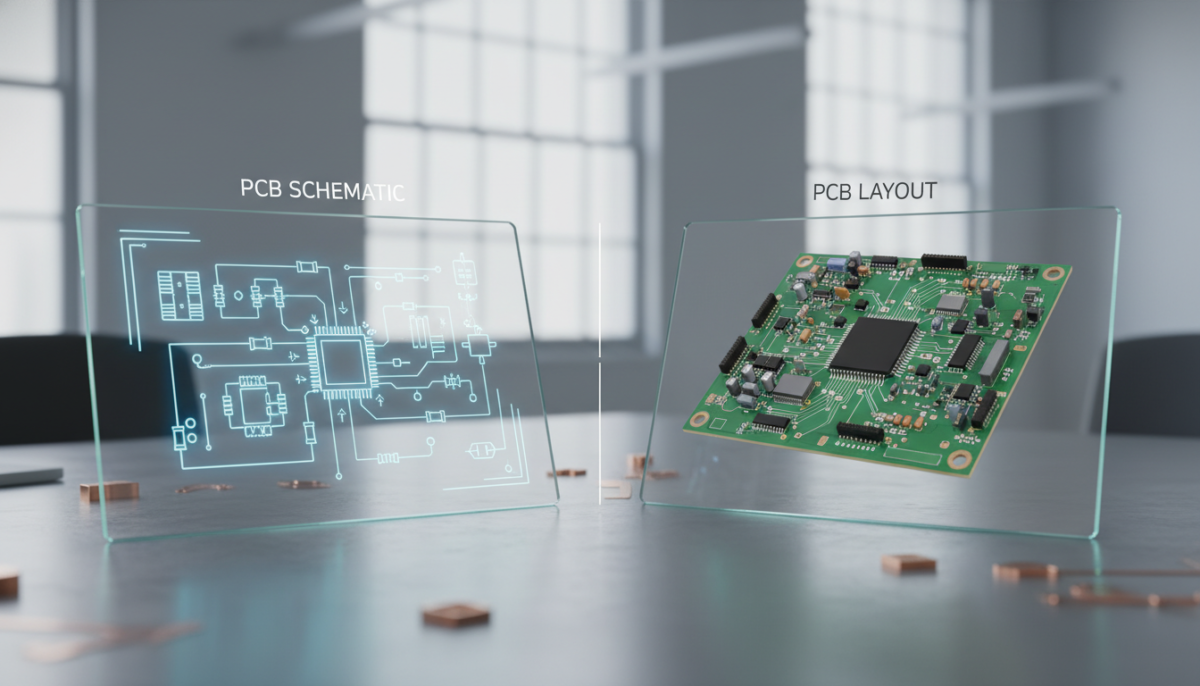
At Megabyte Circuit Systems, we’ve built our reputation over two decades by being that partner. Whether you’re in the heart of Ahmedabad or anywhere across India, we make it easy to transition from a schematic to a high-quality physical board.

Ready to bring your design to life?

Upload your Gerber files here for an instant quote, or reach out to our senior consulting team to discuss your custom project requirements. Let’s build something exceptional together.
Categories
PCB Guide

The Complete Guide to Single Layer PCB Design and Manufacturing

The Complete Guide to Single Layer PCB Design and Manufacturing

In an era of high-speed processors and 12-layer stackups, it’s easy to overlook the humble 1-layer board. But in my 20+ years at Megabyte Circuit Systems, I’ve seen countless IoT startups and consumer electronics brands over-engineer their products, leading to bloated BOM costs and manufacturing delays.

The truth is, when it’s done right, a Single Layer PCB is often the most elegant solution for cost-sensitive, high-volume production. Whether you are designing a simple LED driver, a power supply, or a basic sensor node, simplicity often translates directly to reliability.

If you are struggling to keep your production costs down or wondering if you can squeeze your design into a single copper layer without signal integrity issues, you are in the right place. I’ll walk you through how we approach 1-layer fabrication here in India and how you can optimize your Gerber files to ensure a 100% yield at our factory.

Single Layer PCB vs. Double Layer PCB: Which One Do You Need?

The most common question hardware engineers ask me during our PCB developing services consultations is: “Can I get away with a single layer?”

The answer depends on your component density and routing complexity. A Single Layer PCB has conductive copper on only one side of the substrate. This means no Vias (Vertical Interconnect Access) are used to jump signals between layers. Every trace must find its path without crossing another.

If your design involves:

  • High-current power paths
  • Minimal surface-mount components (SMD)
  • Budget-driven mass production

…then a single layer is your best friend. However, if you have a dense BGA or high-speed differential pairs, you likely need a Double Layer PCB to provide a dedicated ground plane for EMI shielding.

Single Layer PCBs utilize a single conductive copper layer on one side of a dielectric substrate (usually FR4 or MCPCB). They are the most cost-effective solution for low-density designs, offering higher reliability in thermal dissipation and easier troubleshooting compared to multi-layer alternatives.

Common Applications of a Single Layer PCB in Consumer Electronics

You’d be surprised how much of the world still runs on 1-layer technology. In the Indian market, where price-to-performance ratio is king, we see these boards used everywhere:

  • LED Lighting: Especially Metal Core PCBs (MCPCB) where the single layer of copper sits on an aluminum base for heat dissipation.
  • Power Supplies & Adapters: The wide traces required for high current are easier to manage on a single, thick copper layer (e.g., 2oz or 3oz copper).
  • Simple Household Appliances: Coffee makers, irons, and digital clocks.
  • Industrial Sensors: Basic IoT nodes that don’t require complex signal routing.

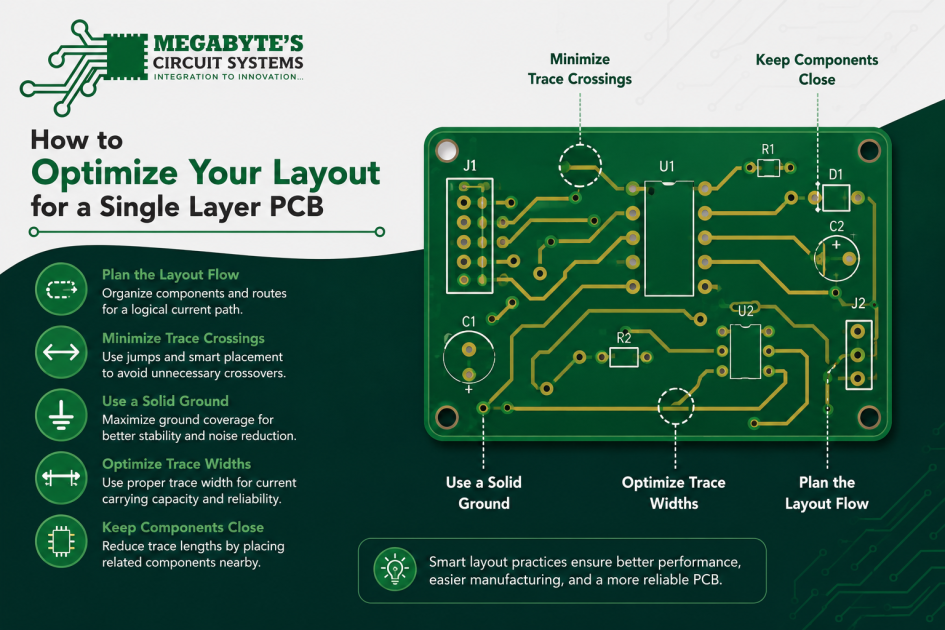
How to Optimize Your Layout for a Single Layer PCB

How to Optimize Your Layout for a Single Layer PCB

One thing I always tell my clients is that a single-layer layout is actually harder to design than a multi-layer one. Why? Because you can’t “cheat” by using vias to solve routing dead-ends.

1. Master the Art of the "Jumper"

In a 1-layer design, zero-ohm resistors or wire jumpers are your only way to “cross” traces. Use them sparingly, but strategically. Place them in areas where they won’t interfere with automated pick-and-place machines if you are opting for a full PCB Assembly service.

2. Trace Width and Spacing

For single-layer boards, we often use thicker laminates. To prevent etching issues, I recommend a minimum trace width and spacing of 8 mil (0.2mm). While we can go lower at Megabyte, staying at 8 mil or higher significantly improves your manufacturing yield and reduces costs.

3. Copper Pour and Ground Planes

Even without a dedicated ground layer, you should use a copper pour on your signal layer. This helps with EMI and reduces the amount of etchant chemical we need to use, which is better for the environment and the board’s structural integrity.

Technical Comparison: 1-Layer vs. 2-Layer vs. Multilayer

Feature

Single Layer

Double Layer

Multilayer (4+)

Manufacturing Cost

Lowest

Moderate

High

Design Complexity

High (Routing logic)

Low to Moderate

High (Signal Integrity)

Lead Time

Fastest (24-48 hours)

Standard

Longer

Ideal Use Case

Power/LED/Simple IoT

General Electronics

High-Speed Computing

EMI Shielding

Poor

Good

Excellent

Single Layer PCBs offer the fastest manufacturing turnaround and the lowest unit cost, but require more creative routing due to the absence of signal layers. While they lack the built-in EMI shielding of a Multilayer PCB, they are superior for high-current and thermal-intensive applications.

Design for Manufacturing (DFM) Tips for 1-Layer Boards

Before you upload your files to our PCB Calculator, check these three things:

  1. Solder Mask Clearance: Ensure your solder mask opening is at least 3-4 mil larger than the pad. Since single-layer boards often use larger components, this prevents solder bridging during manual soldering or assembly.
  2. Component Silkscreen: Because there’s only one side of copper, the silkscreen (legend) usually goes on the non-copper side (top) for through-hole components, or the copper side (bottom) for SMDs. Make sure your layers are labeled correctly in your CAD tool (like Altium, Eagle, or KiCad).
  3. Hole Size vs. Pad Size: For through-hole components, I recommend a pad diameter that is at least 20 mil larger than the finished hole size. This provides a strong mechanical bond, which is vital since there is no copper in the barrel of the hole (non-plated through holes).

Cost Optimization in India: How to Get the Best Price

Being a premier PCB Manufacturing service in Ahmedabad, we understand the Indian electronics ecosystem. Here is how you can drive your costs down even further:

  • Standardize Board Thickness: Stick to the industry-standard 1.6mm FR4. Choosing 0.8mm or 2.0mm can sometimes lead to longer lead times as we may not have that specific laminate in stock for immediate “Quick-Turn” production.
  • Panelize Your Designs: If your board is small (e.g., 30mm x 30mm), panelize them into a 2×2 or 3×3 array. This reduces handling time and makes it easier for our PCB Assembly service team to process your order.
  • Surface Finish Selection: For most 1-layer applications, Lead-Free HASL (Hot Air Solder Leveling) is the most cost-effective and durable finish. Only move to ENIG (Gold) if you have very fine-pitch SMD components or need a perfectly flat surface for tactile buttons.

FAQs: People Also Ask

1. Can I use Surface Mount Devices (SMD) on a single layer PCB?

Absolutely. In fact, many modern LED drivers are 100% SMD on a single layer. Just remember that your components and traces will all be on the same side, so plan your routing carefully to avoid “trapped” pads.

2. Is FR4 the only material for single layer PCBs?

No. While FR4 is the most common, we also use Paper Phenolic (FR1/FR2) for extremely low-cost toys and Metal Core (Aluminum) for high-power LED applications where heat management is critical.

3. Why are there no "Plated Through Holes" (PTH) on a single layer board?

By definition, a single layer board doesn’t need to connect one layer to another, so the holes are usually NPTH (Non-Plated Through Holes). This actually makes the board cheaper to produce as it skips the electroless copper plating step.

4. How fast can Megabyte Circuit Systems deliver a 1-layer prototype?

We see this issue very often where a client needs a board “yesterday.” For standard single-layer designs, we can often ship within 24 to 48 hours from our Ahmedabad facility.

5. Do I need a PCB Design Service to convert my 2-layer design to 1-layer?

If your design isn’t too dense, it’s worth a try! If you’re stuck, our team can help review your schematic to see if a single-layer conversion is feasible to save production costs.

Conclusion: Trust the Senior Experts at Megabyte

Simplicity shouldn’t mean a sacrifice in quality. Whether you are building a simple prototype or scaling to 10,000 units, a Single Layer PCB from Megabyte Circuit Systems ensures you get the best of Indian manufacturing: speed, precision, and unbeatable value.

We’ve helped hundreds of engineers across India from the hardware hubs of Bangalore to the industrial belts of Gujarat bring their products to life.

Ready to see the difference experience makes?

Let’s get your project moving!

Categories
PCB Guide

Why a PCB Company in India Offers the Best Value for Global Buyers

Why a PCB Company in India Offers the Best Value for Global Buyers

If you are a hardware engineer or a procurement manager, you’ve likely faced the classic “Golden Triangle” dilemma: you want it fast, you want it cheap, and you want it to actually work. For years, the default move was to look across the border for high-volume manufacturing. But in my 20+ years at Megabyte Circuit Systems, I’ve seen a massive shift.

The question is no longer just about the lowest price per unit; it’s about the Total Cost of Ownership (TCO). When you factor in shipping delays, customs duties, communication gaps, and the nightmare of a “bad batch” arriving three weeks late, a PCB Manufacturing service based right here in India often emerges as the superior financial and technical choice.

In this guide, I’ll break down exactly how an Indian PCB partner helps you balance your budget while meeting stringent IPC quality standards, and why local expertise is your best defense against project delays.

The Economics of Local Manufacturing: Reducing "Hidden" Costs

Most engineers look at the price on a quote and think that’s their final cost. It rarely is. When you work with a global supplier, you are often at the mercy of volatile shipping rates and unpredictable customs clearances.

By choosing a reliable PCB company in India, you immediately eliminate several layers of expenditure:

  1. Zero Import Duties: For domestic projects, you bypass the 10-20% overhead associated with importing electronics.
  2. Lower Logistics Overhead: Shipping a 10kg box from Ahmedabad to Bangalore is significantly cheaper and faster than an international air-freight shipment.
  3. Real-time DFM Correction: One thing I always tell my clients is that a “cheap” board becomes the most expensive board if it doesn’t work. We catch errors in your Gerber files during the PCB developing services phase before the copper is even etched.

Choosing an Indian PCB manufacturer reduces the Total Cost of Ownership by eliminating import duties, reducing logistics costs by up to 60%, and ensuring technical support in the same time zone. This local proximity allows for faster Design for Manufacturing (DFM) iterations, which prevents costly production re-runs.

Top Certifications to Look for in a PCB Company in India

In the world of PCB fabrication, “Quality” isn’t a vague feeling it’s a set of measurable standards. If your manufacturer isn’t talking about IPC-A-600 or ISO 9001:2015, you might be headed for trouble.

At Megabyte, we emphasize that quality starts with the raw material. Whether you are ordering a Single Layer PCB or a high-density interconnect board, the dielectric strength and TG (Glass Transition Temperature) of the FR4 must be verified.

Key standards to verify include:

  • IPC Class 2 & 3 Compliance: This dictates the tolerance for annular rings, hole registration, and solder mask clearance.
  • UL Certification: Essential for export-oriented units (EOUs) and safety-critical industrial applications.
  • RoHS Compliance: Ensuring your boards are lead-free and environmentally sustainable for modern markets.

Comparison: Indian Standards vs. Low-Cost Overseas Alternatives

Feature

Typical Low-Cost Overseas

Premium Indian Manufacturer (Megabyte)

Material Quality

Recycled or B-grade FR4

Grade-A KB/Isola/Shengyi Laminates

Testing

Visual Sampling Only

100% E-Test / Flying Probe

Trace Precision

$\pm 20\%$ Variance

$\pm 5\%$ Controlled Impedance

Support

Ticket-based / Bot-led

Direct Senior Consultant Access

Lead Time

15-25 Days (with Shipping)

3-7 Days (Express Prototyping)

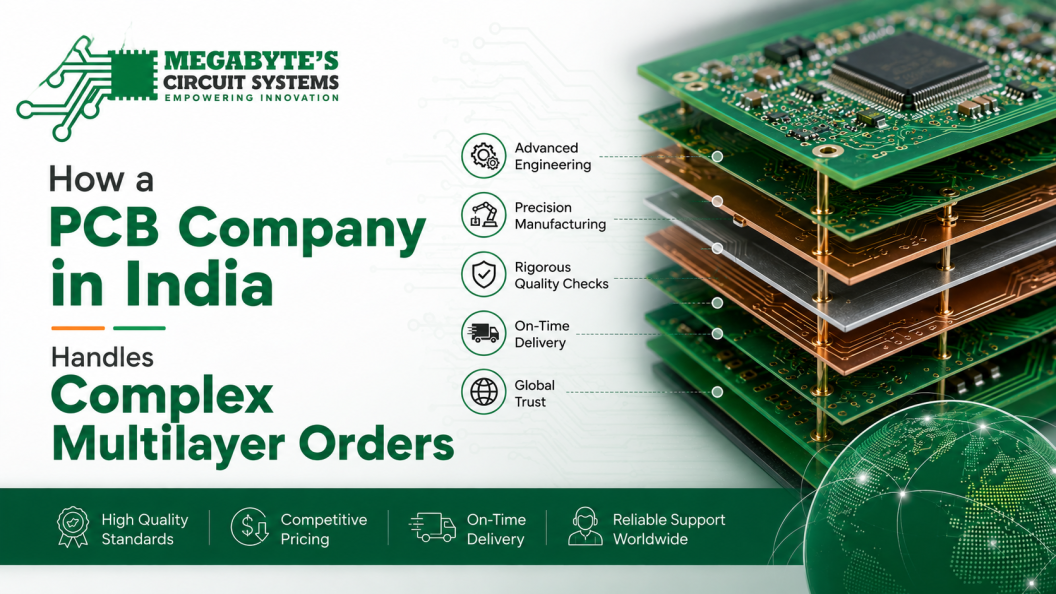
How a PCB Company in India Handles Complex Multilayer Orders

How a PCB Company in India Handles Complex Multilayer Orders

There is a common misconception that India is only good for simple boards. In reality, the technical capability for a Multilayer PCB in India has reached world-class levels.

Managing 4, 6, or 8 layers requires precision in Registration (aligning the layers) and Lamination. If the layers are off by even a few microns, your vias won’t hit the pads correctly. We see this issue very often with startups that try to DIY their first high-speed design.

A professional Indian fab house uses automated optical inspection (AOI) after each layer is etched to ensure no shorts or opens are buried inside the board where you can’t see them. This level of rigor is why many IoT and medical device companies are moving their production back to India.

Modern Indian PCB facilities utilize advanced Lamination Presses and Automated Optical Inspection (AOI) to manufacture high-density Multilayer PCBs with tight tolerances. This ensures structural integrity and signal fidelity for complex high-speed designs while maintaining a localized supply chain.

Lead Time Comparison: PCB Company in India vs. China

Time is money, especially during the prototyping phase. If you are waiting three weeks for a prototype, your competitors might already be on their second iteration.

  • The “Overseas” Reality: 3 days for production + 5 days for shipping + 4 days for customs clearance = 12 Days Minimum.
  • The Indian Reality (Megabyte): 24-48 hour Quick-turn + 1 day for domestic courier = 3 Days Total.

For a specialized PCB Design Service, being in the same time zone means you can have a technical call at 10:00 AM and have a revised design by 2:00 PM. That agility is impossible when dealing with a 12-hour time difference.

Pro-Tips for Optimizing Your PCB Costs in 2026

I always tell my procurement clients: “Help me help you save money.” Here are three technical ways to lower your quote without touching the quality:

1. Panelization is Your Friend

Don’t order individual small boards. Ask your manufacturer to panelize them. This reduces the handling time and material waste. You can even use our PCB Calculator to see how different board dimensions affect the final price.

2. Standardize Your Trace Widths

Unless your design absolutely requires it, try to stay above 6 mil (0.15mm) for trace width and spacing. Moving into the “Ultra-Fine” territory (under 4 mil) requires specialized lithography which increases the scrap rate and, consequently, your price.

3. Stick to Standard Stackups

For a Double Layer PCB, use the standard 1.6mm thickness with 1oz copper. Deviating to 2.0mm or 2oz copper is sometimes necessary for high-power applications, but it will add a premium to your cost.

Engineering Checklist: Preparing for an Indian Fab House

Before you hit “Send” on that RFQ, run through this senior consultant’s checklist:

  • [ ] Gerber Files: RS-274X or ODB++ format.
  • [ ] Drill Files: Excellon format with a clear tool list.
  • [ ] Solder Mask: Ensure you have clearance for all pads (usually +2 to 3 mils).
  • [ ] Silk Screen: Is the text at least 30 mil high for readability?
  • [ ] Assembly Prep: If you need a full PCB Assembly service, ensure your BOM (Bill of Materials) includes manufacturer part numbers (MPN).

Frequently Asked Questions (FAQs)

1. Is it actually cheaper to manufacture PCBs in India compared to China?

For small to medium batches (prototypes to 5,000 units), India is often cheaper when you include shipping, customs, and the cost of your time. For massive consumer volumes (100k+ units), overseas might have a slight edge on raw unit price, but the risk to your supply chain is significantly higher.

2. What is the standard lead time for a double-layer PCB in India?

Typically, standard production takes 5–7 working days. However, quick-turn services can deliver prototypes in as little as 24 to 48 hours depending on the complexity and finish (HASL vs. ENIG).

3. Can Indian PCB companies handle high-speed digital designs?

Yes. Modern Indian manufacturers specialize in controlled impedance, high-TG materials, and fine-pitch BGA routing. The key is to provide a detailed stackup requirement during the quoting phase.

4. What files do I need to provide for a quote?

You need a complete Gerber folder (Copper layers, Solder Mask, Silk Screen, Drill files, and Board Outline). Providing a “ReadMe” file with your preferred finish (e.g., Lead-free HASL) and copper weight helps speed up the process.

5. Why is DFM (Design for Manufacturing) so important?

DFM is the bridge between your “ideal” design and a “manufacturable” reality. A good Indian PCB partner will review your files to ensure traces aren’t too close to the board edge and that vias are properly sized, preventing a 0% yield rate.

Conclusion: Partner with India’s Electronics Experts

Choosing the right PCB company in India is about more than just buying a green board; it’s about finding a partner who understands your engineering challenges. At Megabyte Circuit Systems, we pride ourselves on being that partner. From our facility in Ahmedabad, Gujarat, we have spent two decades perfecting the art of high-quality, cost-effective fabrication.

Whether you are looking for a quick-turn prototype or a long-term production partner for your next IoT breakthrough, we are here to help you scale.

Categories
PCB Guide

How to Select a Trusted PCB Circuit Board Manufacturer

How to Select a Trusted PCB Circuit Board Manufacturer

If you are scaling up from a prototype to 5,000 or 50,000 boards, you already know the nightmare. One wrong via, one slightly off impedance, or a delayed shipment can kill your product launch.

I have seen this happen more times than I can count in my 20+ years at Megabyte Circuit Systems. A brilliant hardware engineer chooses a PCB circuit board manufacturer based only on price. Three weeks later? They are staring at delamination, solder mask peeling, or failed electrical tests.

But here is the good news. You don’t need to learn this the hard way.

In this guide, I will walk you through exactly how to evaluate a PCB circuit board manufacturer for high-volume production. You will learn the technical red flags, the must-have certifications, and the exact questions to ask before sending your Gerber files.

Let’s fix your supply chain today.

What Makes a PCB Circuit Board Manufacturer Industry-Ready?

Not every shop with a etching machine is ready for volume production. There is a huge gap between a small batch prototyping house and a high-volume PCB circuit board manufacturer.

A truly industry-ready manufacturer must have three things:

  • Automated optical inspection (AOI) for every panel, not just random samples.
  • Flying probe or fixture test capability for 100% electrical testing.
  • IPC Class 2 or Class 3 compliance as their baseline.

In my experience, if a vendor cannot show you their AOI logs or IPC training records, walk away. We have built our entire PCB manufacturing line around these three pillars because volume production has zero tolerance for “maybe it works.”

Quick Technical Summary:
An industry-ready PCB circuit board manufacturer must use AOI on every panel, offer 100% electrical testing, and comply with IPC-A-600. Never rely on visual inspection alone for high-volume orders.

2. The 7 Critical Factors for High-Volume PCB Success

Let me share the exact checklist I give to every industrial procurement manager who visits our factory in Ahmedabad.

1 Material Traceability & Storage

Your single layer PCB or multilayer board is only as good as the laminate. Ask for material certificates (UL or IPC-4101). Also check how the manufacturer stores prepreg and copper-clad laminates. Improper humidity control = hidden reliability issues.

We store all our materials in climate-controlled zones, and we log every batch. If a problem appears after 10,000 pieces, we can trace it to the exact panel.

2 Impedance Control Capability

For high-speed designs, impedance matching is non-negotiable. Your PCB circuit board manufacturer must provide impedance test coupons and actual TDR (Time Domain Reflectometry) reports.

If they say “we can try,” that is a red flag. You need guaranteed 50Ω or 100Ω differential impedance.

3 Lead Time Transparency

High-volume means predictable lead times. A reliable PCB company in India will give you separate timelines for:

  • Prototype approval
  • Material procurement
  • Fabrication
  • Electrical testing
  • Shipping

At Megabyte, we use a real-time PCB calculator so you can see lead times and pricing instantly. No hidden surprises.

4 DFM Feedback Quality

Before running volume production, a good manufacturer will send you a detailed DFM (Design for Manufacturing) report. This includes:

  • Minimum trace width violations
  • Annular ring issues
  • Solder mask slivers
  • Drill-to-copper clearance

If they only say “OK” without a report, they are not reviewing your files properly.

Quick Technical Summary:
For high-volume success, prioritize material traceability, impedance control, transparent lead times, and detailed DFM reports. These four factors prevent 90% of common production failures.

5 Red Flags When Vetting a PCB Circuit Board Manufacturer

After reviewing over 2,000 vendor audits, I have seen the same red flags again and again.

Red Flag

Why It’s Dangerous

No AOI machine on site

Defects will reach you, not caught in factory

Refuses to share IPC test reports

Likely not meeting Class 2 or 3 standards

Vague about laminate brand (e.g., “Taiwan material”)

Potential counterfeit or subgrade FR4

No E-test for volume orders

Opens and shorts will escape

Requests full payment before shipment

Cash flow problems – risk of delayed delivery

Let me be blunt. One of my clients ignored the “no AOI” red flag with a cheap PCB board manufacturer in India outside Gujarat. They received 5,000 boards with micro-shorts. Rework cost? ₹18 lakhs. Lost time? Two months.

Do not save 5% on unit cost to risk 200% in rework.

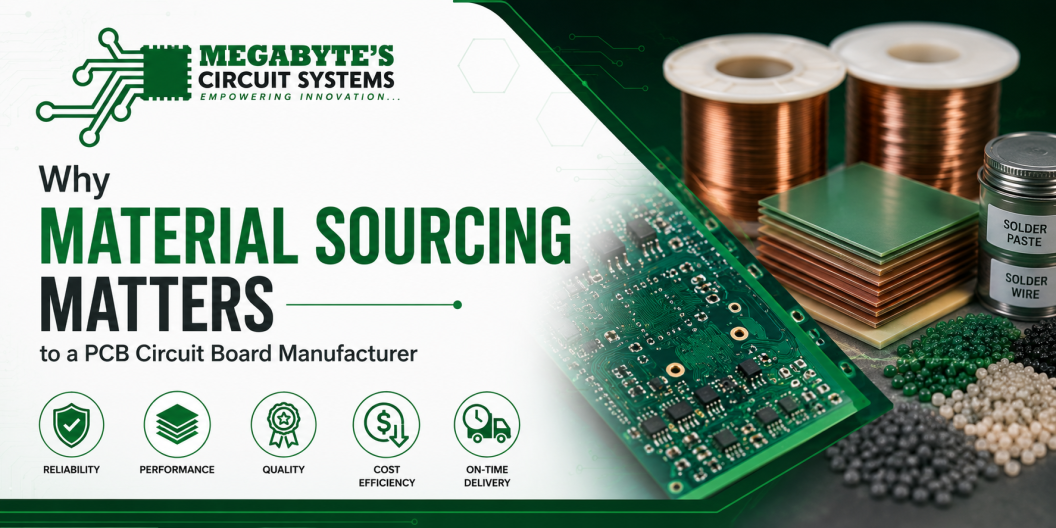
Why Material Sourcing Matters to a PCB Circuit Board Manufacturer

Material Sourcing Matters to a PCB Circuit Board

You might think all FR4 is the same. It is not.

Leading PCB board manufacturers in India source from approved vendors like:

  • KB Group (Korea)
  • ITEQ (Taiwan)
  • ShengYi (China)
  • Isola (USA/Europe)

Each has different Tg (glass transition temperature), CTE (coefficient of thermal expansion), and CAF resistance.

For example, if you need lead-free assembly (260°C peak), you must use a high-Tg material (170°C+). A standard 130°C Tg board will get damaged.

In our multilayer PCB production, we always confirm the material TG and CTE before ordering copper-clad laminates. We also share these specifications in your quote.

Quick Technical Summary:
Material selection directly impacts thermal reliability. For lead-free assembly or dense multilayer boards, always require high-Tg (170°C+) FR4 and ask for the laminate brand name before production.

Design for Manufacturing (DFM) Checklist for High-Volume Orders

You can avoid most volume production delays by following this DFM checklist. Share this with your design team before sending Gerber files to any PCB circuit board manufacturer.

Trace Width & Spacing

  • Minimum trace width: 5 mil (0.127 mm) for standard volume
  • Minimum spacing: 5 mil (0.127 mm)
  • Below these values? You need advanced laser direct imaging (LDI)

Hole Size & Annular Ring

  • Minimum finished hole size: 0.25 mm (10 mil)
  • Minimum annular ring: 4 mil (0.1 mm) from hole wall to copper

Solder Mask & Silkscreen

  • Solder mask clearance around pads: 2–3 mil
  • Silkscreen text width: minimum 6 mil line width

Panelization

  • Add tooling holes (3–4 mm diameter) on breakaway rails
  • Use V-scoring or mouse bites carefully – avoid fiberglass splinters

I have created a free PCB developing services checklist for our clients. You can request it anytime.

Quality Control & Electrical Testing Standards

Let me walk you through how a serious PCB circuit board manufacturer ensures quality.

Incoming Material Inspection (IQC)

Each laminate panel is checked for:

  • Warpage (less than 0.75%)
  • Copper thickness tolerance (±10%)
  • No scratches or dents

During Fabrication

  • AOI after etching (every panel)
  • Automated optical inspection after solder mask
  • Impedance coupons measured every batch

Final Electrical Test (100% for volume)

  • Flying probe for prototypes and small volumes
  • Fixture testing (grid) for high volumes – faster and cheaper

We follow IPC-A-600 (acceptability of printed boards) as our inspection standard. If a board fails, it does not leave our factory. Period.

Quick Technical Summary:
A reliable manufacturer uses IQC, in-process AOI, and 100% electrical testing. For high-volume orders, fixture testing is the gold standard. Always ask for IPC-A-600 compliance.

How to Optimize Cost for High-Volume PCB Production in India

One question I hear every single week: “How can I reduce my PCB cost without lowering quality?”

Here is the honest answer from a PCB company in India that has quoted thousands of volume jobs.

Panel Utilization

Your single layer PCB or double layer PCB layout should maximize the standard panel size (usually 18″ x 24″ or 21″ x 24″). Awkward board shapes waste material.

We use automated panel optimization software. You can experiment with the PCB calculator on our website to see panel utilization percentage.

Standardize Your Stack-Up

Avoid exotic material combinations. Standard FR4 with 1 oz copper is the most economical. Mixed copper weights (e.g., 0.5 oz inner, 2 oz outer) increase lamination cycles and cost.

Combine Multiple Designs

If you have two different small boards, consider panelizing them together. This saves tooling costs and setup time.

Plan Your Lead Time

Emergency 3-day turns cost 3–5x more. For volume, plan 2–3 weeks standard lead time.

A practical tip: Order 15–20% extra panels. Scrap happens. It is cheaper than a second rush order.

Real-World Example: How a Pune IoT Startup Fixed Their PCB Quality

I want to share a real case.

A Pune-based IoT company was struggling with intermittent failures in their field devices. They had chosen the cheapest PCB board manufacturer in India they could find.

After reviewing their boards, we found:

  • Inconsistent trace widths (etching undercut)
  • Plated through-hole voids (poor PTH process)
  • No AOI or E-test records

We requoted the job with proper specifications:

  • IPC Class 2
  • High-Tg FR4 (ITEQ)
  • 100% flying probe test
  • Standard 10-day lead time

The unit cost increased by 18%. But field failure rate dropped by 94%.

That extra 18% saved them from service calls, customer returns, and brand damage. Smart procurement is not about lowest price. It is about lowest total cost of ownership.

Quick Technical Summary:
Low initial price often hides poor quality and high failure rates. Focus on total cost of ownership (TCO). A slightly higher unit cost with reliable testing saves money in the long run.

FAQs from Hardware Engineers & Procurement Managers

What is the minimum order quantity (MOQ) for high-volume PCB production?

Most reliable PCB circuit board manufacturers start volume MOQ at 500–1,000 pieces. At Megabyte, we accept smaller volumes too, but unit price drops significantly above 2,000 pieces.

How do I share Gerber files for a quote?

Upload your RS-274X Gerber files, drill file, and readme directly on our quote page. We usually respond within 24 hours with a DFM report and pricing.

Can I get impedance-controlled boards from an Indian PCB manufacturer?

Yes, absolutely. Many PCB board manufacturers in India including us offer impedance control for 50Ω single-ended and 90Ω/100Ω differential pairs. We provide TDR reports with every batch.

What is the typical lead time for 5,000 double-layer PCBs?

Standard lead time is 10–12 working days. For single layer PCB, 7–9 days. For multilayer PCB (6+ layers), 15–18 days. Expedited options are available.

How do I verify if a manufacturer follows IPC standards?

Ask for their latest IPC training certificates and a sample IPC-A-600 inspection report. Serious manufacturers proudly share these.

Why should I choose a PCB company in India over China?

Indian manufacturers offer competitive pricing, faster communication in English, no geopolitical shipping risks, and often shorter delivery times to domestic customers. Plus, you can visit the factory easily.

Conclusion: Your Next Step Toward Reliable High-Volume PCBs

Choosing the right PCB circuit board manufacturer is not complicated. But it does require the right questions and standards.

To recap:

  1. Look for AOI, E-test, and IPC compliance.
  2. Avoid the five red flags I shared.
  3. Demand material traceability and DFM reports.
  4. Optimize your design for panel utilization.
  5. Focus on total cost, not just unit price.

At Megabyte Circuit Systems (Ahmedabad, Gujarat), we have been doing exactly this for over two decades. We manufacture single layer PCB, double layer PCB, and multilayer PCB for hundreds of Indian hardware startups, industrial OEMs, and IoT companies.

Whether you need a quick-turn prototype or a high-volume production run, our team is ready to help.

Have a specific requirement? Just reply to this email or call our technical team. I personally review all complex DFM queries.

Let’s build reliable hardware together.

Senior Consultant, Megabyte Circuit Systems
20+ years in PCB fabrication | IPC-certified | Based in Ahmedabad, India

Categories
PCB Guide

Circuit Board Manufacturer in India: Complete Buyer Guide (2026)

Circuit Board Manufacturer in India: Complete Buyer Guide (2026)

If you are a hardware engineer, IoT startup founder, or procurement manager in India, you already know the frustration. You have a solid design, clean Gerber files, and tight deadlines but finding a circuit board manufacturer in India that consistently delivers quality, on-time, and at a competitive price feels like a gamble.

I have spent the last 20+ years at Megabyte Circuit Systems in Ahmedabad guiding hundreds of teams exactly like yours. This complete buyer guide for 2026 cuts through the noise. You will learn exactly what to look for, which questions to ask, how to avoid costly mistakes, and how to get the best possible PCB fabrication from an Indian manufacturer.

Let’s get straight to what matters.

Why Indian Circuit Board Manufacturers Are the Smart Choice in 2026

The Indian PCB industry has matured dramatically. Today we offer world-class quality at 30-40% lower cost than China or Europe for most prototype-to-medium volume runs. Faster shipping within India, no language barriers, and easier compliance with Make-in-India policies make local manufacturers the default choice for most hardware teams.

Yet not every “PCB manufacturer in India” is equal. Some still struggle with consistent multilayer registration, impedance control, or quick-turn delivery. This guide will help you separate the professionals from the rest.

Quick Technical Summary

Indian circuit board manufacturers now routinely deliver IPC Class 2 and Class 3 boards with 24-72 hour quick-turn prototypes. Focus on factories that own their own CNC drilling, AOI, and flying probe lines. Always demand full material traceability for FR4, solder mask, and copper.

Types of PCBs Every Buyer Should Understand

Before you shortlist any circuit board manufacturer in India, know exactly which board type you need.

  • Single Layer PCB: Simplest and cheapest. Ideal for basic power supplies, LED drivers, and consumer gadgets.
  • Double Layer PCB: Most popular for IoT, consumer electronics, and industrial controls.
  • Multilayer PCB (4 to 12+ layers): Essential for high-speed digital, RF, medical, and automotive applications.

Here is a clear comparison that I share with every new client:

PCB Type

Layers

Typical Applications

Relative Cost (2026)

Minimum Trace/Space

Best For

Single Layer

1

LED, power supplies, simple sensors

1x

8 mil

Low-cost, high-volume

Double Layer

2

IoT modules, consumer devices

1.8x

5 mil

Most Indian startups

Multilayer

4–12

High-speed digital, RF, automotive

3–8x

3 mil

Complex, high-reliability

Explore our Single Layer PCB options

See Double Layer PCB capabilities

Multilayer PCB fabrication details

Quick Technical Summary

Choose single layer only when cost is the only driver. Double layer covers 70% of Indian IoT projects. Move to multilayer the moment you need impedance control, EMI reduction, or high component density.

7 Non-Negotiable Factors When Selecting a Circuit Board Manufacturer in India

In my experience, these are the exact points that separate reliable partners from painful suppliers:

  1. In-house manufacturing – No outsourcing of drilling or plating.
  2. IPC-A-600 & IPC-6012 certification – Visible on their website and test reports.
  3. Full DFM review before production – They should flag issues free of cost.
  4. Quick-turn prototype capability – 24-48 hours for 5-10 boards.
  5. Material traceability – RoHS, UL, and halogen-free options.
  6. Electrical testing – 100% flying probe or fixture test.
  7. Transparent pricing – No hidden setup or tooling charges.

One thing I always tell my clients is: “If they cannot show you their factory on video call within 24 hours, keep looking.”

Design for Manufacturing (DFM) Tips That Save Time and Money

Most design-related rejections happen because engineers ignore Indian fabrication realities. Here is the practical checklist we use at Megabyte before every job:

  • Minimum trace width: 5 mil (0.127 mm) for double layer, 3 mil for multilayer
  • Minimum hole size: 0.3 mm for PTH (0.2 mm possible but costly)
  • Solder mask expansion: 0.05 mm on each side
  • Keep copper pour at least 0.5 mm from board edge
  • Annular ring minimum 0.15 mm for reliable plating
  • Panelization with 3-5 mm rails and fiducials

Upload your Gerber files early. A good circuit board manufacturer in India will return a detailed DFM report within hours not days.

Use our free PCB Calculator to get instant pricing before you finalise the design.

Quick Technical Summary

80% of delays come from DFM issues. Fix trace width, annular ring, and via placement before sending files. A 10-minute DFM review can save 2-3 weeks and 15-25% cost.

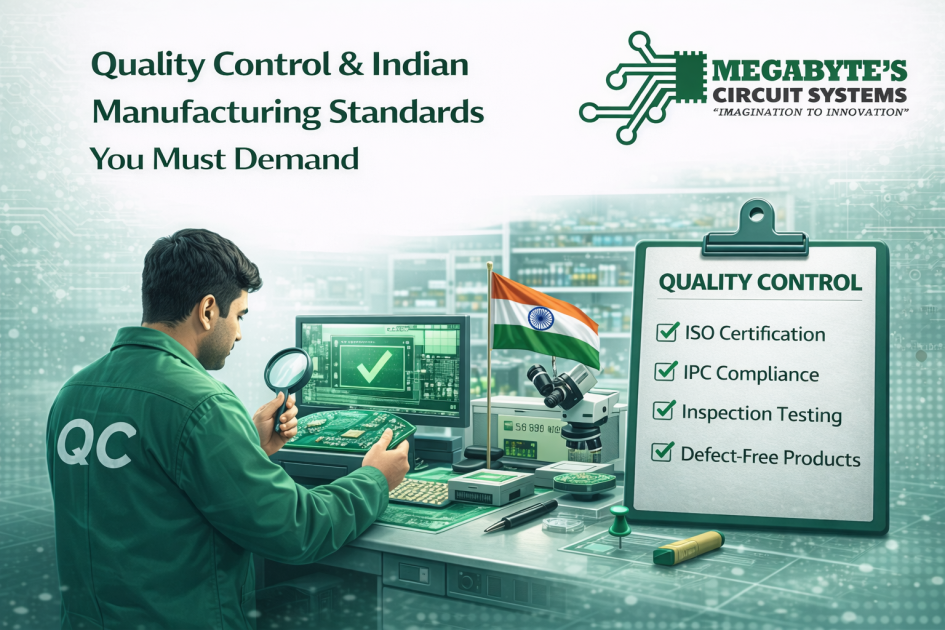
Quality Control & Indian Manufacturing Standards You Must Demand

Quality Control & Indian Manufacturing Standards You Must Demand

At Megabyte Circuit Systems we follow a strict 7-step QC process:

  • Incoming raw material inspection (FR4 thickness, copper weight)
  • AOI after etching
  • Flying probe / bed-of-nails electrical test
  • Cross-section micro-sectioning for multilayer boards
  • Final visual inspection under 10x magnification
  • Impedance testing for high-speed designs
  • 100% packing with desiccant and moisture barrier

Ask for the full IPC-A-600 Class 2 or Class 3 inspection report with every batch.

Cost Optimization Strategies for PCB Manufacturing in India (2026)

Here is what actually moves the needle on price in 2026:

  • Order in panel form instead of single boards
  • Standard 1.6 mm FR4, 35 µm copper unless you need 1 oz or 2 oz
  • Choose green solder mask and white silkscreen (cheapest colours)
  • Keep board size under 100×100 mm for better panel utilisation
  • Combine prototype and production runs when possible

We regularly help startups reduce PCB cost by 22-28% simply by applying these rules.

How to Get Started with Any Circuit Board Manufacturer in India

  1. Finalise your Gerber, drill, and BOM files
  2. Use the online PCB Calculator for instant pricing
  3. Request a formal quote with your stack-up and quantity
  4. Approve DFM report
  5. Approve sample (if required)
  6. Go into production

At Megabyte Circuit Systems, our PCB manufacturing service is built exactly for this flow from 5-piece prototype to 10,000-piece production.

Frequently Asked Questions

What is the typical lead time for PCB manufacturing in India in 2026?

Prototypes: 24-72 hours. Standard production: 5-7 working days. Multilayer or HDI boards may take 8-10 days. We beat these numbers regularly for repeat customers.

How much does it cost to manufacture PCBs in India?

A simple double-layer 50×50 mm board in 100 pcs quantity starts around ₹8-12 per piece. Multilayer 6-layer same size starts at ₹45-65 per piece. Use the online calculator for exact pricing.

What files does a circuit board manufacturer need?

Gerber RS-274X, Excellon drill file, README with stack-up, and BOM if assembly is required. We also accept ODB++.

Should I choose a manufacturer in Gujarat or elsewhere?

Location matters for logistics. Ahmedabad-based manufacturers offer fastest domestic courier reach across India with lowest freight damage risk.

What is the minimum order quantity for most Indian PCB makers?

None for prototypes (5-10 pcs). Production usually starts at 50-100 pcs depending on board complexity.

How do I verify a manufacturer’s quality before placing a big order?

Ask for recent IPC test reports, factory video tour, and a small paid prototype run. Reliable partners are happy to prove themselves.

Final Thoughts & Your Next Step

Finding the right circuit board manufacturer in India in 2026 does not have to be complicated. Focus on in-house capability, transparent DFM feedback, IPC standards, and genuine quick-turn support. Everything else is secondary.

At Megabyte Circuit Systems in Ahmedabad, Gujarat, we have built our entire process around exactly these principles. Whether you need a handful of single layer boards for your first prototype or multilayer production volumes for your latest IoT product, our team is ready to support you.

Upload your Gerber files right now on our PCB Calculator or reach out for a personalized quote. We reply within 2 hours, usually faster.

Your next board is waiting. Let’s build it right together.

Categories
PCB Guide

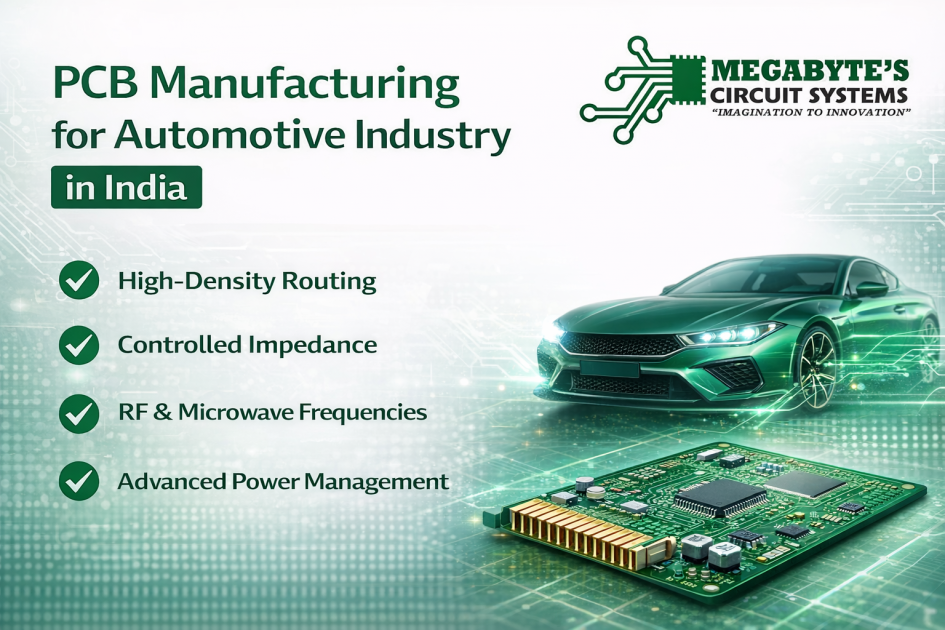
PCB Manufacturing for Automotive Industry in India

PCB Manufacturing for Automotive Industry in India

If you’re an automotive hardware engineer or procurement manager in India, you already know the pain: one failed PCB in an ECU, BMS or ADAS module can stop an entire production line. With EVs, connected cars and stricter safety norms exploding across India, your PCB supplier must deliver boards that survive 150 °C, constant vibration, thermal shock and 15-year lifespans all while keeping costs competitive and lead times under control.

In this guide I share exactly what I’ve learned in 20+ years guiding Tier-1 and Tier-2 automotive clients at Megabyte Circuit Systems in Ahmedabad. You’ll walk away with clear technical requirements, DFM mistakes that cost Indian OEMs lakhs every month, material choices that actually work, and practical steps to get production-ready automotive PCBs faster and cheaper right here in India.

Why Automotive PCBs Are Fundamentally Different

Standard consumer PCBs simply don’t survive under the bonnet. Automotive boards face extreme temperature cycling (−40 °C to +150 °C), continuous vibration (up to 10 g), humidity, salt spray and functional-safety requirements under ISO 26262. A single short or open can trigger ASIL-D failure.

That’s why automotive PCB manufacturing demands IPC Class 3 acceptance criteria (instead of Class 2), tighter impedance control (±10 % instead of ±15 %), and full traceability from laminate to final board.

Quick Technical Summary

Automotive PCBs must meet AEC-Q100/200 component-level qualification plus IPC Class 3 workmanship. They require high-Tg materials, controlled impedance and 100 % electrical testing with flying probe or fixture. In India, only a handful of manufacturers consistently deliver this combination without 8–12 week China lead times.

Key Requirements for Automotive PCB Manufacturing in India

1. Reliability Standards Every Engineer Must Know

  • IPC-A-600 Class 3 + IPC-6012 Class 3
  • AEC-Q100 / AEC-Q200 for passive components mounted on the board
  • ISO 26262 functional safety (ASIL-B to ASIL-D depending on system)
  • IATF 16949 certified factory processes (we maintain this at Megabyte)

2. Environmental & Mechanical Demands

  • Operating temperature: −40 °C to +125/150 °C continuous
  • Thermal shock: 1000+ cycles
  • Vibration: 10–2000 Hz, 10 g RMS
  • Humidity: 85 °C / 85 % RH for 1000 hours

We see many startups from Pune, Bengaluru and Chennai initially design with standard FR-4 only to fail qualification. One thing I always tell my clients is: choose material and stack-up during schematic stage, not after Gerber release.

Material Selection That Actually Works for Indian Automotive Projects

For most engine-control and body-control units we recommend high-Tg FR-4 (Tg ≥ 170 °C) or FR-4 with high Td (≥ 340 °C). For radar, 77 GHz ADAS or 5G-V2X modules we move to Rogers RO4000 or Rogers 4350B with hybrid stack-ups.

Here’s a quick comparison I share with every new automotive client:

Parameter

Standard FR-4

High-Tg FR-4 (170 °C+)

Rogers RO4350B (Hybrid)

Metal-Core (Aluminium)

Tg

130–140 °C

170–180 °C

280 °C+

N/A

CTE (Z-axis)

50–60 ppm/°C

30–40 ppm/°C

30 ppm/°C

Very low

Thermal Conductivity

0.3 W/m·K

0.5–0.7 W/m·K

0.69 W/m·K

1.0–2.0 W/m·K

Best For

Non-critical

Most ECUs & BMS

Radar & RF

LED headlights & power

Cost in India (2026)

Lowest

+15–20 %

+80–120 %

+40–60 %

Multilayer PCBs with 4–8 layers using high-Tg material are now the sweet spot for most Indian EV and two-wheeler OEMs.

Design for Manufacturing (DFM) Tips Every Automotive Engineer Should Follow

I’ve reviewed thousands of automotive Gerber files. The top three reasons for rejection or costly re-spins are:

  1. Trace width & spacing too aggressive for automotive current & voltage requirements
  2. Via placement directly under high-power components without thermal relief
  3. Impedance not specified or stack-up not locked before fabrication

Practical Automotive DFM Checklist (copy-paste into your next design review):

  • Minimum trace width: 0.15 mm (6 mil) for Class 3 automotive
  • Minimum annular ring: 0.1 mm
  • Copper thickness: 1 oz inner, 2 oz outer for power-heavy boards
  • Solder mask clearance: 0.05 mm minimum
  • Silkscreen minimum line width: 0.15 mm
  • Controlled impedance: clearly call out 50 Ω / 90 Ω / 100 Ω single-ended or differential
  • Thermal vias under BGAs and power ICs: 0.3 mm diameter, filled & plated
  • Panelization: include 5–8 mm rails with fiducials for automated assembly

Upload your files to our PCB Calculator it instantly flags DFM issues specific to automotive standards.

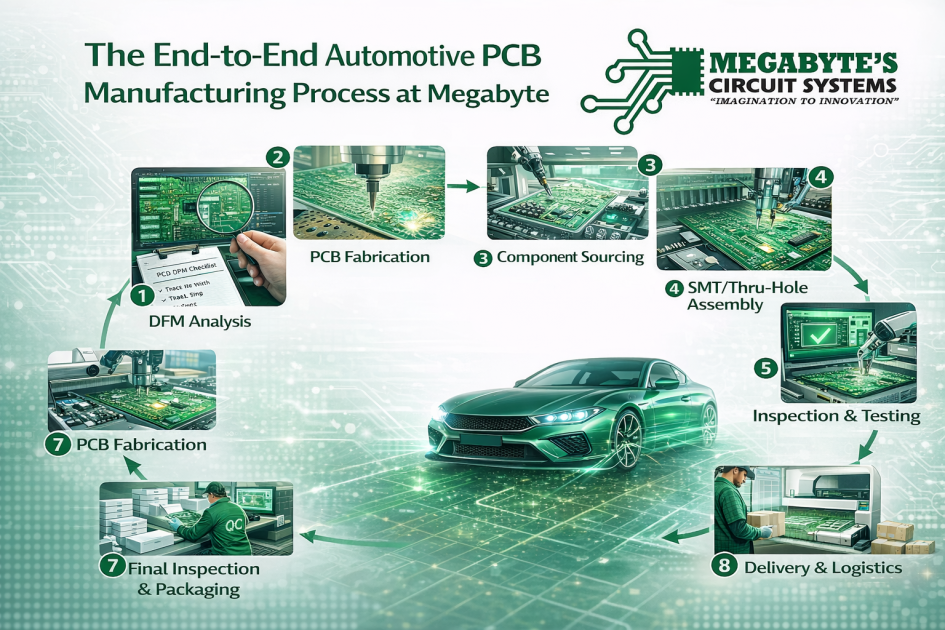
The End-to-End Automotive PCB Manufacturing Process at Megabyte

The End-to-End Automotive PCB Manufacturing Process at Megabyte

From Gerber review to final shipment, every step is IATF 16949 controlled:

  1. Engineering & DFM review (24–48 hrs)
  2. Inner layer imaging & etching
  3. Automated lay-up & lamination (vacuum press)
  4. Drilling + PTH + back-drilling for high-speed signals
  5. Outer layer + solder mask + surface finish (ENIG preferred for automotive)
  6. 100 % flying-probe + fixture electrical test
  7. AOI + X-ray + cross-section verification
  8. Final QC with full traceability report

For urgent EV prototypes we offer quick-turn automotive PCBs in 5–7 working days using our dedicated automotive line.

Quality Control & Standards That Give You Peace of Mind

Every board leaving our Ahmedabad facility carries:

  • IPC-A-600 Class 3 inspection report
  • 100 % electrical test data
  • Ionic contamination test (below 1.56 µg/cm²)
  • Thermal stress test coupons
  • Solderability test per J-STD-003

We also provide PPAP documentation (Production Part Approval Process) when your customer demands it, something very few PCB manufacturers in India are equipped to deliver.

Cost Optimization Strategies for Automotive PCB Manufacturing in India

Indian automotive buyers can achieve 18–28 % lower landed cost compared to China when volume crosses 500 pcs/lot. Here’s how:

  • Lock stack-up and materials early → avoid NRE charges
  • Use our PCB Manufacturing service with standard panel sizes
  • Choose ENIG over HASL for zero-lead compliance
  • Order in quarterly blanket orders instead of monthly spot orders
  • Combine single-layer sensor boards with multilayer main boards in same panel run

For Single Layer PCB dashboard indicators or Double Layer PCB body-control modules, we regularly beat imported pricing while delivering in 8–10 days.

Frequently Asked Questions

What is the minimum order quantity for automotive PCBs in India?

For prototypes we start at 5–10 pcs. Production typically begins at 100–500 pcs/lot depending on board complexity.

Do you provide IATF 16949 and PPAP documentation?

Yes. Every automotive project includes full PPAP Level 3 documentation as standard.

What surface finish is best for automotive applications?

ENIG (Electroless Nickel Immersion Gold) is the industry choice because of excellent solderability after multiple reflows and long shelf life.

Can you handle high-current heavy copper PCBs for EV chargers?

Absolutely. We regularly manufacture 3 oz and 4 oz outer layers with 2 oz inner layers for 48 V and 800 V battery-management systems.

How do you ensure traceability for every board?

Every panel carries a unique job number laser-marked. We maintain digital records of laminate batch, drill program, and test results for 15 years.

What is the typical lead time for multilayer automotive PCBs?

5–7 days for prototypes, 12–15 days for production lots of 500+ pcs.

Ready to Move Your Automotive PCB Production to India?

At Megabyte Circuit Systems in Ahmedabad, Gujarat, we’ve built our entire process around the exact needs of Indian automotive and EV companies. Whether you need 10 prototype boards for an ADAS module or 10,000 multilayer ECUs every month, you’ll get consistent Class 3 quality, full documentation, and pricing that makes “Make in India” actually profitable.

Upload your Gerber files right now on our PCB Calculator or drop me a message for a same-day technical review and quote.

Your next automotive board is only one click away from being manufactured by a partner who truly understands what’s under the hood.

Harshil Patel, Senior Consultant & Head of Automotive PCB Projects

Megabyte Circuit Systems, Ahmedabad

Categories
PCB Guide

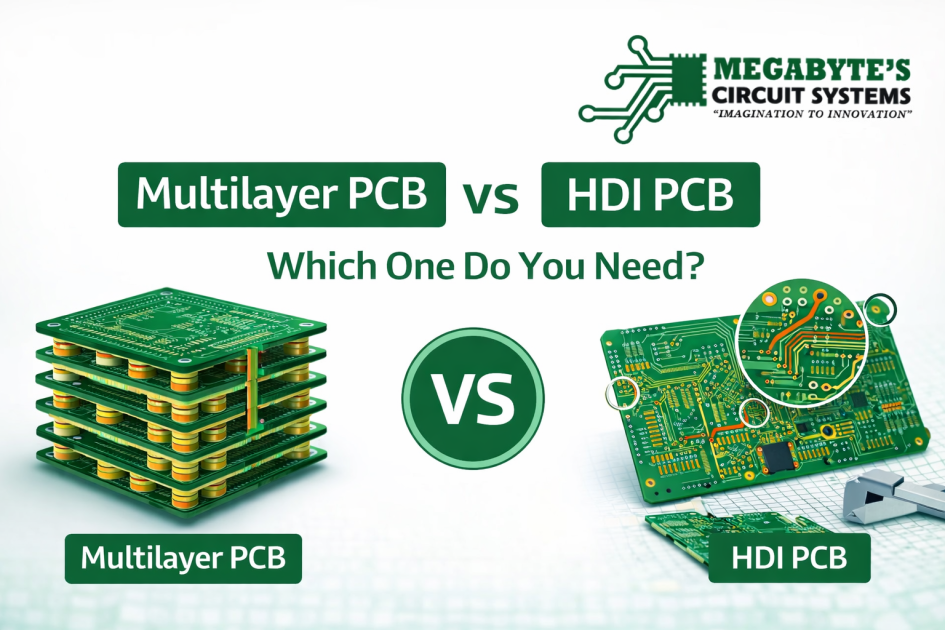
Multilayer PCB vs HDI PCB: Which One Do You Need?

Multilayer PCB vs HDI PCB: Which One Do You Need?

If you’re designing a new IoT device, industrial controller, or compact consumer gadget in India, one question often comes up during the layout stage: Should I go with a standard multilayer PCB or step up to an HDI PCB?

Many hardware engineers and procurement teams I’ve worked with over the years face this exact dilemma. A standard multilayer board feels familiar and budget-friendly, but as components get finer (think 0.4mm or 0.3mm pitch BGAs, high-speed interfaces like PCIe or DDR), space constraints and signal integrity issues push them toward High-Density Interconnect (HDI) technology.

In this guide, I’ll break it down clearly from construction differences to real-world performance, cost implications in the Indian manufacturing context, and practical DFM advice. By the end, you’ll know exactly which one your project needs, and how to optimize your design for reliable fabrication.

Quick Technical Summary

Standard multilayer PCBs use through-hole vias and conventional lamination for 4–16+ layers. HDI PCBs employ microvias (≤150µm), blind/buried vias, and sequential build-up for higher routing density in a smaller footprint. Choose multilayer for cost-sensitive, moderate-density designs; go HDI when you need miniaturization, finer traces, or superior high-speed performance.

What Is a Standard Multilayer PCB?

A multilayer PCB consists of three or more copper layers laminated together with prepreg and core materials, typically FR4. Connections between layers are made primarily with plated through-hole (PTH) vias that go all the way through the board.

These boards are the workhorse of electronics manufacturing. You can have 4-layer, 6-layer, 8-layer, or even 12–16 layer stack-ups depending on routing complexity, power distribution, and grounding needs.

In my 20+ years at Megabyte Circuit Systems in Ahmedabad, I’ve seen multilayer PCBs handle everything from simple industrial automation boards to moderately complex medical and automotive controllers. They offer good impedance control, solid thermal management with proper plane layers, and are straightforward to fabricate with high yield.

Common features:

  • Trace width/spacing: usually 4–6 mil or more
  • Via diameter: 0.3mm (12 mil) or larger
  • Reliable for most medium-speed signals

If your design fits comfortably in a standard size with these parameters, a multilayer board often gives the best balance of performance and cost.

What Is an HDI PCB?

HDI (High-Density Interconnect) PCBs take multilayer technology further. They achieve significantly higher wiring density per unit area by using microvias (laser-drilled holes typically 50–150µm in diameter), blind vias, buried vias, and sequential lamination processes.

Instead of drilling one big through-hole that wastes space on every layer, HDI allows connections only where needed between adjacent layers or specific build-up layers. This frees up routing channels and lets you pack more components into a smaller board.

HDI stack-ups are often described as 1+N+1, 2+N+2, or even Any-Layer HDI (ELIC). Microvias can be stacked (aligned vertically for maximum density) or staggered (offset for better reliability).

HDI shines in applications demanding miniaturization and high performance:

  • Smartphones and wearables
  • 5G modules and high-speed networking
  • Automotive ADAS systems
  • Medical imaging devices
  • Advanced IoT gateways with dense sensor integration

Quick Technical Summary

HDI uses laser-drilled microvias with low aspect ratios (≤0.8:1 or 1:1) for reliable plating, enabling trace/space down to 3/3 mil or finer. This results in shorter signal paths, reduced parasitic inductance/capacitance, and better EMI control compared to traditional multilayer boards with longer PTH vias.

Key Differences: Multilayer PCB vs HDI PCB

Here’s a clear side-by-side comparison that many of my clients find helpful when explaining choices to their teams:

Feature

Standard Multilayer PCB

HDI PCB

Via Types

Primarily through-hole (PTH)

Microvias, blind, buried vias

Via Diameter

≥0.3mm (12 mil)

0.05–0.15mm (2–6 mil)

Trace/Space

4–6 mil typical

2–4 mil or finer

Routing Density

Moderate

Very High

Board Size

Larger for same functionality

Significantly smaller & lighter

Layer Count Efficiency

Needs more layers for complex routing

Achieves same routing in fewer effective layers

Signal Integrity

Good for most applications

Superior for high-speed (>5GHz) & fine-pitch BGA

Manufacturing Complexity

Standard lamination & drilling

Sequential build-up, laser drilling

Typical Cost

Lower

20–50%+ higher (depends on stack-up)

Best For

Industrial controls, power electronics, medium IoT

Compact consumer, 5G, medical, automotive ADAS

The biggest practical difference? Space and signal path length. In HDI, you can fan out a 0.4mm pitch BGA without needing extra layers or board area, and signals travel shorter distances with fewer stubs improving integrity and reducing crosstalk.

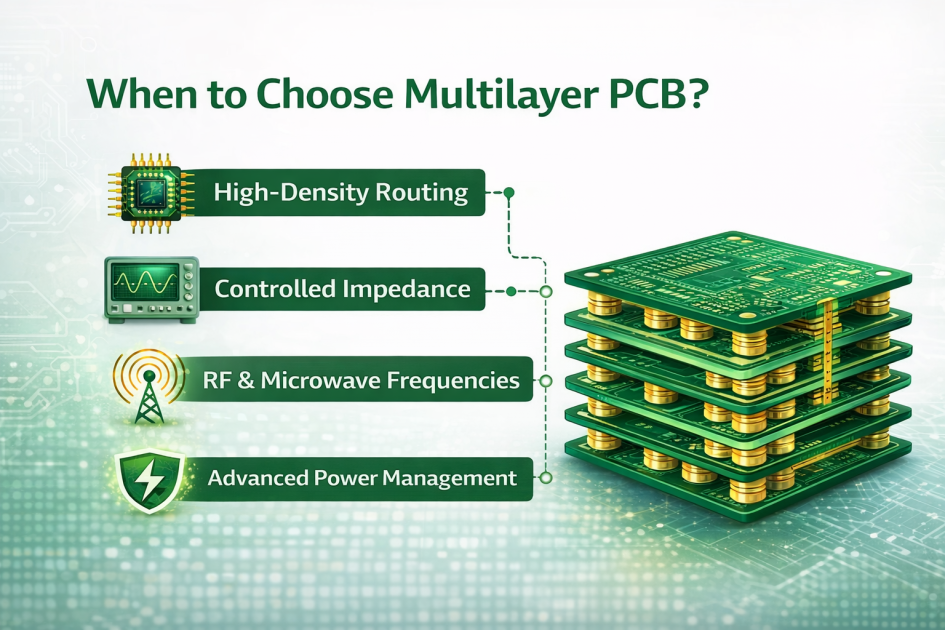
When to Choose Multilayer PCB

When to Choose Multilayer PCB

Go with a standard multilayer PCB in these common scenarios:

  • Your design has moderate component density and larger available board space.
  • Signal speeds are below ~5GHz with standard interfaces.
  • Budget and lead time are primary concerns (especially for prototypes or medium volumes in India).
  • You need robust power/ground planes for thermal or current handling.
  • Simpler supply chain most Indian fabricators handle multilayer very well.

One thing I always tell startup teams: Don’t over-specify. A well-optimized 6-layer or 8-layer board with good DFM often outperforms a rushed HDI design in both reliability and total project cost.

We frequently recommend starting with multilayer and only moving to HDI when layout tools show you can’t meet size or routing constraints otherwise.

When to Choose HDI PCB

Consider HDI when:

  • Board real estate is extremely limited (wearables, handheld devices, drones).
  • You’re using fine-pitch components (0.5mm or smaller BGAs, QFNs with high pin count).
  • High-speed signals demand minimal via stubs and better impedance control.
  • You need to reduce overall product size/weight for market competitiveness.
  • EMI/EMC compliance is critical in dense layouts.

In 2026, with 5G, edge AI, and compact industrial IoT growing fast in India, HDI is becoming the default for many new designs.

However, HDI comes with trade-offs: higher upfront tooling, stricter DFM rules, and potentially longer lead times if your fabricator isn’t experienced.

Quick Technical Summary

Multilayer PCBs suit cost-effective, reliable medium-complexity designs with through vias. HDI excels in miniaturization and high-performance scenarios through microvias and build-up technology, but requires tighter design rules and advanced manufacturing capabilities. Evaluate your component pitch, signal frequency, and target form factor first.

Design for Manufacturing (DFM) Tips: Engineer’s Checklist

Whether you choose multilayer or HDI, good DFM saves headaches and money. Here’s what I share with every client uploading Gerber files:

For Multilayer PCBs:

  • Maintain minimum 4/4 mil trace/space where possible for better yield.
  • Keep via aspect ratio reasonable (≤8:1 or better).
  • Balance copper distribution across layers to avoid warping.
  • Provide clear stack-up drawing with material specs (standard FR4, high Tg if needed).

For HDI PCBs (Critical):

  • Define microvia diameter, pad size, and aspect ratio clearly (target ≤1:1).
  • Prefer staggered microvias over stacked for better long-term reliability under thermal cycling.
  • Use via-in-pad only when necessary and specify filling/plating requirements per IPC-4761.
  • Plan your stack-up early 1+N+1 for simpler HDI, 2+N+2 for denser routing.
  • Avoid skip vias if possible; they increase complexity and risk.

Common mistake I see: Engineers design in CAD without consulting fabrication limits, then face costly revisions. Always run a DFM check early.

At Megabyte, we review every file and suggest optimizations often reducing layers or improving yield without changing functionality.

Quality Control & Indian Manufacturing Standards

Whether multilayer or HDI, quality matters. We follow IPC-A-600 Class 2 or Class 3 standards depending on application, perform flying probe or bed-of-nails electrical testing (E-test), and conduct AOI, X-ray for vias, and cross-section analysis for critical builds.

In India, material consistency (FR4 from trusted suppliers) and process control make a big difference in HDI reliability. Look for fabricators with in-house laser drilling and sequential lamination experience.

Cost Optimization for Multilayer vs HDI in India

Multilayer generally offers lower per-board cost and faster turnaround ideal for prototypes to medium volumes. You can often get competitive pricing with quick-turn options.

HDI costs more due to laser drilling, multiple lamination cycles, and tighter tolerances. However, it can reduce overall system cost by shrinking enclosure size, lowering assembly complexity, or even reducing layer count in some cases.

Tips for best pricing:

  • Optimize panel utilization.
  • Choose standard materials and stack-ups.
  • Order in higher quantities where possible.
  • Provide complete, clean Gerber/ODB++ files with clear notes.

Use our PCB Calculator to get instant estimates for both options. Many clients discover that a well-designed multilayer meets 80% of needs at half the premium of HDI.

For complex projects, we also support PCB Design Service and PCB Developing Services to refine your layout for manufacturability.

If you’re exploring basic options first, check our Single Layer PCB, Double Layer PCB, or Multilayer PCB pages.

FAQs

1. Is HDI PCB always better than multilayer PCB?

No. HDI is better when you need higher density or superior high-speed performance in a small form factor. For many industrial and IoT applications in India, a well-designed multilayer PCB delivers excellent reliability at lower cost and faster lead times.

2. How much more expensive is HDI compared to standard multilayer?

Typically 20–60% higher depending on stack-up complexity, via structure, and volume. However, total product cost (including enclosure and assembly) can sometimes be lower with HDI due to miniaturization.

3. Can I convert my existing multilayer design to HDI?

Yes, often. We help many clients re-layout for HDI to shrink board size or add functionality without increasing layers significantly. Early consultation gives the best results.

4. What via type is recommended for reliable HDI boards?

Staggered microvias generally offer better reliability than stacked, especially in thermal cycling environments common in Indian industrial applications. Stacked vias save space but need careful filling and plating.

5. Does Megabyte Circuit Systems manufacture both multilayer and HDI PCBs?

Yes. We fabricate standard multilayer up to 16+ layers and support HDI with microvias and advanced build-ups. Our Ahmedabad facility handles quick-turn prototypes as well as production volumes.

6. How do I decide during the design phase?

Start with component footprint analysis and routing estimates in your CAD tool. If you struggle with fan-out or hit size limits, evaluate HDI. Share your schematic and preliminary layout with us we’ll give honest feedback on the best option.

Ready to Build Your Next PCB?

Choosing between multilayer PCB and HDI PCB ultimately comes down to your project’s specific needs size, performance, budget, and timeline.

At Megabyte Circuit Systems, based in Ahmedabad, Gujarat, India, we’ve guided hundreds of Indian hardware engineers and startups through exactly this decision. Our team combines deep fabrication expertise with practical design-for-manufacturing advice to deliver reliable boards on time.

Upload your Gerber files today, use the PCB Calculator for instant pricing, or simply request a quote. Whether you need standard multilayer or advanced HDI, we’ll help you get it right the first time.

Have questions about your specific design? Drop us a message I’m always happy to discuss technical details and find the most practical solution for your team.

Let’s build something reliable together.

  –   Harshil Patel, Senior Consultant, Megabyte Circuit Systems

Categories
PCB Guide

Best PCB Manufacturer in India: How to Choose the Right Partner

Best PCB Manufacturer in India: How to Choose the Right Partner

If you’re searching for the best PCB manufacturer in India, you’re probably facing a very real challenge.

You have a design ready. Maybe your Gerber files are finalized. Maybe you’re still iterating. But one question is always there:

“Can I trust this manufacturer with my product?”

In my 20+ years of working with hardware engineers, startups, and procurement teams across India, I’ve seen this decision make or break entire projects. A PCB is not just a component it’s the foundation of your product’s reliability. If something goes wrong at this stage, the cost doesn’t stay limited to the board. It affects testing, assembly, performance, and sometimes even your brand reputation.

This guide is not just theory. I’ll walk you through how experienced engineers actually evaluate PCB manufacturers in India what matters, what doesn’t, and how to avoid expensive mistakes.

Understanding What “Best PCB Manufacturer” Really Means

When people say “best PCB manufacturer,” they often think in terms of price or speed. But in reality, the definition is much deeper.

A good PCB manufacturer ensures your board works.
A great PCB manufacturer ensures your product succeeds.

There’s a difference.

For example, I’ve seen cases where a low-cost manufacturer delivered boards on time, but the impedance was off by just enough to cause signal integrity issues. The product worked in lab testing but failed in real-world conditions. The redesign cost was far higher than what was saved initially.

That’s why the right partner is someone who understands not just fabrication, but also application-level requirements whether it’s IoT, automotive, RF, or industrial electronics.

Quick Technical Summary

The best PCB manufacturer is not the cheapest it’s the one who ensures performance, reliability, and scalability from prototype to production.

Manufacturing Capability: Can They Handle Your Design Today and Tomorrow?

One of the first things I always evaluate is whether the manufacturer can handle both current requirements and future complexity.

A simple prototype might work on a 2-layer board today, but what happens when your design evolves into a multilayer PCB with controlled impedance?

This is where many partnerships fail. Engineers choose a vendor based on current needs, only to realize later that the same vendor cannot support advanced designs.

For example, basic boards like
Single Layer PCB are relatively straightforward. But once you move into Double Layer PCB and especially Multilayer PCB you start dealing with stack-ups, signal integrity, EMI control, and thermal considerations.

A capable manufacturer should be able to guide you through these transitions not just accept your files and fabricate blindly.

Quick Technical Summary

Choose a manufacturer that supports multilayer PCBs, tight tolerances, and advanced materials to future-proof your product.

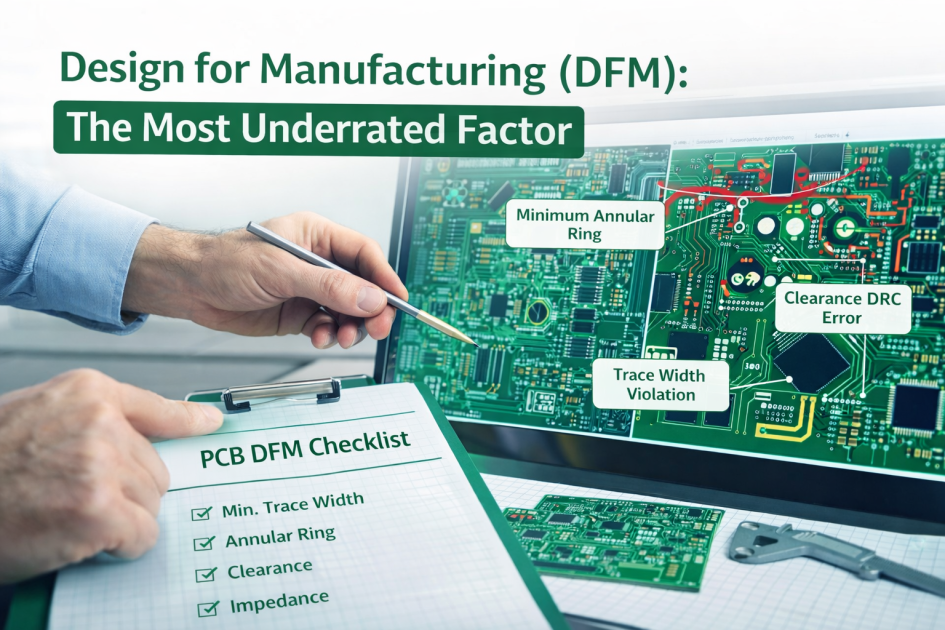
Design for Manufacturing (DFM): The Most Underrated Factor

Design for Manufacturing (DFM) The Most Underrated Factor

Let me be very direct here.

Most PCB issues don’t happen in manufacturing they start in design.

And if your manufacturer is not reviewing your design, you’re taking a big risk.

DFM (Design for Manufacturing) is where an experienced partner adds real value. Instead of simply fabricating what you send, they check whether your design is actually manufacturable and reliable.

In real projects, we often see problems like trace widths being too narrow for the required current, insufficient annular ring sizes, or poor solder mask clearance. These are not design “mistakes” in the traditional sense they are optimization issues that only show up when design meets manufacturing reality.

For example, current handling in a PCB trace is not arbitrary. It depends on copper thickness, width, and temperature rise:

𝐼=𝑘⋅(Δ𝑇)0.44⋅(𝐴)0.725I=k⋅(ΔT)0.44⋅(A)0.725

Without proper calculation or validation, overheating becomes a real issue.

And if your design is still evolving, working with experts through PCB Design Service can significantly reduce iterations and time-to-market.

Quick Technical Summary

DFM ensures your PCB design is manufacturable, reliable, and cost-efficient before production even begins.

Quality Standards: Where Serious Manufacturers Stand Apart

This is where the gap between average and top-tier PCB manufacturers becomes very clear.

A serious manufacturer doesn’t rely on visual inspection alone. They follow structured, globally accepted standards like IPC-A-600 and IPC-6012, which define how a PCB should be built and inspected.

Testing is not optional it’s essential.

For prototypes, flying probe testing is often used because it doesn’t require fixtures. For production, E-test (electrical testing) ensures every connection is verified. Automated Optical Inspection (AOI) helps detect defects that are invisible to the naked eye.

In my experience, skipping or compromising on testing is one of the fastest ways to create field failures. And those failures don’t just cost money they damage trust.

Quick Technical Summary

High-quality PCB manufacturers follow IPC standards and perform thorough testing like AOI and E-test to ensure zero-defect delivery.

Cost vs Value: The Biggest Misunderstanding

Let’s talk honestly about cost.

India is known for cost-effective PCB manufacturing, and that’s absolutely true. But there’s a difference between low cost and optimized cost.

A cheaper PCB might use lower-grade material, inconsistent copper thickness, or poor plating quality. These differences are not always visible immediately, but they affect long-term performance.

On the other hand, an optimized PCB balances cost with performance.

For example, choosing between single, double, and multilayer boards is not just about price it’s about functionality.

PCB Type

Typical Use Case

Cost Impact

Complexity

Single Layer

Basic circuits, power supply

Low

Simple

Double Layer

Embedded systems, IoT

Medium

Moderate

Multilayer

High-speed, industrial

High

Complex

In many cases, I’ve advised clients to slightly increase their initial PCB cost to avoid much larger costs in redesign, testing delays, or product failures.

Quick Technical Summary

Focus on value, not just price. A slightly higher upfront cost often saves significant long-term expenses.

Lead Time and Scalability: From Prototype to Production

Speed matters but consistency matters more.

A good PCB manufacturer should be able to deliver quick prototypes, but also maintain the same quality when you scale to production volumes.

This transition phase is where many vendors struggle.

You might receive excellent prototype boards, but when you move to bulk production, variations start appearing different solder mask quality, inconsistent drilling, or even dimensional inaccuracies.

A reliable partner ensures process consistency, not just fast delivery.

Quick Technical Summary

Choose a manufacturer who can maintain consistent quality from prototype to mass production.

Communication: The Silent Deciding Factor

This might sound simple, but it’s one of the most important factors.

A good manufacturer communicates clearly. A great one communicates proactively.

If you send Gerber files and receive no feedback, that’s not efficiency that’s a warning sign. A serious partner will review your design, ask questions, and suggest improvements.

In real-world projects, this communication often prevents major issues before they happen.

Quick Technical Summary

Strong communication ensures fewer errors, faster decisions, and smoother project execution.

Why India (and Ahmedabad) is a Smart Choice

India has rapidly become a strong hub for PCB manufacturing, thanks to its combination of technical expertise, competitive pricing, and growing electronics ecosystem.

Cities like Ahmedabad, Gujarat are especially well-positioned because of strong industrial infrastructure and access to skilled engineers.

Companies like Megabyte Circuit Systems have built their reputation by combining local manufacturing strength with global quality standards.

FAQs

What is the best PCB manufacturer in India?

The best manufacturer is one who combines technical expertise, quality standards, and reliable communication, not just low pricing.

How do I choose the right PCB partner?

Look for experience, DFM support, testing capabilities, and scalability. Always evaluate beyond cost.

What is DFM in PCB manufacturing?

DFM ensures your design is optimized for production, reducing errors and improving reliability.

How long does PCB manufacturing take?

Prototypes can be ready in 2–3 days, while production depends on complexity and quantity.

What affects PCB cost the most?

Layer count, material, board size, and quantity are the biggest cost drivers.

Conclusion: Work with a Partner Who Thinks Like an Engineer

If you’ve read this far, you already understand something important:

Choosing the right PCB manufacturer is not a purchasing decision it’s an engineering decision.

At Megabyte Circuit Systems, based in Ahmedabad, Gujarat, we work closely with engineers, startups, and industries to ensure their designs are not just manufactured but optimized, tested, and ready for real-world performance.

If you already have your Gerber files ready, you can:

And if you’re still in the design phase, our team can guide you through every step just like a true technical partner.

Categories
PCB Guide

PCB Manufacturer, Prototype vs Mass Production: Choosing the Right Partner in India

PCB Manufacturer, Prototype vs Mass Production: Choosing the Right Partner in India

Bringing a new electronic hardware product to market is a rigorous process that demands precision at every stage. For hardware engineers and product managers, one of the most critical decisions involves selecting the right fabrication partner. The hardware development lifecycle typically dictates working with two distinct types of facilities: a prototype facility for early-stage validation and a mass production facility for market rollout. Understanding the operational, financial, and technical distinctions between these two types of vendors is essential for maintaining product quality and protecting your bottom line.

The electronics manufacturing sector is currently experiencing a massive shift, particularly within the Indian subcontinent. From the bustling electronic manufacturing clusters in the Peenya Industrial Area of Bangalore to the rapidly expanding GIDC (Gujarat Industrial Development Corporation) estates in Ahmedabad, the region is cementing its position as a global hardware hub. Within this dynamic environment, finding a reliable PCB Manufacturer India offers requires a deep understanding of your project’s current lifecycle stage and future scalability requirements.

The Role of a Prototype PCB Manufacturer

During the initial stages of hardware development, the primary objective is validation. Engineers must verify that the circuit design functions exactly as intended, testing for signal integrity, power distribution, and physical form factor. A prototype facility is specifically optimized for this iterative process. These manufacturers prioritize speed, flexibility, and the ability to process multiple unique designs simultaneously, rather than focusing on high-volume efficiency.

When working on early-stage iterations, engineers frequently encounter design flaws or optimization opportunities. A facility geared toward prototyping anticipates these changes. The production lines are designed to handle rapid changeovers, utilizing direct imaging techniques rather than creating expensive, permanent photo-tooling. This agility allows hardware teams to receive a small batch of boards often ranging from a single unit to fifty pieces—within a matter of days. If your team is currently in the testing phase, utilizing rapid turnaround prototype PCB fabrication services is the most efficient way to validate your schematics without committing substantial capital.

Furthermore, prototyping facilities often carry a wider variety of specialized laminate materials in smaller quantities. Because they do not need to secure bulk supply chains for a single order, they can accommodate experimental builds, such as high-frequency RF boards or specialized metal-core designs, giving engineers the freedom to test boundary-pushing concepts.

The Mechanics of Mass Production PCB Manufacturing

Once a design is fully validated and locked, the project transitions into the mass production phase. At this stage, the priorities shift entirely. Speed of initial delivery becomes secondary to unit cost reduction, absolute consistency across thousands of boards, and rigorous quality control. A mass production facility operates on the principle of economies of scale.

In high-volume PCB manufacturing, the setup process is intensive. Engineers at the fabrication house will spend significant time generating precise photo-tooling, optimizing CNC drill paths to minimize machine travel time, and setting up automated optical inspection (AOI) parameters. This extensive setup generates higher Non-Recurring Engineering (NRE) costs upfront. However, once the production line is operational, the cost per individual circuit board drops exponentially.

Mass production facilities also implement stringent statistical process control (SPC). When producing tens of thousands of units, even a microscopic deviation in etching chemistry or lamination temperature can result in massive yield losses. Therefore, these facilities invest heavily in automated chemical analysis and environmental controls to ensure that the ten-thousandth board is identical to the first.

Key Differences in the Fabrication Process

To effectively manage a hardware project, stakeholders must understand the specific operational differences between these two manufacturing approaches. The divergence impacts everything from budgeting to procurement timelines.

Tooling and Setup Costs: Prototype manufacturers often absorb or minimize tooling costs because they use digital manufacturing methods like laser direct imaging (LDI) and flying probe testing. Mass production requires physical film generation and custom bed-of-nails testing fixtures. These permanent fixtures are expensive to create but are essential for testing thousands of boards rapidly. To manage your project budget effectively, it is highly recommended to spend time accurately estimating your printed circuit board fabrication costs before shifting from prototyping to volume production.

Material Procurement: A prototype run uses whatever standard FR4 laminates the manufacturer has in stock. Mass production, however, requires exact material specification. The manufacturer must secure large batches of specific copper-clad laminates, prepreg, and solder mask from their supply chain. This procurement process can add weeks to the lead time but guarantees material consistency across the entire production run.

Yield Expectations: In prototyping, yield is less of a concern. If a facility needs to deliver ten boards, they might start twelve panels to account for potential defects. In mass production, yield optimization is the primary driver of profitability. The facility will meticulously analyze the design to ensure maximum panel utilization, reducing wasted FR4 material and lowering the final unit price.

The Critical Bridge: Design for Manufacturability

The most dangerous phase of hardware development is the transition between the prototype bench and the mass production line. A board that functions perfectly in a batch of five may fail miserably when scaled to a batch of five thousand. This failure usually stems from a lack of DFM analysis.

Design for Manufacturability involves adjusting trace widths, annular rings, via structures, and component spacing to align with the specific tolerances of high-volume manufacturing equipment. For instance, a prototype facility might easily fabricate a 3-mil trace using specialized low-volume equipment, but a standard mass production line might struggle to etch that same trace consistently without acid traps or over-etching.

By implementing robust design for manufacturability (DFM) support early in the design phase, engineering teams can identify and eliminate these production bottlenecks. This proactive approach prevents costly redesigns, avoids delayed product launches, and ensures that the transition to a mass production facility is completely seamless.

Layer Complexity and Production Scaling in India

The complexity of your circuit board heavily influences how you select a vendor in India. The manufacturing ecosystem here handles everything from basic consumer goods to advanced aerospace electronics.

For simple consumer electronics, appliances, or LED lighting systems, manufacturers often rely on straightforward, subtractive fabrication processes. If your product falls into this category, establishing a relationship with a vendor capable of reliable single-layer PCB production runs will yield the best profit margins due to the highly automated nature of these specific production lines.

Conversely, industrial controls, telecommunications equipment, and complex IoT devices require dense routing that is only possible with multiple layers. Scaling a multi-layer board introduces immense complexity, requiring precise impedance control, blind/buried vias, and exact layer-to-layer registration during the lamination cycle. When transitioning these complex designs, hardware teams must rigorously vet their partners. 

Engaging with an established entity like Megabytes Circuit Systems ensures that strict quality parameters are maintained. For advanced projects, sourcing high-density multi-layer printed circuit boards in Ahmedabad provides access to state-of-the-art lamination presses and strict environmental controls necessary for high-yield production.

Partnering with Megabytes Circuit Systems provides a distinct advantage, as their engineering teams understand the nuances of both the agile prototyping phase and the stringent requirements of high-volume scaling. This dual expertise minimizes the friction typically experienced when moving a product from the laboratory into the hands of consumers.

Frequently Asked Questions

What is the minimum order quantity for a prototype PCB manufacturer?

A prototype PCB manufacturer typically has no strict minimum order quantity, allowing engineers to order as few as one to five boards. This low-volume approach focuses on design validation and functional testing before committing to expensive mass production tooling and setup costs.

Because the primary goal is rapid iteration, prototype facilities structure their pricing to accommodate these micro-batches. They utilize digital imaging and flying probe testing to eliminate the need for physical tooling. While the per-unit cost is significantly higher than in mass production, the total financial risk is kept to an absolute minimum, allowing hardware startups and engineering departments to iterate through multiple design versions quickly.

How does PCB manufacturing differ between single-layer and multi-layer mass production?

Single-layer mass production is highly automated and extremely cost-effective due to its simple subtractive process. Multi-layer mass production requires complex lamination cycles, precise layer registration, and advanced drilling techniques, significantly increasing both the manufacturing time and the stringent quality control requirements.

In a single-layer board, the manufacturer simply drills the FR4, applies the etch resist, etches away the unwanted copper, and applies the solder mask. Multi-layer boards, however, require the inner layers to be etched and optically inspected first. These layers are then carefully aligned and bonded together under immense heat and pressure using prepreg materials. Any slight misalignment during this lamination phase will result in a short circuit, making the entire panel unusable. This is why multi-layer mass production demands much higher technical competency from your chosen fabrication partner.

Why should I choose a PCB manufacturer in India for my electronics project?

Choosing a PCB manufacturer in India provides a strategic advantage through competitive labor costs, rapidly advancing technological infrastructure, and strong government incentives. Facilities across industrial hubs like Gujarat and Karnataka now offer world-class quality standards that rival global competitors while mitigating international supply chain risks.

The Indian electronics manufacturing sector has matured significantly over the last decade. Industrial zones such as the GIDC in Ahmedabad and the electronics manufacturing clusters in Sriperumbudur are equipped with modern fabrication machinery capable of handling high-density interconnect (HDI) designs. Working with an indigenous partner like Megabytes Circuit Systems not only reduces shipping times and import duties but also provides easier communication and accessibility for on-site quality audits during critical mass production runs.

Categories
PCB Guide

PCB Layout vs PCB Schematic: Key Differences and Engineering Principles

PCB Layout vs PCB Schematic: Key Differences and Engineering Principles

Electronics engineering requires absolute precision at every phase of development. The journey from an initial concept to a fully functional electronic device relies heavily on two distinct but deeply interconnected phases: the schematic capture and the physical board design. While often confused by novices or categorized under the same general umbrella, experienced engineers understand that the schematic acts as the logical blueprint, whereas the physical rendering represents the tangible reality of the hardware. Mastering the transition between these two phases is essential for producing reliable, high-performance electronics.

At Megabytes Circuit Systems, we recognize that a flawless logical diagram can still result in a failing board if the subsequent engineering phases lack rigorous oversight. Understanding the precise boundaries, functions, and rules of both domains is critical for hardware developers, especially as component densities increase and signal speeds push the limits of traditional physics.

What is a PCB Schematic?

A PCB Schematic is a logical, two-dimensional circuit diagram that dictates how electronic components connect to one another. It serves as the theoretical foundation of the entire project. In this phase, physical dimensions, material properties, and spatial constraints do not apply. Instead, the focus remains entirely on electrical connectivity and functional logic.

Engineers utilize standardized symbols to represent resistors, capacitors, integrated circuits, and microcontrollers. These symbols are connected by lines known as “nets,” which represent the electrical pathways. A well-drafted schematic clearly defines the voltage levels, input/output relationships, and the overall functional architecture of the circuit. It is the document that firmware engineers study to understand pin assignments and that test engineers review to verify expected electrical behaviors.

The schematic is also responsible for generating the Bill of Materials (BOM) and the netlist. The netlist is a crucial data file that lists every single electrical connection required in the circuit. Without a perfectly accurate netlist, the subsequent physical design phase will inherently fail, regardless of how meticulously the physical routing is handled.

What is a PCB Layout?

The PCB Layout is the physical representation of the logical schematic. If the schematic is the theoretical blueprint, the layout is the architectural rendering that dictates exactly how the board will be manufactured. This phase transitions the project from pure logic into the realm of physical physics, mechanical constraints, and material science.

During PCB Layout Design, engineers must assign physical dimensions—known as footprints—to every symbol from the schematic. A resistor that was merely a squiggly line on the schematic now becomes a specific surface-mount package, such as an 0402 or 0805 footprint, with exact pad dimensions. The nets from the schematic are converted into physical copper traces routed across various layers of FR4 or other substrate materials.

This phase requires intense attention to real-world variables. Engineers must manage thermal dissipation, ensuring that high-power components do not overheat the substrate. They must calculate trace widths to handle specific current loads and manage impedance for high-speed digital signals to prevent data corruption. When dealing with complex hardware, such as engineering complex multi-layer printed circuit boards, the layout must carefully manage internal routing, ground planes, and blind or buried vias to maintain signal integrity.

Core Differences Between Logic and Physical Design

Quality Control & Standards: Why IPC-A-600 Matters

To fully grasp the engineering workflow, one must clearly delineate the differences between these two phases. The distinctions fall into several distinct categories:

  • Purpose: The schematic proves that the circuit works in theory. The layout proves that the circuit can be manufactured and operate in reality.
  • Dimensionality: Schematics are abstract and two-dimensional, focusing on readability. Layouts are strictly bound by three-dimensional physical constraints, including the enclosure size and component heights.
  • Representation: Schematics use universal symbols (like a triangle for an operational amplifier). Layouts use exact mechanical footprints that match the physical dimensions of the purchased component.
  • Rules and Constraints: Schematic rules primarily involve electrical connectivity and logic. Layout rules involve physical clearances, creepage distances, copper weight, thermal reliefs, and electromagnetic interference (EMI) mitigation.

Even for less complex projects, such as standard double-layer circuit board configurations, the transition from logic to physical routing requires careful spatial planning to ensure traces do not cross and ground returns are kept as short as possible.

The Transition Process: From Netlist to Physical Routing

The bridge between the schematic and the physical board is the netlist. Once the schematic is verified and approved, the engineering software generates this file and imports it into the physical design workspace. Instantly, all the required component footprints appear, connected by thin, unrouted lines known as a “ratsnest.”

The first step in the physical phase is component placement. This is arguably the most critical part of PCB Layout Design. Components must be grouped logically. Power supplies should be placed near the power inputs, bypass capacitors must be placed immediately adjacent to the power pins of integrated circuits, and high-speed digital lines must be kept away from sensitive analog signals.

Once placement is optimized, the routing begins. Engineers replace the theoretical ratsnest lines with physical copper traces. This involves calculating the exact width of the copper based on the current it must carry and the temperature rise allowed. During this phase, utilizing calculating precise manufacturing costs and material specifications becomes vital to ensure the physical design aligns with the project’s financial and physical manufacturing limits.

Manufacturing Realities in the Indian Electronics Sector

The physical design must account for the actual capabilities of the manufacturing facility. In India, the rapid expansion of electronics manufacturing hubs has created a robust ecosystem for hardware development. From Bengaluru’s Electronics City to the specialized Gujarat Industrial Development Corporation (GIDC) estates in Ahmedabad, and the automotive-focused tech corridors in Pune, the Make in India initiative has driven demand for high-precision engineering.

However, local manufacturing capabilities dictate layout rules. Engineers must verify the minimum trace widths, minimum via drill sizes, and annular ring tolerances that local fabrication houses can reliably produce. This is where implementing rigorous design for manufacturability protocols becomes essential. A layout that looks perfect on a computer screen is useless if a fabrication plant in Ahmedabad or Pune cannot physically etch the dense copper traces without causing short circuits.

By consulting with fabrication experts early in the layout phase, engineers can avoid costly redesigns. Megabytes Circuit Systems continually emphasizes that aligning the physical layout with regional manufacturing capabilities ensures higher yield rates and significantly reduces time-to-market.

Testing and Prototyping

Before committing to mass production, the layout must be validated through prototyping. While the schematic can be simulated using SPICE models, the physical layout can only be truly verified by holding a fabricated board. Engaging in rapid printed circuit board prototyping services allows engineers to test for physical flaws that software might miss, such as unexpected electromagnetic cross-talk, thermal hotspots, or mechanical interferences with the device enclosure.

Frequently Asked Questions

What is the primary difference between a PCB schematic and a PCB layout?

The primary difference is that a schematic is a logical, two-dimensional diagram illustrating how electrical components connect via nets, while a layout is the physical, three-dimensional representation detailing exact component placement, copper routing, and board dimensions required for actual manufacturing.

While the schematic ensures the circuit will function mathematically and logically, the layout ensures the circuit can survive the laws of physics. The layout must account for heat generation, electrical interference, and the exact mechanical dimensions of the final product enclosure, none of which are detailed in the schematic phase.

Can auto-routing software generate a PCB layout directly from a schematic?

Auto-routing software can generate a layout from a schematic, but it is rarely sufficient for complex designs. Human engineers must manually route critical signals, manage thermal dissipation, and ensure impedance control, as auto-routers often fail to account for advanced physical constraints.

Auto-routers operate strictly on algorithms designed to connect point A to point B. They do not intuitively understand that a specific analog trace needs to be shielded from a noisy digital clock line. Professional engineers use auto-routing sparingly, relying on manual routing to ensure signal integrity and electromagnetic compatibility.

Why is the netlist so important in PCB Layout Design?

The netlist acts as the absolute source of truth between the schematic and the layout. It is a data file containing every single electrical connection defined in the schematic, ensuring that the layout software knows exactly which component pins must be physically connected with copper.

If a connection is missing in the netlist, it will be missing on the physical board. Layout software relies on the netlist to perform Design Rule Checks (DRC), which alert the engineer if a required connection has been missed or if a trace has been routed to the wrong component pin.

How does component placement affect the final printed circuit board?

Component placement dictates the success or failure of the physical board. Poor placement forces long, convoluted copper traces that increase resistance, introduce signal delay, and create antennas that emit electromagnetic interference, ultimately causing the electronic device to fail regulatory compliance testing.

Strategic placement ensures that high-current paths are kept short and wide, reducing heat generation. It also ensures that sensitive analog components are isolated from noisy digital components. Experienced designers often spend more time planning the component placement than they do routing the actual copper traces.

Conclusion

The distinction between the logical schematic and the physical layout is a fundamental concept in hardware engineering. The schematic provides the necessary electrical logic, proving that an idea is theoretically sound. The PCB Layout Design translates that theory into a physical object, navigating the complex realities of material science, thermal dynamics, and manufacturing constraints.

For hardware developers operating within India’s growing electronics sectors, mastering both phases is non-negotiable. A flawless schematic paired with a poorly executed layout will result in a non-functional product. By understanding the distinct roles of each phase, adhering to rigorous design rules, and partnering with experienced fabrication facilities like Megabytes Circuit Systems, engineers can ensure their theoretical concepts successfully transition into reliable, market-ready electronic devices.